Orthotics vs Rehabilitation for Foot Pain: Which Is Better?
Foot and ankle pain can be frustrating when you are unsure whether you need orthotics, rehabilitation, or both. Some patients are told they need custom orthotics to support their feet. Others are told they need exercises, strengthening, mobility work, or rehabilitation. The confusing part is that both can be correct, depending on the cause of the pain.
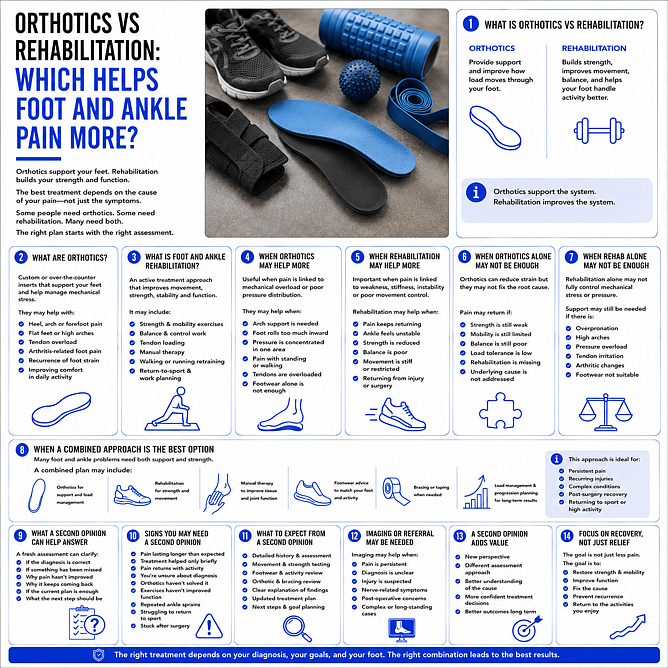
Orthotics and rehabilitation do different jobs.
Orthotics are designed to support the foot, improve load distribution, reduce strain, and help manage mechanical stress. Rehabilitation is designed to improve strength, movement, balance, control, tendon capacity, and function.
So, when comparing orthotics vs rehabilitation for foot pain, the real question is not which one is always better. The better question is: what does your foot or ankle problem actually need?
At Foot Foundation, treatment is based on assessment, not guesswork. Some patients need orthotics. Some need rehabilitation. Many patients need a combination of both, along with footwear advice, manual therapy, load management, bracing, or return-to-activity planning.
Cameron Collins, Foot Foundation’s Lead Clinician and dual-qualified Physiotherapist and Podiatrist, combines orthotic therapy with rehabilitation, strength work, footwear advice, and manual therapy where clinically appropriate. This broader approach is especially useful for patients with persistent, recurring, or complex foot and ankle pain.
What Are Orthotics?
Orthotics are shoe inserts designed to support the feet and influence how pressure and load move through the foot and lower limb.
They may be used to help with:
Arthritis-related foot pain
Tendon overload
Recurrent foot strain
Some walking or running-related issues
Orthotics may help by:
Supporting foot posture
Reducing strain on painful tissues
Improving pressure distribution
Helping control excessive movement
Improving comfort during walking
Supporting footwear function
Orthotics can be very useful when the foot needs support. But they are not a cure for every foot problem.
What Is Foot and Ankle Rehabilitation?
Foot and ankle rehabilitation is an active treatment process focused on improving movement, strength, balance, stability, and function.
Rehabilitation may include:
Strength exercises
Mobility exercises
Balance and control work
Tendon loading
Walking or running retraining
Return-to-sport progression
Return-to-work planning
Post-injury or post-operative recovery
Long-term prevention exercises
Rehabilitation is especially important when pain is linked to weakness, stiffness, poor movement control, tendon overload, instability, or incomplete recovery after injury.
The goal is not just to reduce pain. The goal is to help the foot and ankle tolerate load better.
Orthotics vs Rehabilitation: The Key Difference
Orthotics mainly provide support.
Rehabilitation mainly builds capacity.
That difference matters.
Orthotics may reduce strain while the foot is being loaded. Rehabilitation helps the body become stronger, more controlled, and better able to handle activity.
A simple way to understand it:
Orthotics help support the system.
Rehabilitation helps improve the system.
Neither is automatically better. The right option depends on the diagnosis.
For example, a patient with plantar heel pain may benefit from orthotics to reduce strain on the plantar fascia. But if calf weakness, poor foot strength, or poor load tolerance is also involved, rehabilitation may be needed for longer-term improvement.
A patient with chronic ankle instability may benefit from bracing or orthotics, but without balance and strength rehabilitation, the ankle may still feel unstable.
When Orthotics May Help More
Orthotics may be especially useful when foot pain is linked to mechanical overload or poor pressure distribution.
They may help when:
The arch needs support
The foot rolls excessively inward
Pressure is concentrated under one area
Footwear alone is not enough
Pain worsens with standing or walking
There is recurring heel, arch, or forefoot pain
Tendons are being overloaded
Arthritis-related foot pain needs support
The patient needs improved comfort during daily activity
Orthotics may also help reduce symptoms while rehabilitation is underway.
For some patients, reducing pain enough to move comfortably is the first step before they can properly strengthen or rehabilitate.
When Rehabilitation May Help More
Rehabilitation may be more important when pain is linked to weakness, stiffness, instability, poor movement control, or reduced load tolerance.
Rehabilitation may help when:
Pain keeps returning after rest
The ankle feels unstable
Strength is reduced
Balance is poor
Movement is stiff or restricted
Tendon pain keeps flaring up
The patient is returning from injury
The patient has had surgery
Walking or running mechanics need improvement
Orthotics helped only temporarily
Rehabilitation is especially important for active patients who want to return to sport, running, physical work, or longer walking distances.
Without rehabilitation, the painful area may settle briefly but flare again when activity increases.
When Orthotics Alone May Not Be Enough
Orthotics can reduce strain, but they do not automatically strengthen the foot, improve ankle control, restore mobility, or rebuild tendon capacity.
Orthotics alone may not be enough if:
Pain returns when activity increases
The ankle still feels weak or unstable
The patient has poor balance
Tendon pain keeps recurring
Footwear is still aggravating the problem
Muscles are weak or tight
The patient has not completed rehab
The injury involves sport or higher-level activity
Pain has been present for a long time
This is where some patients get frustrated. They receive orthotics, feel some improvement, but the pain does not fully resolve.
That does not always mean the orthotics failed. It may mean orthotics were only one part of what the foot or ankle needed.
When Rehabilitation Alone May Not Be Enough
Rehabilitation is powerful, but there are cases where support is also needed.
Rehabilitation alone may not be enough if:
Foot mechanics are placing high strain on painful tissues
The patient cannot tolerate activity without support
Footwear is not controlling pressure
Arthritis pain needs mechanical support
Severe flat feet or high arches are contributing
Tendon overload continues despite strengthening
Standing or walking demands are high
Symptoms flare before rehab can progress
In these cases, orthotics may help reduce strain so the patient can move better, tolerate rehab, and continue daily activities with less pain.
This is why a combined plan can be more effective than choosing only one option.
Common Conditions Where Both May Be Needed
Many foot and ankle conditions may benefit from both orthotics and rehabilitation.
These include:
Arthritis-related foot pain
Running injuries
Sports-related foot and ankle pain
Recurring foot pain
For example, Achilles pain may need heel lifts, footwear advice, orthotics, and progressive calf strengthening. Plantar heel pain may need arch support, load management, calf mobility, and foot strengthening. Chronic ankle instability may need bracing, balance work, strength training, and return-to-activity progression.
The strongest treatment plan is usually built around what the patient actually needs, not around one fixed treatment.
Why Assessment Matters Before Choosing
Choosing orthotics or rehabilitation without assessment is guesswork.
A detailed assessment may include:
Pain history
Previous injury history
Foot posture assessment
Ankle mobility testing
Strength testing
Balance assessment
Walking or running assessment
Footwear review
Orthotic review if already used
Work, sport, and daily activity demands
Treatment history
This helps answer important questions:
Is the pain mechanical?
Is the pain caused by weakness or instability?
Is the tendon overloaded?
Is footwear contributing?
Does the patient need support, strengthening, or both?
Are orthotics still appropriate?
Has rehabilitation progressed enough?
The right treatment starts with understanding the cause.
Where Cameron Collins Fits Into Orthotics and Rehabilitation
Cameron Collins is Foot Foundation’s Lead Clinician and is dual-qualified as both a Physiotherapist and Podiatrist.
This is especially useful when comparing orthotics vs rehabilitation because Cameron can assess the problem from both perspectives.
A podiatry view may identify:
Foot mechanics
Pressure distribution
Orthotic needs
Footwear issues
Arch support requirements
Structural contributors
A physiotherapy view may identify:
Strength deficits
Mobility restrictions
Movement control problems
Balance issues
Tendon loading needs
Functional rehabilitation needs
Cameron combines orthotic therapy with rehabilitation, strength work, footwear advice, manual therapy, bracing, and exercise programmes where clinically appropriate.
This is important because foot and ankle pain is rarely solved by one tool alone. Complex or persistent cases often need a broader plan.
What Treatment May Include
Treatment depends on the assessment findings.
Orthotic therapy may help support the foot, reduce strain, and improve pressure distribution.
It may be used for heel pain, arch pain, tendon overload, arthritis-related pain, flat feet, high arches, or recurring mechanical foot pain.
Exercise rehabilitation may help rebuild strength, balance, control, and load tolerance.
It may include calf strengthening, foot muscle work, ankle stability exercises, mobility work, and progressive return-to-activity exercises.
Manual therapy may be used where joint stiffness, soft tissue restriction, or reduced mobility is contributing to pain.
It is usually most useful when combined with active rehabilitation.
Footwear may need to be reviewed if shoes are contributing to pressure, instability, or poor support.
This may include advice on shoe width, cushioning, stability, toe box depth, and activity suitability.
Bracing may be useful for ankle instability, repeated sprains, or patients needing extra support during activity.
Load Management
Load management helps patients adjust activity levels so they can recover without completely stopping movement.
This is important for tendon pain, sports injuries, and recurring pain.
Orthotics vs Rehabilitation in Auckland
Foot Foundation provides assessment and treatment planning for patients who may need orthotics, rehabilitation, or both.
Cameron Collins is available at:
These Auckland locations may suit patients with persistent foot pain, ankle pain, recurring injuries, heel pain, Achilles pain, ankle instability, orthotic concerns, and complex foot and ankle problems.
Foot and Ankle Care in Hamilton
Foot Foundation provides podiatry and foot care services in Hamilton.
Hamilton clinic locations include:
Patients in Hamilton can access care for foot pain, heel pain, ankle concerns, orthotics, general podiatry, nail conditions, and rehabilitation-related needs depending on service availability.
Foot and Ankle Care in Tauranga
Foot Foundation provides podiatry care in Tauranga for patients with foot pain, walking pain, heel pain, sports injuries, and general foot concerns.
The Tauranga clinic is located at:
Patients can access assessment and treatment support for common foot and ankle concerns, with referral pathways available where more specialised rehabilitation input is required.
So, Which Helps Foot and Ankle Pain More?
The honest answer is that it depends on the cause of the pain.
Orthotics may help more when the main problem is mechanical overload, pressure, poor foot support, or strain during walking and standing.
Rehabilitation may help more when the main problem is weakness, stiffness, instability, tendon capacity, poor control, or incomplete recovery.
Many patients need both.
A strong treatment plan may use orthotics to support the foot while rehabilitation improves strength, movement, and long-term function.
That is the key difference between short-term symptom support and long-term recovery planning.
Book an Assessment for Foot and Ankle Pain
If you are unsure whether you need orthotics, rehabilitation, or both, the best next step is a proper assessment.
Foot and ankle pain should not be treated with guesswork. The right plan depends on the diagnosis, the cause of the pain, and the demands of your work, sport, and daily life.
Foot Foundation provides assessment and treatment planning for foot and ankle pain, including orthotic therapy and rehabilitation support with Cameron Collins at Remuera and Smales Farm.