Post-Operative Foot and Ankle Rehabilitation: What to Expect
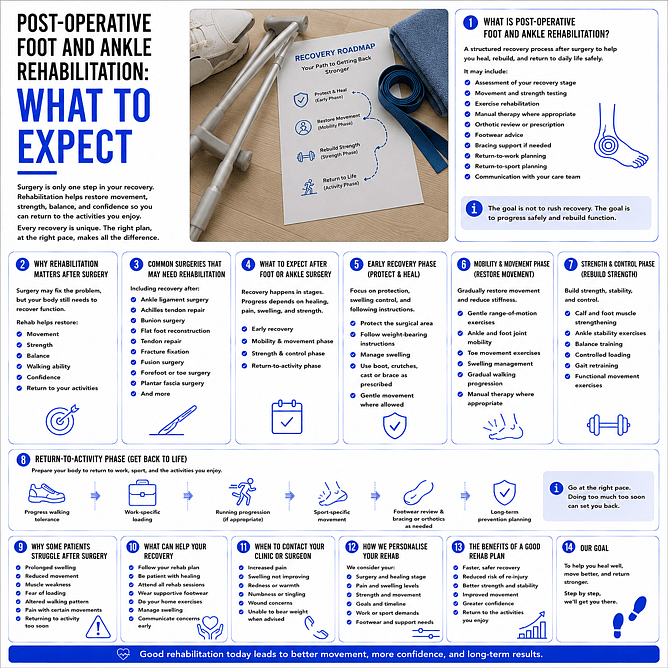
Recovering from foot or ankle surgery takes more than waiting for the wound to heal. Surgery may repair or correct a problem, but rehabilitation helps restore movement, strength, balance, walking confidence, and function.
Post-operative foot and ankle rehabilitation is designed to support recovery after surgery by helping patients rebuild safely and progressively. Without a structured plan, some patients continue to experience stiffness, weakness, swelling, altered walking patterns, pain, or reduced confidence when returning to work, sport, or daily activity.
Every recovery is different. The right rehabilitation plan depends on the type of surgery, the surgeon’s instructions, healing timeframes, weight-bearing status, pain levels, swelling, strength, mobility, footwear needs, and personal goals.
At Foot Foundation, post-operative rehabilitation focuses on helping patients understand where they are in recovery, what needs to improve, and how to progress safely.
Cameron Collins, Lead Clinician and dual-qualified Physiotherapist and Podiatrist, works with post-operative foot and ankle recovery and helps patients rebuild strength, movement, and confidence after surgery. His background in both physiotherapy and podiatry allows him to assess the foot and ankle from both a functional and mechanical perspective.
What Is Post-Operative Foot and Ankle Rehabilitation?
Post-operative foot and ankle rehabilitation is a structured recovery process after surgery. It helps restore movement, strength, balance, walking ability, and confidence.
It may include:
Review of surgery history and recovery stage
Assessment of movement and swelling
Walking and gait assessment
Strength testing
Balance and stability work
Exercise rehabilitation
Manual therapy where appropriate
Footwear advice
Orthotic review or prescription where needed
Bracing support if required
Return-to-work planning
Return-to-sport planning
Communication with the wider care team where appropriate
The aim is not to rush recovery. The aim is to progress safely and avoid doing too much too soon.
Why Rehabilitation Matters After Foot or Ankle Surgery
Surgery can address structural problems, but the body still needs to recover function afterwards.
After surgery, patients may experience:
Reduced joint movement
Muscle weakness
Swelling
Stiffness
Altered walking pattern
Reduced balance
Loss of confidence
Difficulty wearing normal shoes
Pain with activity
Reduced fitness or strength
Fear of re-injury
These issues do not always resolve automatically. Rehabilitation helps guide the recovery process so patients can rebuild properly.
Without rehabilitation, patients may compensate by changing the way they walk, placing extra pressure on other joints, or avoiding normal activity for longer than necessary.
Common Foot and Ankle Surgeries That May Need Rehabilitation
Post-operative rehabilitation may be recommended after many types of foot and ankle surgery.
This may include recovery after:
Ankle ligament surgery
Achilles tendon repair
Bunion surgery
Flat foot reconstruction
Tendon repair
Fracture fixation
Fusion surgery
Arthritis-related foot or ankle surgery
Forefoot surgery
Toe surgery
Plantar fascia surgery
Ankle stabilisation procedures
The rehabilitation plan should always respect the surgeon’s instructions and the specific procedure performed.
What to Expect After Foot or Ankle Surgery
Recovery is usually staged. Patients often move through different phases depending on healing, pain, swelling, strength, and mobility.
Early Recovery Phase
The early phase usually focuses on protection, swelling management, pain control, and following post-operative instructions.
This stage may include:
Protecting the surgical area
Following weight-bearing instructions
Managing swelling
Using a boot, crutches, cast, or brace where prescribed
Gentle movement where allowed
Monitoring pain and wound healing
Avoiding activities that overload the repair
This stage is not about doing aggressive exercise. It is about protecting healing tissue.
Mobility and Movement Phase
Once it is safe to move more, rehabilitation may focus on restoring movement.
This may include:
Gentle range-of-motion exercises
Ankle mobility work
Foot joint mobility
Toe movement exercises
Swelling reduction strategies
Gradual walking progression
Manual therapy where appropriate
Stiffness is common after surgery, especially if the foot or ankle has been immobilised.
Strength and Control Phase
As healing progresses, strength becomes more important.
This stage may include:
Calf strengthening
Foot muscle strengthening
Ankle stability exercises
Balance training
Controlled loading
Gait retraining
Functional movement exercises
This stage helps rebuild the support system around the foot and ankle.
Return-to-Activity Phase
The final stage focuses on getting back to work, walking, sport, or everyday activity.
This may include:
Walking tolerance progression
Work-specific loading
Running progression where appropriate
Sport-specific movement
Balance and reaction training
Footwear review
Bracing or orthotic support where needed
Long-term prevention planning
This stage should be gradual. Returning too quickly can trigger pain, swelling, or setbacks.
Why Some Patients Struggle After Surgery
Some patients feel frustrated because they expected surgery to solve everything immediately. Surgery may correct the structural problem, but recovery still requires time and function needs rebuilding.
Post-operative recovery may feel slow because of:
Prolonged swelling
Reduced movement
Muscle weakness
Fear of loading the foot or ankle
Altered walking pattern
Pain with certain movements
Scar sensitivity
Footwear difficulty
Incomplete rehabilitation
Returning to activity too quickly
This does not always mean the surgery failed. It may mean the rehabilitation process needs more structure.
Signs You May Need Post-Operative Rehabilitation
You should consider rehabilitation support if:
Walking still feels uneven
You feel stiff or weak
Swelling keeps returning
You are unsure how much activity is safe
You are struggling to return to normal shoes
Your balance feels reduced
You are nervous about re-injury
Pain returns when activity increases
You are unsure how to progress exercises
You want to return to sport or physical work
Recovery has plateaued
Post-operative rehabilitation can help identify what is still limiting recovery.
What a Rehabilitation Assessment May Include
A post-operative foot and ankle rehabilitation assessment should look at the full recovery picture.
This may include:
Surgery history
Surgeon’s instructions
Current weight-bearing status
Pain and swelling review
Walking pattern assessment
Foot and ankle movement testing
Strength testing
Balance and control assessment
Footwear review
Orthotic or brace review
Work or sport goal discussion
Recovery timeline planning
The goal is to create a plan that is safe, realistic, and matched to the patient’s surgery and goals.
Treatment Options During Post-Operative Rehabilitation
Treatment depends on the procedure, healing stage, and patient goals.
Exercise rehabilitation helps rebuild strength, mobility, balance, and function.
This may include:
Range-of-motion exercises
Foot and ankle strengthening
Calf strengthening
Balance work
Walking drills
Step and stair control
Return-to-sport exercises
Long-term prevention exercises
Exercises should be progressed carefully, not rushed.
Manual therapy may help improve stiffness, joint mobility, and soft tissue restriction where appropriate.
This may be useful when movement remains limited after immobilisation or surgery.
Some patients continue walking differently after surgery. This may happen because of pain, weakness, swelling, fear, or habit.
Gait retraining may help improve:
Step length
Foot placement
Push-off
Balance
Confidence
Load distribution
Walking well again is a key part of recovery.
Orthotics may be useful after some surgeries to improve support, reduce strain, or help manage foot mechanics.
They may be considered when:
Foot alignment needs support
Pressure needs redistribution
The patient has recurring overload
Footwear comfort is difficult
The surgery changes loading patterns
Orthotics should be matched to the patient’s recovery stage and long-term needs.
Footwear can be challenging after foot or ankle surgery. Swelling, sensitivity, stiffness, or changed foot shape may affect shoe comfort.
A footwear assessment may review:
Shoe width
Depth
Cushioning
Stability
Heel height
Fastening
Toe box shape
Work or sport suitability
Footwear can strongly affect comfort and confidence during recovery.
Bracing may be useful when extra support is needed after surgery, especially for instability or return-to-activity planning.
Bracing may help:
Support the ankle
Improve confidence
Reduce risk during activity
Assist return to sport
Provide external stability during recovery
Return-to-Work Planning
Patients with physical jobs may need a staged return.
This may consider:
Standing time
Walking distance
Lifting
Climbing stairs or ladders
Uneven ground
Footwear requirements
Fatigue
Swelling response
Returning too quickly can delay recovery.
Return-to-Sport Planning
Sport places higher loads on the foot and ankle than normal walking.
Return-to-sport rehabilitation may include:
Strength testing
Balance and control work
Running progression
Jumping and landing drills
Change-of-direction training
Footwear review
Bracing where needed
Confidence rebuilding
The goal is not just to return to sport. The goal is to return safely.
Where Cameron Collins Fits Into Post-Operative Recovery
Cameron Collins is Foot Foundation’s Lead Clinician and is dual-qualified as both a Physiotherapist and Podiatrist.
This is particularly useful for post-operative recovery because patients often need both rehabilitation and foot mechanics assessed.
Cameron works with patients who need help rebuilding:
Strength
Movement
Walking confidence
Balance
Foot and ankle function
Return-to-work ability
Return-to-sport readiness
His treatment approach may include:
Exercise rehabilitation
Orthotic therapy
Footwear assessment and modification
Custom ankle bracing
Shockwave therapy where appropriate
Dry needling where appropriate
Post-operative rehabilitation programmes
Cameron’s goal is to help patients understand their recovery pathway, rebuild function, and return more confidently to everyday activity.
Post-Operative Foot and Ankle Rehabilitation in Auckland
Foot Foundation provides post-operative foot and ankle rehabilitation support in Auckland.
Cameron Collins is available at:
These locations may suit patients recovering from foot or ankle surgery, including those who need support with walking, strength, swelling management, mobility, footwear, orthotics, bracing, return to work, or return to sport.
Foot and Ankle Care in Hamilton
Foot Foundation provides podiatry and foot care services in Hamilton.
Hamilton clinic locations include:
Hamilton Central – 7/127 Collingwood Street
Hamilton East – 16 Beale Street
Patients in Hamilton can access care for foot pain, heel pain, ankle concerns, nail conditions, orthotics, general podiatry, and rehabilitation-related needs depending on service availability.
Foot and Ankle Care in Tauranga
Foot Foundation provides podiatry care in Tauranga for patients with foot pain, walking pain, heel pain, sports injuries, and general foot concerns.
The Tauranga clinic is located at:
Tauranga Bethlehem – 253A State Highway 2
Patients can access assessment and treatment support for common foot and ankle concerns, with referral pathways available where more specialised rehabilitation input is required.
What to Bring to a Post-Operative Rehabilitation Appointment
To get the most value from your appointment, bring anything that helps explain your recovery so far.
Helpful items include:
Surgeon’s post-operative instructions
Surgery notes if available
Imaging reports if available
Current footwear
Moon boot, brace, or crutches if still used
Existing orthotics
List of exercises already given
Timeline of recovery so far
Details of pain, swelling, or limitations
Work or sport goals
This helps the clinician understand your current stage and plan the next steps safely.
When Should You Start Rehabilitation After Surgery?
The timing depends on the type of surgery and the surgeon’s instructions.
Some patients may begin gentle movement or advice early. Others may need to wait until healing has progressed before starting more active rehabilitation.
Do not start aggressive exercise too early without guidance.
The safest approach is to follow your surgeon’s post-operative plan and work with a clinician who understands staged foot and ankle recovery.
Foot and ankle surgery is only one part of recovery. Rehabilitation helps rebuild movement, strength, confidence, and function.
If you have had foot or ankle surgery and are struggling with stiffness, weakness, swelling, walking, footwear, or returning to activity, a detailed rehabilitation assessment can help guide your next step.
Foot Foundation provides post-operative foot and ankle rehabilitation support, including complex recovery planning with Cameron Collins at Remuera and Smales Farm.