Foot and Ankle Rehabilitation: What It Includes and Who Needs It
Foot and ankle rehabilitation is designed to help patients recover from pain, injury, surgery, instability, weakness, and ongoing movement problems. It is not just about reducing pain for a few days. The goal is to improve how the foot and ankle function so patients can return more confidently to walking, work, sport, and everyday activities.
Many people think rest is enough when they have foot or ankle pain. Rest can reduce symptoms temporarily, but it does not always rebuild strength, balance, mobility, tendon capacity, or confidence. This is why pain often returns when activity increases again.
Foot and ankle rehabilitation may be needed after ankle sprains, Achilles tendon injuries, plantar heel pain, sports injuries, surgery, tendon problems, arthritis-related pain, recurring injuries, or complex foot and ankle conditions that have not responded to previous treatment.
At Foot Foundation, rehabilitation is approached by looking at both the painful area and the factors that may be contributing to the problem. This can include movement, strength, footwear, orthotics, bracing, joint mobility, tendon loading, walking patterns, and activity demands.
Cameron Collins, Lead Clinician and dual-qualified Physiotherapist and Podiatrist, has extensive experience in foot and ankle rehabilitation. His dual background allows him to assess both mechanical and functional contributors to pain and injury, then build treatment plans that may include rehabilitation, manual therapy, orthotic therapy, footwear modification, custom ankle bracing, shockwave therapy, dry needling, and exercise programmes.
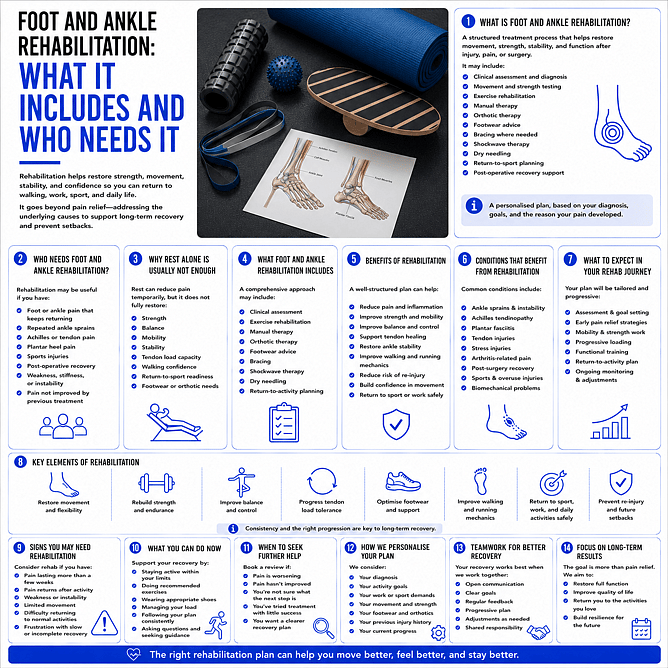
What Is Foot and Ankle Rehabilitation?
Foot and ankle rehabilitation is a structured treatment process that helps restore movement, strength, control, stability, and function after pain, injury, surgery, or long-term dysfunction.
It may include:
Assessment of the foot and ankle
Diagnosis of the problem
Movement and strength testing
Gait and walking assessment
Exercise rehabilitation
Manual therapy
Orthotic therapy
Footwear advice
Bracing where needed
Shockwave therapy where appropriate
Dry needling where appropriate
Return-to-sport planning
Post-operative recovery support
Rehabilitation should not be a random list of exercises. It should be based on the diagnosis, the patient’s goals, and the reason the problem developed in the first place.
For example, a patient recovering from an ankle sprain may need balance, strength, and stability work. A patient with Achilles pain may need careful tendon loading. A patient recovering from surgery may need staged rehabilitation to rebuild movement and confidence.
Health New Zealand notes that physiotherapy after ankle sprain can help restore movement, strength and balance, and support return to normal activities. That is exactly the type of functional goal foot and ankle rehabilitation should work towards.
Who Needs Foot and Ankle Rehabilitation?
Foot and ankle rehabilitation may be useful for patients who have pain, weakness, instability, stiffness, or reduced confidence when moving.
You may need rehabilitation if you have:
Foot pain that keeps returning
Ankle pain that has not improved
Repeated ankle sprains
Sports injuries
Tendon injuries
Ligament injuries
Arthritis-related foot pain
Post-operative foot or ankle recovery needs
Walking pain
Weakness after injury
Poor balance or ankle instability
Pain when returning to sport
Pain that has not responded to previous treatment
Rehabilitation is especially important when pain has been present for a long time or when symptoms keep returning after rest or basic treatment.
Why Rest Alone Is Usually Not Enough
Rest can be useful in the early stage of some injuries, especially when pain and swelling are high. Healthify NZ notes that strains and sprains may respond well to rest, ice, compression, elevation and referral in the first few days after injury.
But rest alone does not always solve the full problem.
Rest may reduce pain temporarily, but it does not automatically restore:
Strength
Balance
Mobility
Stability
Tendon load capacity
Walking confidence
Return-to-sport readiness
Footwear or orthotic needs
This is why people often feel better after resting, then flare up again when they return to walking, running, work, or sport.
A rehabilitation plan helps bridge the gap between pain relief and full function.
What Foot and Ankle Rehabilitation Includes
Clinical Assessment
Rehabilitation starts with assessment. The goal is to understand what is painful, why it is painful, and what factors are keeping the problem going.
An assessment may include:
Symptom history
Previous injury history
Previous treatment review
Foot and ankle movement testing
Strength testing
Balance assessment
Walking or running assessment
Foot posture assessment
Footwear review
Orthotic review if relevant
Discussion of work, sport, and daily activity demands
This helps identify whether the main issue is strength, mobility, instability, overload, footwear, poor mechanics, or incomplete recovery from an earlier injury.
Exercise rehabilitation is one of the most important parts of foot and ankle recovery.
Exercises may focus on:
Calf strength
Foot muscle strength
Ankle stability
Balance and control
Tendon loading
Mobility
Walking tolerance
Sport-specific movement
Return-to-work or return-to-sport demands
The key is progression. Basic exercises may help early on, but more advanced strengthening or functional work may be needed before the patient is ready for full activity.
Manual therapy may be used when joint stiffness, soft tissue restriction, or reduced mobility is contributing to pain or poor movement.
Manual therapy may help support:
Ankle mobility
Foot joint movement
Reduced stiffness
Improved comfort during movement
Better function alongside exercise rehabilitation
Manual therapy is usually strongest when combined with an active rehabilitation plan.
Orthotics may be used to improve pressure distribution, support the foot, reduce strain, and improve mechanical function.
Orthotic therapy may be considered for:
Plantar heel pain
Achilles tendon pain
Flat feet
High arches
Forefoot pain
Arthritis-related foot pain
Tendon overload
Recurring foot pain
Biomechanical overload
Orthotics should not be treated as a magic fix. They work best when they are part of a wider plan that may include footwear advice, strengthening, mobility work, and load management.
Footwear plays a major role in foot and ankle pain.
Poor footwear may contribute to:
Heel pain
Toe pressure
Forefoot pain
Ankle instability
Achilles irritation
Arch strain
Recurrent symptoms
Poor support during work or sport
A footwear assessment may look at:
Shoe width
Cushioning
Stability
Wear patterns
Heel height
Toe box depth
Activity suitability
Work or sports requirements
In some cases, footwear modification may help reduce pressure and support better function.
Ankle bracing may be useful for patients with instability, repeated ankle sprains, or confidence issues when walking, working, or returning to sport.
Bracing may help:
Support unstable ankles
Reduce risk of repeated rolling
Improve confidence during activity
Support return-to-sport planning
Protect the ankle during higher-risk activity
Custom ankle bracing may be considered when standard support is not enough or when the patient needs a more specific solution.
Shockwave therapy may be considered for selected persistent foot and ankle conditions, especially tendon-related pain or long-standing heel pain.
It may be used as part of a wider treatment plan for conditions such as:
Shockwave therapy should not be treated as a stand-alone shortcut. It is usually most useful when combined with rehabilitation, footwear advice, load management, and strengthening.
Dry needling may be used where muscle tightness, pain, or movement restriction is contributing to symptoms.
It may be considered as part of a treatment plan for selected patients, alongside:
Manual therapy
Mobility work
Strengthening
Footwear or orthotic support
Dry needling should support the overall rehabilitation plan, not replace it.
Return-to-Sport Rehabilitation
Returning to sport too soon is one of the main reasons foot and ankle pain returns.
Return-to-sport rehabilitation may include:
Strength testing
Balance testing
Jumping or landing control
Running progression
Change-of-direction work
Footwear review
Sport-specific loading
Confidence rebuilding
Injury prevention planning
The goal is not just to return to sport quickly. The goal is to return safely and reduce the risk of re-injury.
Post-Operative Rehabilitation
Foot and ankle surgery often needs structured rehabilitation to restore movement, strength, confidence, and function.
Post-operative rehabilitation may focus on:
Protecting the surgical repair
Restoring movement safely
Rebuilding strength
Improving walking patterns
Managing swelling
Returning to footwear
Returning to work
Returning to sport or activity
Preventing compensation elsewhere
Cameron has particular experience in post-operative foot and ankle rehabilitation, making this an important area of authority for the clinic.
Conditions That May Need Foot and Ankle Rehabilitation
Foot and ankle rehabilitation may be recommended for many conditions, including:
Achilles tendinopathy
Insertional Achilles pain
Plantar heel pain
Ankle sprains
Chronic ankle instability
Tendon injuries
Ligament injuries
Sports injuries
Running injuries
Arthritis-related foot pain
Post-operative recovery
Persistent foot and ankle pain
Recurring injuries
Complex pain presentations
Patients with unresolved pain often need a broader assessment because more than one factor may be contributing.
Where Cameron Collins Fits Into Foot and Ankle Rehabilitation
Cameron Collins is Foot Foundation’s Lead Clinician and Co-Director. He is dual-qualified as both a Physiotherapist and Podiatrist, which gives him a broader view of foot and ankle problems.
This matters because many foot and ankle conditions are not purely structural and not purely functional. They often involve both.
For example:
A patient with heel pain may need plantar fascia treatment, calf strengthening, footwear advice, and orthotic support.
A patient with recurring ankle sprains may need balance retraining, strength work, bracing, and movement assessment.
A post-operative patient may need staged rehabilitation, walking retraining, mobility work, and return-to-activity planning.
A patient with persistent pain may need a second opinion that looks beyond the original diagnosis.
Cameron’s approach may include:
Foot and ankle rehabilitation
Manual therapy
Exercise rehabilitation
Orthotic therapy
Footwear assessment and modification
Custom ankle bracing
Shockwave therapy
Dry needling
Return-to-sport rehabilitation
Post-operative rehabilitation programmes
His focus is on identifying the cause of pain and dysfunction, then creating a plan that supports long-term improvement.
Foot and Ankle Rehabilitation in Auckland
Foot Foundation provides foot and ankle rehabilitation support in Auckland.
Cameron Collins is available at:
These locations may suit patients seeking care for persistent foot pain, ankle pain, recurring injuries, post-operative rehabilitation, Achilles pain, heel pain, ankle instability, running injuries, and complex foot and ankle problems.
Foot and Ankle Care in Hamilton
Foot Foundation provides podiatry and foot care services in Hamilton.
Hamilton clinic locations include:
Hamilton Central – 7/127 Collingwood Street
Hamilton East – 16 Beale Street
Patients in Hamilton can access care for foot pain, heel pain, ankle concerns, nail conditions, orthotics, general podiatry, and rehabilitation-related needs depending on service availability.
Foot and Ankle Care in Tauranga
Foot Foundation provides podiatry care in Tauranga for patients experiencing foot pain, walking pain, heel pain, sports injuries, and general foot concerns.
The Tauranga clinic is located at:
Tauranga Bethlehem – 253A State Highway 2
Patients can access assessment and treatment support for common foot and ankle concerns, with referral pathways available where more specialised rehabilitation input is required.
What to Expect During a Foot and Ankle Rehabilitation Appointment
Your first appointment should help you understand the problem clearly.
The appointment may include:
Discussion of symptoms and history
Review of previous treatment
Foot and ankle assessment
Strength and mobility testing
Balance and stability assessment
Walking or running assessment
Footwear review
Orthotic review if relevant
Explanation of diagnosis
Personalised rehabilitation plan
Discussion of treatment options and expected outcomes
The goal is to leave with a clear understanding of what is happening, why it may have developed, and what the next steps are.
When Should You Book Foot and Ankle Rehabilitation?
You should consider booking foot and ankle rehabilitation if:
Pain has not improved with rest
Pain keeps coming back
You have repeated ankle sprains
You have tendon pain
You are recovering from foot or ankle surgery
You feel weak, stiff, or unstable
You are struggling to return to sport
Orthotics alone have not solved the problem
You have persistent heel or Achilles pain
You want a second opinion for a complex issue
The earlier the cause is identified, the easier it is to build a plan that supports recovery.
Foot and ankle rehabilitation is not just about treating pain. It is about restoring strength, movement, confidence, and function.
If foot or ankle pain is stopping you from walking, working, exercising, playing sport, or recovering properly after injury or surgery, a detailed rehabilitation assessment can help identify the next step.
Foot Foundation provides foot and ankle rehabilitation support, including complex assessment and treatment planning with Cameron Collins at Remuera and Smales Farm.