Dry Needling for Foot and Ankle Pain: What Patients Should Know
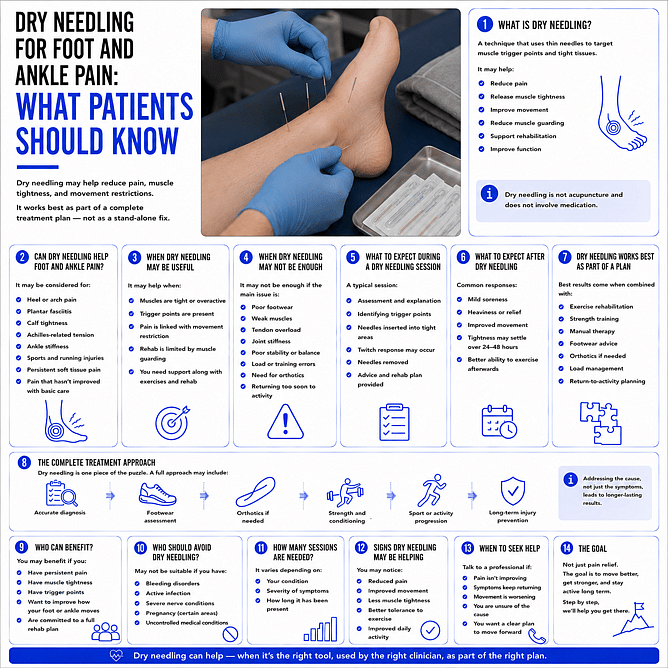
Dry needling is one treatment option that may be used for selected foot and ankle pain presentations, especially where muscle tightness, trigger points, stiffness, movement restriction, or pain sensitivity may be contributing.
It is not a magic fix. It is not a replacement for proper assessment. It should not be used as a stand-alone answer for every foot or ankle problem.
The strongest use of dry needling is usually as part of a broader rehabilitation plan. That plan may also include strengthening, mobility work, manual therapy, footwear changes, orthotics, load management, bracing, and return-to-activity planning where clinically appropriate.
At Foot Foundation, dry needling may be considered when it fits the patient’s condition and treatment goals. The focus is always on understanding why the pain is present, what is limiting recovery, and what needs to change for longer-term improvement.
Cameron Collins, Foot Foundation’s Lead Clinician and dual-qualified Physiotherapist and Podiatrist, works with persistent and complex foot and ankle problems. Where clinically appropriate, dry needling may be used alongside rehabilitation, manual therapy, footwear changes, and strengthening as part of a complete treatment plan.
What Is Dry Needling?
Dry needling is a treatment technique where a trained clinician inserts very thin needles into or near specific muscle trigger points or tight tissue areas. The aim is usually to help reduce pain, improve muscle function, and support movement. Cleveland Clinic describes dry needling as a treatment used for pain and movement problems linked with myofascial trigger points, and notes that it is usually used as part of a broader pain management plan that may include exercise, stretching, massage, and other techniques.
The word “dry” means no medication is injected.
Dry needling may be used to address:
Muscle tightness
Trigger points
Local pain
Referred pain
Movement restriction
Stiffness
Muscle sensitivity
Pain linked with altered movement patterns
In foot and ankle care, dry needling may be considered when muscle or soft tissue contributors are part of the pain pattern.
Is Dry Needling the Same as Acupuncture?
Dry needling and acupuncture both use thin needles, but they are not the same treatment.
Dry needling is usually based on musculoskeletal assessment, trigger points, pain patterns, movement restrictions, and orthopaedic testing. Acupuncture is based on traditional Chinese medicine principles and may be used for a wider range of health concerns. Cleveland Clinic explains that dry needling focuses on muscle tissue with the goal of reducing pain, inactivating trigger points, and improving movement, and is typically used within a broader physical therapy approach.
For Foot Foundation content, keep the explanation simple:
Dry needling is not acupuncture.
Dry needling is not an injection.
Dry needling should be used as part of a wider treatment plan.
Dry needling should be selected based on assessment.
Can Dry Needling Help Foot and Ankle Pain?
Dry needling may help selected patients with foot and ankle pain, especially where muscle tightness, trigger points, movement restriction, or pain sensitivity are contributing.
It may be considered for:
Persistent heel pain
Plantar heel pain
Calf tightness linked with foot pain
Achilles-related muscle tension
Ankle stiffness with soft tissue tightness
Sports-related foot or ankle pain
Running-related overload
Complex or persistent pain presentations
Foot and ankle pain that has not fully improved with basic care
Evidence for dry needling varies by condition. A 2024 systematic review and meta-analysis on dry needling for plantar fasciitis reported that dry needling was effective in relieving pain and restoring function, but also stated that more large, high-quality, multi-centre randomised trials are needed.
That means the message should be balanced.
When Dry Needling May Be Useful
Dry needling may be considered when symptoms suggest a muscle or soft tissue component is contributing to the pain.
It may be useful when:
Muscle tightness is limiting movement
Trigger points are contributing to pain
Calf tightness is linked with foot strain
Pain is affected by movement restriction
Heel or arch pain is linked with soft tissue sensitivity
Ankle stiffness is affecting function
Rehabilitation is being limited by muscle guarding
Pain has not fully improved with basic treatment
The patient needs support alongside strengthening and manual therapy
Dry needling should not be the first answer for every case. It should be selected because the assessment suggests it has a role.
When Dry Needling May Not Be Enough
Dry needling may reduce pain or muscle tightness, but it does not automatically fix the underlying cause of foot or ankle pain.
It may not be enough if the main issue is:
Poor footwear
Weak calf muscles
Weak foot muscles
Tendon overload
Poor ankle stability
Restricted joint mobility
Poor balance or control
Running load errors
Repeated ankle sprains
Orthotic support needs
Structural foot mechanics
Incomplete rehabilitation
Returning to activity too quickly
This is why dry needling should not be used as a stand-alone fix.
For example, a patient with Achilles pain may also need calf strengthening, tendon loading, footwear advice, and load management. A patient with heel pain may need foot strengthening, calf mobility, orthotics, footwear changes, and activity modification. A patient with ankle instability may need balance training, strength work, bracing, and return-to-sport planning.
Dry needling may support the plan, but it should not replace the plan.
Conditions Where Dry Needling May Be Considered
Dry needling may be considered as part of care for selected foot and ankle conditions, including:
Heel pain linked with muscle tightness
Achilles-related pain with calf tightness
Calf muscle tightness affecting foot function
Ankle stiffness with soft tissue restriction
Running-related foot and ankle pain
Sports-related foot and ankle pain
Persistent foot or ankle pain
Complex pain presentations
Pain that has not fully improved with basic care
Not every patient needs dry needling. Some patients need strengthening. Some need footwear changes. Some need orthotics. Some need bracing. Some need imaging or referral. Some need a full rehabilitation plan before any needling is considered.
What Happens During Dry Needling?
Before dry needling, the clinician should assess whether it is suitable.
This may include:
Symptom history
Medical history
Foot and ankle assessment
Movement testing
Strength testing
Palpation of tight or sensitive areas
Discussion of treatment goals
Explanation of risks and expected response
Consent before treatment
During treatment, thin needles are inserted into selected areas. Some patients may feel a twitch, ache, pressure, or temporary discomfort. Cleveland Clinic notes that patients may feel discomfort during dry needling and may feel tightness or soreness afterwards.
After treatment, the clinician may provide advice on movement, hydration, activity, and exercises.
Is Dry Needling Safe?
Dry needling is generally considered low risk when performed by a trained clinician using appropriate technique and sterile equipment, but it is still an invasive treatment and must be used carefully. Cleveland Clinic notes that dry needling carries a low risk of complications when performed by a trained provider, but also lists possible side effects such as soreness, stiffness, bruising, fainting, fatigue, and infection risk.
A large adverse event study reported that minor adverse events such as mild bleeding, bruising, and pain during dry needling are common, while major adverse events are rare.
Patients should tell their clinician if they:
Are pregnant
Are taking blood-thinning medication
Have immune system concerns
Have recently had surgery
Have infection or skin concerns near the area
Have strong needle fear
Have had a previous bad reaction to needling
Feel faint during medical procedures
Have any medical condition that may affect suitability
Dry needling should always be discussed before treatment so patients understand why it is being recommended and what to expect.
Does Dry Needling Hurt?
Dry needling can be uncomfortable, but it should be tolerable.
Patients may feel:
A small prick
Deep ache
Muscle twitch
Temporary soreness
Tightness after treatment
Mild bruising
Local tenderness
Some soreness after treatment can be normal. Cleveland Clinic notes that post-treatment muscle soreness may last 24 to 36 hours, and bruising may last up to a week.
The clinician should adjust the treatment to the patient’s comfort, response, and clinical needs.
Dry Needling vs Manual Therapy
Dry needling and manual therapy are different tools.
Manual therapy may help with:
Joint stiffness
Restricted movement
Soft tissue tightness
Pain with movement
Mobility limitations
Dry needling may help when trigger points, muscle tightness, or soft tissue sensitivity are contributing.
Some patients may benefit from both. Others may need one but not the other.
The correct choice depends on assessment.
Dry Needling vs Rehabilitation Exercises
Dry needling and rehabilitation exercises also do different jobs.
Dry needling may help reduce pain, tightness, or muscle sensitivity.
Rehabilitation exercises help rebuild:
Strength
Balance
Control
Mobility
Tendon capacity
Walking tolerance
Running tolerance
Return-to-sport readiness
For long-term improvement, rehabilitation is often the more important part of the plan.
Dry needling may help patients move more comfortably so they can complete rehabilitation better, but it should not replace strengthening and movement work.
Dry Needling vs Orthotics
Dry needling and orthotics also serve different purposes.
Orthotics may help:
Support foot mechanics
Improve pressure distribution
Reduce strain on painful tissues
Improve footwear function
Support walking comfort
Dry needling may help:
Reduce muscle tightness
Address trigger points
Improve movement comfort
Support pain reduction in selected cases
Some patients may need orthotics, dry needling, and rehabilitation together.
For example:
Heel pain may need footwear advice, orthotics, calf mobility, foot strengthening, and dry needling where appropriate.
Achilles pain may need tendon loading, footwear changes, heel lift support, and dry needling if calf tightness is contributing.
Recurring ankle pain may need strength work, balance training, bracing, and dry needling if muscle guarding is limiting movement.
The best plan depends on the cause of the pain.
Why Assessment Matters Before Dry Needling
Dry needling should not be chosen just because pain is present.
A proper assessment helps answer:
Is the pain muscle-related?
Are trigger points contributing?
Is joint stiffness involved?
Is tendon overload involved?
Is footwear contributing?
Is weakness contributing?
Are orthotics needed?
Is rehabilitation missing?
Is dry needling appropriate?
Is another treatment pathway more suitable?
Without assessment, dry needling becomes guesswork.
Where Cameron Collins Fits Into Dry Needling and Rehabilitation
Cameron Collins is Foot Foundation’s Lead Clinician and is dual-qualified as both a Physiotherapist and Podiatrist.
This is useful for patients with persistent foot and ankle pain because symptoms often involve both mechanical and functional contributors.
Cameron may assess:
Foot and ankle mechanics
Muscle tightness
Movement restriction
Strength deficits
Tendon load tolerance
Footwear suitability
Orthotic needs
Walking or running patterns
Bracing requirements
Return-to-sport demands
Previous treatment that has not worked
Where clinically appropriate, dry needling may be used alongside:
Strengthening
Mobility work
Footwear changes
Load management
Return-to-activity planning
The aim is not simply to needle a sore area. The aim is to understand why the pain is there and build a treatment plan that supports better movement and long-term function.
Dry Needling for Foot and Ankle Pain in Auckland
Foot Foundation provides assessment and treatment planning for selected foot and ankle pain presentations in Auckland.
Cameron Collins is available at:
These Auckland locations may suit patients with persistent foot pain, ankle pain, heel pain, Achilles-related pain, muscle tightness, sports injuries, running injuries, recurring symptoms, and complex foot and ankle problems that have not improved with basic care.
Foot and Ankle Care in Hamilton
Foot Foundation provides podiatry and foot care services in Hamilton.
Hamilton clinic locations include:
Hamilton Central – 7/127 Collingwood Street
Hamilton East – 16 Beale Street
Patients in Hamilton can access care for foot pain, heel pain, ankle concerns, orthotics, general podiatry, nail conditions, and rehabilitation-related needs depending on service availability.
Foot and Ankle Care in Tauranga
Foot Foundation provides podiatry care in Tauranga for patients with foot pain, walking pain, heel pain, sports injuries, and general foot concerns.
The Tauranga clinic is located at:
Tauranga Bethlehem – 253A State Highway 2
Patients can access assessment and treatment support for common foot and ankle concerns, with referral pathways available where more specialised rehabilitation input is required.
What to Bring to a Dry Needling Appointment
Bring anything that helps explain your pain and what has already been tried.
Helpful items include:
Shoes you wear most often
Sports shoes or work shoes
Existing orthotics
Braces or supports
Previous imaging reports
Previous treatment notes if available
List of exercises already tried
Timeline of pain and flare-ups
Details of work, walking, or sport demands
Notes on what movements make symptoms worse
Any relevant medical information
This helps the clinician decide whether dry needling is suitable and what else should be included in the treatment plan.
When Should You Consider Dry Needling?
You may consider discussing dry needling if:
Foot or ankle pain has not fully improved
Muscle tightness seems to be contributing
Movement feels restricted
Heel or Achilles pain is linked with calf tightness
You have persistent pain despite basic care
You are struggling to progress rehabilitation
Pain is affecting walking, sport, or daily activity
You want to understand all suitable treatment options
Dry needling should not be the only question.
The better question is:
What is causing the pain, and would dry needling help as part of the full treatment plan?
Dry needling may be useful for selected foot and ankle pain presentations, but it should not be treated as a stand-alone fix.
The strongest treatment plans usually include proper diagnosis, rehabilitation, manual therapy, strengthening, footwear advice, orthotics where needed, load management, and staged return to activity.
Foot Foundation provides assessment and treatment planning for foot and ankle pain, including dry needling where clinically appropriate and broader rehabilitation support with Cameron Collins at Remuera and Smales Farm.