Foot or Ankle Pain Not Improving? What to Do Next
Foot or ankle pain can be frustrating when it does not improve after treatment. You may have rested, changed footwear, tried exercises, used orthotics, taken time away from sport, or followed advice that helped slightly but did not fully resolve the problem.
When foot or ankle pain is not improving, it usually means the original cause needs to be reviewed more carefully. The painful area may have been treated, but the underlying reason for the pain may still be present.
This can involve strength, mobility, tendon capacity, ankle stability, footwear, walking pattern, joint restriction, load management, previous injury, or incomplete rehabilitation.
At Foot Foundation, unresolved foot and ankle pain is assessed by looking beyond the symptom. The goal is to understand why the pain has not settled, what may have been missed, and what treatment pathway may be needed next.
For patients with persistent or complex symptoms, Cameron Collins, Lead Clinician and dual-qualified Physiotherapist and Podiatrist, may be suited to cases that need a broader assessment. His background allows him to consider both the mechanical and functional causes of ongoing foot and ankle pain.
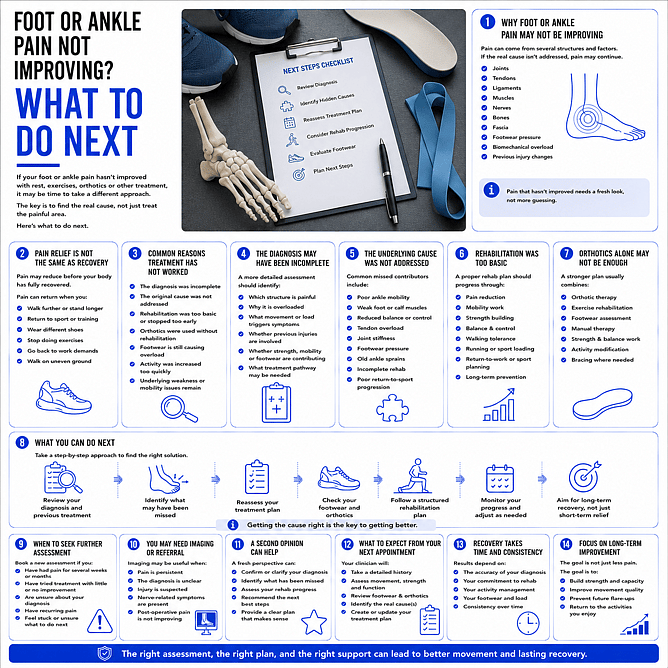
Why Foot or Ankle Pain May Not Be Improving
Foot and ankle pain does not always improve with basic treatment because pain can come from several different structures.
Pain may involve:
Joints
Tendons
Ligaments
Muscles
Nerves
Bones
Fascia
Footwear pressure
Biomechanical overload
Previous injury changes
If treatment only focuses on the painful area, it may not address the reason the pain started or why it continues.
For example, heel pain may not improve if calf strength, ankle mobility, footwear, and loading habits are not addressed. Ankle pain may persist if instability after a sprain has not been rehabilitated properly. Forefoot pain may continue if pressure distribution, footwear shape, or foot mechanics are still contributing.
Pain that has not improved needs a fresh look, not more guessing.
Pain Relief Is Not the Same as Recovery
A common mistake is assuming that if pain reduces slightly, the problem is fixed.
Pain can reduce before strength, balance, movement, and tissue capacity have fully recovered. This is especially common with tendon injuries, ankle sprains, plantar heel pain, Achilles pain, post-operative recovery, and recurring sports injuries.
You may feel better for everyday walking, but pain returns when you:
Walk further
Stand longer
Return to sport
Increase training
Wear different shoes
Walk on uneven ground
Stop doing exercises
Go back to work demands
Full recovery should not only be measured by pain. It should also consider strength, function, confidence, movement quality, and the ability to return to normal activity without symptoms returning.
Common Reasons Treatment Has Not Worked
The Diagnosis Was Incomplete
If the diagnosis is too broad, treatment can miss the real problem.
For example, “foot pain” is not a full diagnosis. “Heel pain” is not a full diagnosis. “Ankle pain” is not enough by itself.
A more useful assessment should identify:
Which structure is painful
Why it is overloaded
What movement or load triggers symptoms
Whether previous injuries are involved
Whether footwear is contributing
Whether strength or mobility is reduced
Whether orthotics, bracing, or rehab may be needed
Without a clear diagnosis, treatment becomes trial and error.
The Original Cause Was Not Addressed
Pain can settle temporarily when symptoms are treated, but return when the underlying cause remains.
Common causes that may be missed include:
Poor ankle mobility
Weak calf or foot muscles
Reduced balance or control
Tendon overload
Joint stiffness
Footwear pressure
Flat feet or high arches
Old ankle sprains
Poor return-to-sport progression
Incomplete post-operative rehabilitation
This is why unresolved foot or ankle pain often needs a more detailed assessment.
Rehabilitation Was Too Basic
Some patients are given exercises, but the exercises are not progressed far enough.
Early exercises may reduce pain, but they may not rebuild enough strength, control, or load tolerance for normal activity.
A stronger rehabilitation plan may need to progress through:
Pain reduction
Mobility work
Strength building
Balance and control
Walking tolerance
Running or sport-specific loading
Return-to-work or return-to-sport planning
Long-term prevention
If rehabilitation stops too early, pain may return when activity increases.
Orthotics Were Used Without Rehabilitation
Orthotics can be helpful, but they are not always the full answer.
Orthotics may reduce strain, improve support, and change pressure through the foot. However, if the patient also needs strength work, mobility, balance training, footwear changes, or load management, orthotics alone may not solve the problem.
A stronger plan may combine:
Orthotic therapy
Exercise rehabilitation
Footwear assessment
Manual therapy
Strength and balance work
Activity modification
Bracing where needed
The best treatment plan should match the cause of the pain, not rely on one tool.
Footwear Is Still Causing Overload
Footwear can make or break recovery.
Pain may continue if shoes are:
Too narrow
Too flexible
Too worn out
Too shallow
Poorly cushioned
Unsuitable for work
Unsuitable for sport
Pressing on the heel, toes, or forefoot
Not supporting the patient’s foot mechanics
Even good treatment can fail if the footwear keeps irritating the same area every day.
A footwear review is often important when foot or ankle pain is not improving.
Activity Was Increased Too Quickly
Many people return to full activity too soon once pain feels slightly better.
This can restart the pain cycle.
Activity may need to be adjusted after:
Tendon injuries
Stress injuries
Running injuries
Sports injuries
A proper return-to-activity plan should consider pain, strength, balance, movement, footwear, and the demands of work or sport.
When You Should Seek a Second Opinion
A second opinion may be useful when foot or ankle pain has not improved as expected.
You should consider a second opinion if:
Pain has lasted longer than expected
Treatment helped only temporarily
You are still unsure about the diagnosis
Orthotics have not fully solved the problem
Exercises have not improved function
Pain returns when activity increases
You have repeated ankle sprains
You still feel weak, unstable, or limited
You have had surgery but recovery feels stuck
You feel like the same advice is not working
A second opinion does not always mean the previous treatment was wrong. It may mean the case needs a broader assessment.
How a Detailed Assessment Can Help
When foot or ankle pain is not improving, assessment should look at the full picture.
This may include:
Symptom history
Previous diagnosis and treatment
Foot and ankle movement
Joint mobility
Muscle strength
Balance and control
Walking or running pattern
Footwear
Orthotics if already used
Work, sport, and daily activity demands
Previous injury or surgery history
The goal is to identify what is still driving the pain.
A clearer assessment can help answer:
What is causing the pain?
Why has it not improved?
What treatment has been missing?
Does the plan need rehabilitation, orthotics, bracing, or footwear changes?
Is imaging or referral needed?
What is the next step?
Where Cameron Collins Fits Into Unresolved Foot and Ankle Pain
Cameron Collins is Foot Foundation’s Lead Clinician and is dual-qualified as both a Physiotherapist and Podiatrist.
This is important for unresolved foot and ankle pain because many persistent cases involve both structure and function.
For example, a patient may need foot mechanics assessed from a podiatry perspective, while also needing rehabilitation, strength, mobility, and movement assessment from a physiotherapy perspective.
Cameron commonly works with patients who have:
Persistent foot and ankle pain
Recurring injuries
Complex cases
Previous treatment that has not worked
Post-operative rehabilitation needs
Achilles tendon injuries
Running and sporting injuries
Ongoing foot and ankle dysfunction
His approach may include rehabilitation, manual therapy, orthotic therapy, footwear modification, bracing solutions, shockwave therapy, dry needling, and return-to-activity planning where appropriate.
The goal is not just to reduce symptoms. The goal is to identify why the pain has not improved and create a pathway towards better function.
Treatment Options When Pain Has Not Improved
Treatment depends on the diagnosis and contributing factors.
Rehabilitation helps rebuild strength, mobility, balance, control, and confidence.
This may be needed when pain has lasted longer than expected or keeps returning with activity.
Manual therapy may help improve joint movement, reduce stiffness, and support better function.
This may be useful when restricted movement is contributing to ongoing pain.
Orthotics may help improve pressure distribution and reduce strain on painful structures.
They are often most useful when combined with footwear advice and rehabilitation.
Footwear Assessment and Modification
Footwear may need to be reviewed if it is causing pressure, instability, or repeated overload.
Sometimes small footwear changes can make a major difference.
Bracing may be useful for patients with instability, repeated ankle sprains, or support needs during activity.
Shockwave therapy may be considered for selected persistent tendon or heel pain conditions.
It should usually be part of a wider treatment plan, not the only treatment.
Dry needling may be used where muscle tightness, pain, or movement restriction is contributing.
It should be used alongside rehabilitation and assessment, not as a stand-alone fix.
Return-to-Sport or Return-to-Work Planning
Patients who need to return to sport, walking, physical work, or daily activity may need a staged plan.
This helps reduce the risk of flare-ups and repeated injury.
Foot or Ankle Pain Not Improving in Auckland
Foot Foundation provides assessment and treatment for unresolved foot and ankle pain in Auckland.
Cameron Collins is available at:
These Auckland locations may suit patients seeking help for persistent foot pain, ankle pain, second opinions, recurring injuries, post-operative rehabilitation, Achilles pain, heel pain, ankle instability, and complex foot and ankle conditions.
Foot and Ankle Care in Hamilton
Foot Foundation provides podiatry and foot care services in Hamilton.
Hamilton clinic locations include:
Hamilton Central – 7/127 Collingwood Street
Hamilton East – 16 Beale Street
Patients in Hamilton can access care for foot pain, heel pain, ankle concerns, nail conditions, orthotics, general podiatry, and rehabilitation-related needs depending on service availability.
Foot and Ankle Care in Tauranga
Foot Foundation provides podiatry care in Tauranga for patients with foot pain, walking pain, heel pain, sports injuries, and general foot concerns.
The Tauranga clinic is located at:
Tauranga Bethlehem – 253A State Highway 2
Patients can access assessment and treatment support for common foot and ankle concerns, with referral pathways available where more specialised rehabilitation input is required.
What to Bring to Your Appointment
To get the most value from your appointment, bring anything that helps explain the history of the problem.
Helpful items include:
Shoes you wear most often
Sports shoes or work shoes
Existing orthotics or braces
Previous imaging reports
Previous treatment notes if available
A list of exercises already tried
Details of what makes symptoms worse
Timeline of when the pain started
Information about sport, work, or daily activity demands
This helps the clinician understand what has already been done and what may still be missing.
What to Expect From a Second-Opinion Appointment
A second-opinion appointment should give you more clarity, not more confusion.
The appointment may include:
Review of your symptoms and history
Discussion of previous treatments
Foot and ankle examination
Strength and mobility assessment
Functional movement testing
Footwear review
Orthotic review if relevant
Explanation of likely causes
Treatment planning
Discussion of next steps
The goal is to leave with a clearer understanding of why the pain has not improved and what can be done next.
Book an Assessment for Foot or Ankle Pain That Has Not Improved
If foot or ankle pain has not improved after treatment, the next step is not repeating the same plan again and again.
Persistent pain often needs a more detailed assessment that considers diagnosis, movement, strength, footwear, orthotics, bracing, rehabilitation, and activity demands.
Foot Foundation provides assessment and treatment options for foot and ankle pain that has not improved, including complex foot and ankle rehabilitation with Cameron Collins at Remuera and Smales Farm.