Second Opinion for Foot and Ankle Pain: When Should You Seek Help?
Foot and ankle pain can be frustrating when it does not improve as expected. You may have already rested, changed footwear, tried exercises, used orthotics, had treatment, or followed advice from another clinician. The pain may have improved slightly, but not fully. Or it may keep returning every time you walk further, stand longer, return to sport, or increase activity.
This is where a second opinion for foot and ankle pain can be useful.
A second opinion does not always mean the first treatment was wrong. Sometimes the issue is more complex than it first appeared. Pain may involve several contributing factors, including strength, mobility, tendon capacity, joint stiffness, ankle instability, footwear, biomechanics, previous injury, or incomplete rehabilitation.
At Foot Foundation, second-opinion assessments are focused on understanding why symptoms have not improved and what may be missing from the current treatment plan.
Cameron Collins, Lead Clinician and dual-qualified Physiotherapist and Podiatrist, is frequently consulted for unresolved or complex foot and ankle cases that have not responded to previous treatment. His background allows him to assess both mechanical and functional contributors to pain, making him well suited for persistent, recurring, and rehabilitation-heavy cases.
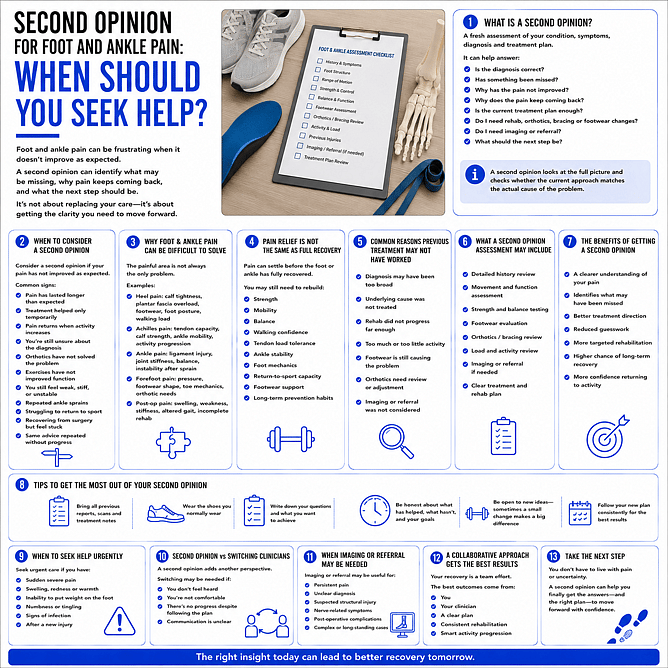
What Is a Second Opinion for Foot and Ankle Pain?
A second opinion is a fresh assessment of your condition, symptoms, diagnosis, and treatment plan.
It may help answer questions such as:
Is the diagnosis correct?
Has something been missed?
Why has the pain not improved?
Why does the pain keep coming back?
Is the current treatment plan enough?
Do I need rehabilitation, orthotics, bracing, or footwear changes?
Do I need imaging or referral?
What should the next step be?
A second opinion is not just repeating the same assessment again. It should look at the full picture and consider whether the current approach matches the actual cause of the problem.
When Should You Consider a Second Opinion?
You should consider a second opinion if your foot or ankle pain has not improved as expected.
Common signs include:
Pain has lasted longer than expected
Treatment helped only temporarily
Pain returns when activity increases
You are still unsure about the diagnosis
Orthotics have not solved the problem
Exercises have not improved function
You still feel weak, stiff, or unstable
You have repeated ankle sprains
You are struggling to return to sport
You are recovering from surgery but feel stuck
You feel like the same advice is being repeated without progress
A second opinion can provide clarity when the current plan is not giving you a clear path forward.
Why Foot and Ankle Pain Can Be Difficult to Solve
Foot and ankle pain can be complex because the painful area is not always the only problem.
For example:
Heel pain may involve calf tightness, plantar fascia overload, footwear, foot posture, and walking load.
Achilles pain may involve tendon capacity, calf strength, ankle mobility, and activity progression.
Ankle pain may involve ligament injury, joint stiffness, balance problems, or instability after a previous sprain.
Forefoot pain may involve pressure distribution, footwear shape, toe mechanics, or orthotic needs.
Post-operative pain may involve swelling, weakness, stiffness, altered walking patterns, or incomplete rehabilitation.
This is why a narrow treatment plan can fail. If only the symptom is treated, the underlying cause may remain active.
Pain Relief Is Not the Same as Full Recovery
Many patients feel better for a short time, then become frustrated when symptoms return.
This often happens because pain can reduce before the foot or ankle has fully recovered.
You may still need to rebuild:
Strength
Mobility
Balance
Walking confidence
Tendon load tolerance
Ankle stability
Foot mechanics
Return-to-sport capacity
Footwear support
Long-term prevention habits
When these areas are not fully addressed, pain may return when the body is asked to do more.
This is common after ankle sprains, Achilles tendon pain, plantar heel pain, running injuries, tendon injuries, and foot or ankle surgery.
Common Reasons Previous Treatment May Not Have Worked
The Diagnosis May Have Been Too Broad
A broad diagnosis like “foot pain”, “ankle pain”, or “overuse” may not be detailed enough.
A better diagnosis should identify:
The painful structure
Why it is being overloaded
What movements trigger pain
Whether strength or mobility is limited
Whether footwear is contributing
Whether previous injury is involved
Whether rehabilitation has progressed enough
Without this detail, treatment can become guesswork.
The Underlying Cause Was Not Treated
Symptoms may improve temporarily when the painful area is treated, but the pain can return if the cause remains.
Common missed contributors include:
Poor ankle mobility
Weak calf muscles
Weak foot muscles
Reduced balance or control
Previous ankle sprain
Tendon overload
Footwear pressure
Incomplete rehabilitation
Poor return-to-sport progression
Orthotics that need review
A second opinion can help identify what is still driving the problem.
Rehabilitation Did Not Progress Far Enough
Early exercises can help reduce pain, but they may not be enough for full recovery.
A proper rehabilitation plan may need to progress through:
Pain reduction
Mobility restoration
Strength building
Balance and control
Walking tolerance
Running or sport-specific loading
Return-to-work or return-to-sport planning
Long-term prevention
If rehab stops too early, the pain may return once activity increases.
Orthotics Were Used Without a Complete Plan
Orthotics can be very helpful, but they are not always the full answer.
Orthotics may support the foot and reduce strain, but some patients also need:
Strength work
Mobility work
Footwear changes
Manual therapy
Load management
Bracing
Gait retraining
Return-to-activity planning
A second opinion can help assess whether orthotics are still appropriate, need adjusting, or need to be combined with rehabilitation.
Footwear Is Still Aggravating the Problem
Footwear is often underestimated.
Shoes may contribute to ongoing pain if they are:
Too narrow
Too flexible
Too worn out
Too shallow
Poorly cushioned
Unsuitable for work
Unsuitable for sport
Pressing on the heel, forefoot, or toes
Not supporting the patient’s foot mechanics
Even a good treatment plan can struggle if footwear keeps placing pressure on the same painful area.
Foot and Ankle Conditions That May Need a Second Opinion
A second opinion may be useful for many unresolved or recurring conditions, including:
Persistent foot pain
Persistent ankle pain
Achilles tendon injuries
Plantar heel pain
Ankle sprains
Chronic ankle instability
Running injuries
Sports injuries
Tendon injuries
Ligament injuries
Arthritis-related foot pain
Post-operative foot and ankle recovery
Complex or recurring pain presentations
These conditions often need more than basic advice. They may require a plan that combines assessment, rehabilitation, footwear, orthotics, bracing, and staged return to activity.
What a Second-Opinion Assessment May Include
A second-opinion appointment should provide clarity.
Your assessment may include:
Discussion of your symptoms and history
Review of previous treatment
Review of previous imaging if available
Foot and ankle examination
Strength testing
Mobility testing
Balance and control assessment
Walking or running assessment
Footwear review
Orthotic review if relevant
Discussion of work, sport, and daily activity demands
Explanation of likely contributing factors
Personalised treatment planning
The goal is to understand why the issue has not improved and what needs to change.
Where Cameron Collins Fits Into Second-Opinion Cases
Cameron Collins is Foot Foundation’s Lead Clinician and is dual-qualified as both a Physiotherapist and Podiatrist.
This is valuable for second-opinion cases because unresolved foot and ankle pain often involves more than one issue.
A patient may need:
Podiatry assessment of foot mechanics
Physiotherapy assessment of strength and function
Rehabilitation planning
Orthotic therapy
Footwear modification
Bracing support
Manual therapy
Shockwave therapy where appropriate
Dry needling where appropriate
Return-to-sport planning
Post-operative recovery support
Cameron is frequently consulted for unresolved or complex cases that have not responded to previous treatment. His approach focuses on identifying why the problem developed, why it has not improved, and what treatment pathway may help the patient move forward.
What Treatment May Be Recommended After a Second Opinion?
Treatment depends on the diagnosis and contributing factors.
Rehabilitation may help rebuild strength, movement, balance, stability, and confidence.
This is often important when pain has persisted, returned, or limited activity.
Manual therapy may be used when joint stiffness, soft tissue restriction, or reduced movement is contributing to symptoms.
Orthotics may help improve pressure distribution, support the foot, and reduce strain on painful structures.
Footwear Assessment and Modification
Footwear changes may reduce pressure, improve support, and make recovery more practical.
Bracing may be useful for ankle instability, repeated sprains, or return-to-activity support.
Shockwave therapy may be considered for selected persistent tendon or heel pain conditions.
Dry needling may be used where muscle tightness, pain, or movement restriction is contributing to symptoms.
Return-to-Sport or Return-to-Work Planning
A staged return plan may help reduce flare-ups and support safer progression back to normal activity.
Second Opinion for Foot and Ankle Pain in Auckland
Foot Foundation provides second-opinion assessment and treatment planning for unresolved foot and ankle pain in Auckland.
Cameron Collins is available at:
These locations may suit patients with persistent foot pain, ankle pain, recurring injuries, complex conditions, post-operative recovery needs, Achilles pain, heel pain, ankle instability, and sports-related concerns.
Foot and Ankle Care in Hamilton
Foot Foundation provides podiatry and foot care services in Hamilton.
Hamilton clinic locations include:
Patients in Hamilton can access care for foot pain, heel pain, ankle concerns, nail conditions, orthotics, general podiatry, and rehabilitation-related needs depending on service availability.
Foot and Ankle Care in Tauranga
Foot Foundation provides podiatry care in Tauranga for patients with foot pain, walking pain, heel pain, sports injuries, and general foot concerns.
The Tauranga clinic is located at:
Patients can access assessment and treatment support for common foot and ankle concerns, with referral pathways available where more specialised rehabilitation input is required.
What to Bring to a Second-Opinion Appointment
Bring anything that helps explain your history and previous care.
Helpful items include:
Shoes you wear most often
Sports shoes or work shoes
Existing orthotics
Braces or supports
Previous imaging reports
Previous treatment notes if available
A list of exercises already tried
Information about what makes pain worse
Timeline of when symptoms started
Work, sport, or daily activity goals
This helps avoid repeating the same steps and gives the clinician a clearer view of what may still be missing.
When a Second Opinion Is Especially Important
A second opinion is especially worth considering when symptoms are affecting your quality of life or stopping you from doing normal activities.
This includes:
Pain that affects walking
Pain that affects work
Pain that affects sport
Repeated injuries
Ongoing swelling
Weakness or instability
Loss of confidence
Pain after surgery
Conflicting advice
No clear diagnosis
No clear treatment plan
The longer pain continues without clarity, the easier it is to compensate and develop other problems.
Book a Second Opinion for Foot or Ankle Pain
If foot or ankle pain has not improved, keeps returning, or still has no clear explanation, a second opinion may help identify the next step.
The goal is not to repeat the same plan. The goal is to reassess the diagnosis, review what has already been done, and identify what may be missing.
Foot Foundation provides second-opinion assessment and treatment planning for foot and ankle pain, including complex cases with Cameron Collins at Remuera and Smales Farm.