Shockwave Therapy for Foot and Ankle Pain: When Is It Useful?
Shockwave therapy is often discussed as a treatment option for persistent foot and ankle pain, especially heel pain, plantar fasciitis, Achilles tendon pain, and long-standing tendon problems.
It can sound like a simple solution: apply shockwave therapy, reduce pain, and return to normal activity. But that is not the full picture.
Shockwave therapy may be useful for selected foot and ankle conditions, particularly when pain has become persistent and has not responded well to basic care. However, it should not be treated as a stand-alone fix. The best results usually come when shockwave therapy is used as part of a wider treatment plan that considers diagnosis, rehabilitation, footwear, orthotics, strength, movement, load tolerance, and activity demands.
At Foot Foundation, shockwave therapy may be considered where clinically appropriate, but it is not used in isolation from the bigger picture.
Cameron Collins, Foot Foundation’s Lead Clinician and dual-qualified Physiotherapist and Podiatrist, works with persistent and complex foot and ankle problems. His approach may include shockwave therapy as part of a broader plan that also considers rehabilitation, manual therapy, orthotics, footwear modification, bracing, and exercise programmes.
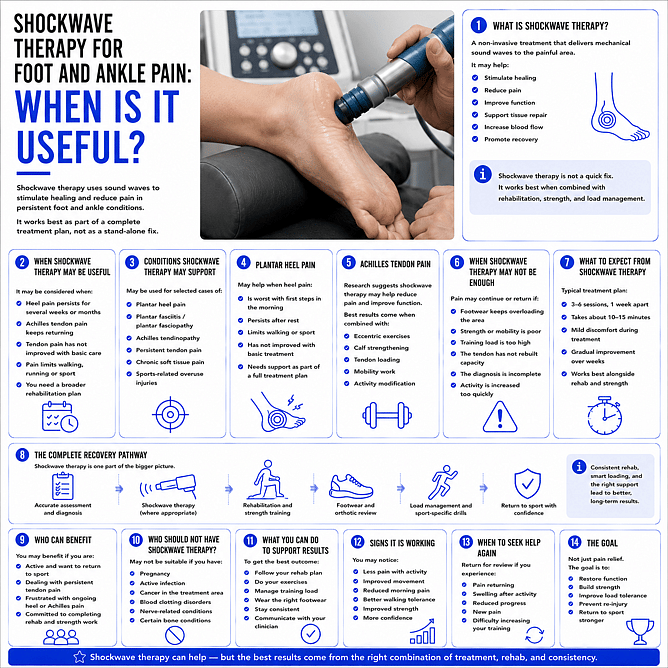
What Is Shockwave Therapy?
Shockwave therapy, also called extracorporeal shockwave therapy, uses a device to deliver mechanical sound waves through the skin to the painful or injured area. Guy’s and St Thomas’ NHS explains that the shockwaves are mechanical rather than electric, and are passed through the skin using a special device.
Shockwave therapy is commonly used for selected persistent soft tissue and tendon-related conditions.
In foot and ankle care, it may be considered for conditions such as:
Plantar fasciitis / plantar fasciopathy
Persistent tendon pain
Some chronic soft tissue pain presentations
Selected sports-related overuse injuries
The goal is not to “break up” pain. The goal is to stimulate a biological response in the affected tissue and support recovery when used appropriately.
NICE describes extracorporeal shockwave therapy for refractory plantar fasciitis as sound waves delivered to the painful area with the aim of stimulating healing of the fascia.
When Shockwave Therapy May Be Useful
Shockwave therapy may be considered when foot or ankle pain has become persistent and has not improved with simpler measures.
It may be useful when:
Heel pain has lasted for several weeks or months
Plantar heel pain is not settling
Achilles pain keeps returning
Tendon pain has become persistent
Pain limits walking, running, work, or sport
Rest has only helped temporarily
Exercise alone has not fully resolved symptoms
The patient needs a broader rehabilitation plan
The diagnosis supports shockwave as an appropriate option
Shockwave therapy should be matched to the condition. It is not the right treatment for every type of foot or ankle pain.
For example, pain from a fracture, nerve problem, infection, inflammatory disease, or serious joint issue may need a different pathway.
Conditions Shockwave Therapy May Support
Plantar heel pain is one of the most common reasons patients ask about shockwave therapy.
This pain is often felt under the heel and may be worse:
First thing in the morning
After rest
After long standing
After walking longer distances
After running or sport
Shockwave therapy may be considered for persistent plantar heel pain when symptoms have not improved with basic care.
However, heel pain often needs more than one treatment. A full plan may include calf mobility, foot strengthening, footwear advice, orthotics, load management, and activity changes.
Achilles tendinopathy can be stubborn because tendons need careful loading, not just rest.
Shockwave therapy may be considered for selected Achilles tendon problems, particularly when symptoms have become persistent.
A 2022 review on midportion Achilles tendinopathy suggested that extracorporeal shockwave therapy can reduce pain and improve function, and that combining shockwave therapy with eccentric exercises and stretching may be more effective than shockwave alone.
That is the key point: shockwave may help, but rehabilitation still matters.
Achilles pain often needs:
Calf strengthening
Tendon loading
Footwear review
Heel lift or orthotic support where appropriate
Activity modification
Running load review
Progressive return-to-sport planning
Persistent Tendon Pain
This can happen with:
Achilles tendon pain
Tibialis posterior tendon pain
Peroneal tendon pain
Other foot and ankle tendon overload conditions
Shockwave therapy may be considered as part of a treatment algorithm for various tendinopathies. A 2025 British Journal of Sports Medicine recommendation paper states that shockwave and/or pressure wave therapy is recommended as part of the treatment algorithm for various tendinopathies and plantar fasciopathy.
Again, the wording matters: part of the treatment algorithm, not the entire treatment plan.
When Shockwave Therapy May Not Be Enough
Shockwave therapy may not be enough if the underlying cause of the pain is still present.
Pain may continue or return if:
Footwear keeps overloading the area
Calf or foot strength is poor
Ankle mobility is restricted
Training load is too high
The tendon has not rebuilt capacity
Orthotics are needed but not used
The diagnosis is incomplete
The patient returns to activity too quickly
There is nerve, bone, joint, or inflammatory involvement
This is why shockwave should not be sold as a quick fix.
The best treatment plan starts with assessment, then uses shockwave only where it fits the diagnosis and recovery goals.
Why Shockwave Works Best With Rehabilitation
Shockwave therapy may help reduce pain and support tissue response, but rehabilitation helps the body handle load better.
Rehabilitation may include:
Strength exercises
Mobility work
Tendon loading
Balance and control training
Walking progression
Running progression
Return-to-sport planning
Long-term prevention exercises
For tendon and heel pain, this matters because pain often comes back when the tissue is asked to do more than it can tolerate.
A strong treatment plan may use shockwave therapy to support recovery while rehabilitation rebuilds strength, movement, and capacity.
Shockwave Therapy vs Exercises
Shockwave therapy and exercises should not be seen as enemies.
They do different jobs.
Shockwave therapy may help stimulate the painful area and support symptom improvement.
Exercises help rebuild:
Strength
Load tolerance
Balance
Mobility
Movement control
Return-to-activity confidence
For many patients, the better question is not “shockwave or exercises?”
The better question is:
Does your condition need shockwave, rehabilitation, or a combination of both?
Shockwave Therapy vs Orthotics
Shockwave therapy and orthotics also do different jobs.
Orthotics may help support the foot, reduce strain, improve pressure distribution, and change loading through the foot and ankle.
Shockwave therapy may be used to support selected persistent soft tissue or tendon-related pain.
Some patients may need both.
For example:
A patient with plantar heel pain may need shockwave therapy, orthotics, calf mobility, and strengthening.
A patient with Achilles pain may need shockwave therapy, heel lift support, footwear advice, and progressive loading.
A patient with recurring tendon pain may need orthotics, rehabilitation, and load management.
The right plan depends on the cause of the pain.
Is Shockwave Therapy Painful?
Shockwave therapy can feel uncomfortable during treatment, especially when applied over a painful area. The intensity should be adjusted to suit the patient and the treatment goal.
Patients may feel temporary soreness afterwards.
General advice may include:
Avoiding heavy loading straight after treatment
Following the rehabilitation plan
Monitoring pain response
Reporting unusual or worsening symptoms
Staying consistent with footwear and activity advice
Shockwave therapy should be explained clearly before treatment so patients understand what to expect.
How Many Shockwave Sessions Are Needed?
The number of sessions depends on the condition, severity, response, and clinical plan.
Some NHS patient information describes a course of three treatments, often spaced one to two weeks apart, for Achilles tendinopathy and plantar fasciitis.
However, this can vary. The right course should be based on assessment and clinical judgement.
Patients should not expect one session to instantly solve a long-standing problem.
Why Diagnosis Matters Before Shockwave Therapy
Shockwave therapy should not be used just because pain has lasted a long time.
A proper assessment should identify:
What structure is painful
Whether the condition is suitable for shockwave
Whether imaging or referral is needed
Whether footwear is contributing
Whether orthotics may help
Whether rehabilitation has been completed properly
Whether training or work load needs adjusting
Whether the pain pattern suggests another cause
Without diagnosis, shockwave becomes guesswork.
That is not good treatment.
What a Shockwave Therapy Assessment May Include
A shockwave therapy assessment may include:
Symptom history
Previous treatment review
Foot and ankle examination
Strength testing
Mobility assessment
Walking or running assessment
Footwear review
Orthotic review if relevant
Activity and training load review
Pain behaviour assessment
Treatment suitability discussion
Rehabilitation planning
The goal is to decide whether shockwave therapy is appropriate and what else needs to be included in the treatment plan.
Where Cameron Collins Fits Into Shockwave Therapy Planning
Cameron Collins is Foot Foundation’s Lead Clinician and is dual-qualified as both a Physiotherapist and Podiatrist.
This is useful for patients considering shockwave therapy because persistent foot and ankle pain often has more than one contributor.
Cameron may assess:
Foot and ankle mechanics
Strength and mobility
Tendon load tolerance
Footwear suitability
Orthotic needs
Walking or running patterns
Return-to-sport demands
Previous treatment that has not worked
Shockwave therapy may be used as part of a broader treatment plan where appropriate. It should not be treated as a stand-alone fix.
A broader plan may include:
Exercise rehabilitation
Footwear assessment and modification
Load management
Return-to-sport planning
Shockwave therapy where clinically suitable
Shockwave Therapy for Foot and Ankle Pain in Auckland
Foot Foundation provides assessment and treatment planning for selected persistent foot and ankle pain conditions in Auckland.
Cameron Collins is available at:
These locations may suit patients with persistent heel pain, Achilles pain, tendon pain, recurring foot or ankle pain, sports-related injuries, and complex foot and ankle conditions that have not improved with basic treatment.
Foot and Ankle Care in Hamilton
Foot Foundation provides podiatry and foot care services in Hamilton.
Hamilton clinic locations include:
Hamilton Central – 7/127 Collingwood Street
Hamilton East – 16 Beale Street
Patients in Hamilton can access care for foot pain, heel pain, ankle concerns, orthotics, general podiatry, nail conditions, and rehabilitation-related needs depending on service availability.
Foot and Ankle Care in Tauranga
Foot Foundation provides podiatry care in Tauranga for patients with foot pain, walking pain, heel pain, sports injuries, and general foot concerns.
The Tauranga clinic is located at:
Tauranga Bethlehem – 253A State Highway 2
Patients can access assessment and treatment support for common foot and ankle concerns, with referral pathways available where more specialised rehabilitation input is required.
What to Bring to a Shockwave Therapy Appointment
Bring anything that helps show the history of the problem and what has already been tried.
Helpful items include:
Shoes you wear most often
Sports shoes or work shoes
Existing orthotics
Braces or supports
Previous imaging reports
Previous treatment notes if available
List of exercises already tried
Timeline of pain and flare-ups
Details of work, sport, or walking demands
Information on what makes symptoms worse
This helps avoid repeating ineffective treatment and supports better planning.
When Should You Consider Shockwave Therapy?
You may consider discussing shockwave therapy if:
Heel pain has not improved with basic care
Achilles pain keeps returning
Tendon pain has lasted longer than expected
Pain limits walking, running, work, or sport
Rest only gives temporary relief
You have already tried exercises but symptoms persist
You want to understand all suitable treatment options
You need a broader plan for persistent foot or ankle pain
Shockwave therapy should always be considered in context. The question is not simply whether shockwave can help. The question is whether it fits your diagnosis and recovery plan.
Book an Assessment for Shockwave Therapy and Foot Pain
Shockwave therapy can be useful for selected persistent foot and ankle pain conditions, but it should not be treated as a shortcut.
The strongest treatment plans usually include assessment, rehabilitation, footwear advice, orthotics where needed, load management, and staged return to activity.
Foot Foundation provides assessment and treatment planning for foot and ankle pain, including shockwave therapy where clinically appropriate and broader rehabilitation support with Cameron Collins at Remuera and Smales Farm.