Ankle Bracing for Instability: When Custom Support Can Help
Ankle instability can make walking, sport, work, and everyday movement feel uncertain. Some patients describe it as the ankle “giving way”, rolling repeatedly, or feeling weak on uneven ground. Others feel nervous returning to activity because they do not trust the ankle.
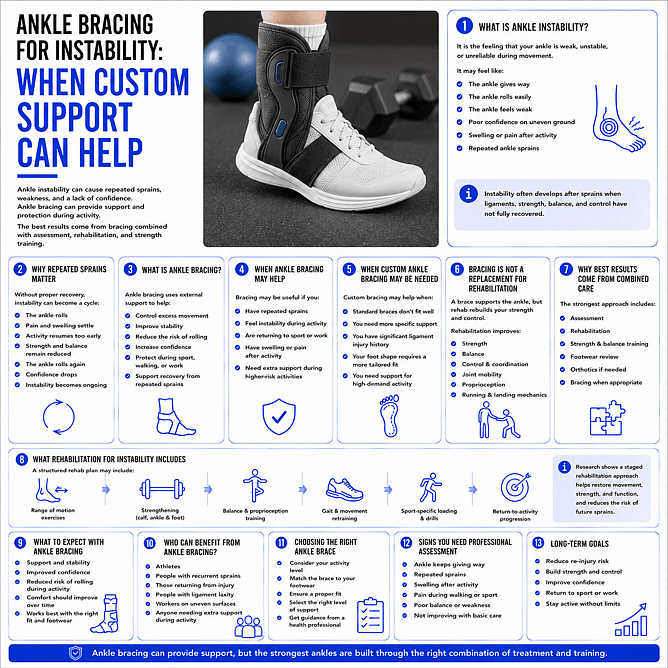
Ankle bracing for instability may help provide external support, improve confidence, and reduce the risk of repeated rolling during certain activities. However, bracing should not be treated as the full solution for every unstable ankle.
The strongest approach usually combines proper assessment, rehabilitation, strength work, balance training, footwear review, and bracing where appropriate.
At Foot Foundation, ankle instability is assessed by looking at both the structure and function of the ankle. The goal is to understand why the ankle feels unstable, whether bracing is suitable, and what else may be needed for long-term improvement.
Cameron Collins, Foot Foundation’s Lead Clinician and dual-qualified Physiotherapist and Podiatrist, has experience with ankle bracing, recurring ankle injuries, and return-to-activity planning. His approach combines rehabilitation, manual therapy, orthotic therapy, footwear assessment, bracing solutions, and exercise programmes where clinically appropriate.
What Is Ankle Instability?
Ankle instability usually means the ankle does not feel secure during walking, sport, or daily movement. It commonly develops after one or more ankle sprains, especially when the ligaments, strength, balance, and control have not fully recovered.
Ankle instability may feel like:
The ankle gives way
The ankle rolls easily
The ankle feels weak
The ankle feels unreliable on uneven ground
There is reduced confidence during sport
The ankle swells after activity
Pain returns after walking or running
Repeated sprains keep happening
Some patients have mechanical instability, where ligaments or joint structures have been damaged. Others have functional instability, where strength, balance, coordination, or control has not recovered properly. Many patients have a combination of both.
Why Repeated Ankle Sprains Matter
An ankle sprain is not always a minor injury. Even when pain and swelling settle, the ankle may remain weaker, less stable, or less coordinated than before.
Health New Zealand notes that physiotherapy after ankle sprain can help restore movement, strength and balance, and support return to normal activities. This matters because ankle stability depends on more than pain relief. It depends on how well the ankle moves, loads, reacts, and controls movement.
If the ankle is not rehabilitated properly, repeated sprains can become a cycle:
The ankle rolls
Pain and swelling settle
Activity resumes too quickly
Strength and balance remain reduced
The ankle rolls again
Confidence drops
Instability becomes ongoing
Ankle bracing may help reduce risk during activity, but the reason the ankle keeps rolling still needs to be assessed.
What Is Ankle Bracing?
Ankle bracing uses an external support around the ankle to help control movement, improve stability, and provide protection during activity.
Ankle braces may be used to:
Support an unstable ankle
Reduce excessive ankle rolling
Improve confidence during walking or sport
Protect the ankle during return to activity
Support recovery after repeated sprains
Assist patients with ligament laxity or instability
Provide added support where rehabilitation alone is not enough
Bracing can be especially useful during higher-risk activities such as sport, walking on uneven ground, physical work, or return-to-training phases.
However, a brace should not be seen as a replacement for rehabilitation.
When Ankle Bracing May Help
Ankle bracing may be considered when the ankle feels unstable, unreliable, or vulnerable during activity.
It may help patients who experience:
Repeated ankle sprains
Ankle giving way
Ongoing instability after a sprain
Poor confidence on uneven ground
Sports-related ankle instability
Swelling or pain after activity
Difficulty returning to running or sport
Ligament injury history
Ankle weakness despite basic care
Need for extra support during work or activity
Bracing can be useful when patients need protection while rebuilding strength and control.
The key is to use bracing as part of a plan, not as the only treatment.
When Custom Ankle Bracing May Be Needed
Standard ankle braces may help some patients, but they do not suit every ankle, foot shape, activity level, or injury pattern.
Custom ankle bracing may be considered when:
Standard braces do not fit well
The ankle needs more specific support
The patient has repeated sprains
The ankle feels unstable during sport or work
There is significant ligament injury history
Foot shape makes off-the-shelf braces uncomfortable
Bracing needs to fit certain footwear
The patient needs support for higher-demand activity
Long-term instability is affecting confidence
Custom bracing can provide more tailored support, but it still needs to be matched to the patient’s condition, footwear, and activity goals.
Bracing Is Not a Replacement for Rehabilitation
This is the part many patients need to understand.
An ankle brace can support the ankle, but it does not automatically rebuild strength, balance, movement control, or tissue capacity.
Rehabilitation may still be needed to improve:
Calf strength
Ankle strength
Balance
Proprioception
Reaction control
Joint mobility
Walking confidence
Running mechanics
Landing control
Return-to-sport readiness
Research on ankle sprain rehabilitation supports a staged approach including range-of-motion work, strengthening, proprioception training, and sport-specific activity before return to competition.
That is why the best plan often combines bracing with rehabilitation. The brace helps support the ankle while the body rebuilds the ability to control movement.
Common Signs You May Need Ankle Stability Assessment
You should consider an assessment if:
Your ankle keeps rolling
You have had more than one ankle sprain
Your ankle feels weak or unreliable
You avoid uneven ground
You feel nervous returning to sport
Swelling returns after activity
Your ankle feels stiff or restricted
You cannot balance well on one leg
Pain keeps returning after walking or running
You already use a brace but still feel unstable
If pain is severe, you cannot bear weight, there is major swelling or bruising, or you suspect a fracture, seek urgent medical assessment.
Why the Ankle Keeps Giving Way
An ankle may keep giving way for several reasons.
Common contributing factors include:
Previous ligament injury
Incomplete rehabilitation after a sprain
Reduced ankle strength
Poor balance or proprioception
Reduced joint mobility
Weak calf or foot muscles
Poor footwear support
Returning to sport too quickly
Foot posture or biomechanical factors
Repeated sprains over time
This is why treatment should start with assessment. Without knowing why the ankle is unstable, it is difficult to choose the right brace or rehabilitation plan.
What an Ankle Bracing Assessment May Include
A proper assessment should look at both support needs and functional deficits.
This may include:
Ankle injury history
Number of previous sprains
Pain and swelling pattern
Ligament stability testing
Joint mobility assessment
Strength testing
Balance and control testing
Walking or running assessment
Foot posture assessment
Footwear review
Current brace review if already used
Sport, work, or activity demands
The goal is to decide whether bracing is needed, what type of support may suit, and what rehabilitation is required.
Treatment Options for Ankle Instability
Ankle bracing may help support the ankle during walking, work, sport, or return-to-activity stages.
Bracing may be temporary or longer-term depending on the condition, activity level, and instability severity.
Custom Ankle Bracing
Custom ankle bracing may be recommended when standard braces are not enough or when the patient needs more specific support.
This may be relevant for recurring sprains, chronic instability, sport demands, or complex ankle history.
Strength Rehabilitation
Strength work helps rebuild the muscles that support the ankle and control movement.
This may include calf strengthening, ankle strengthening, foot muscle work, and progressive loading.
Balance and Proprioception Training
Balance training helps the ankle react better to movement, uneven ground, and sudden changes in position.
This is essential for patients with repeated ankle sprains.
Manual therapy may help improve joint mobility or stiffness where restricted movement is contributing to instability or altered loading.
Footwear can affect ankle stability. Shoes that are too flexible, worn out, narrow, unstable, or unsuitable for sport can increase risk.
A footwear review may assess:
Shoe stability
Cushioning
Fit
Heel counter support
Sole wear
Sport or work suitability
Compatibility with bracing
Orthotics may be considered when foot posture or pressure distribution contributes to ankle instability or recurring strain.
They may be used alongside bracing and rehabilitation where appropriate.
Return-to-Activity Planning
A safe return to activity should be staged.
This may include:
Walking progression
Strength benchmarks
Balance testing
Running progression
Jumping and landing control
Change-of-direction work
Sport-specific loading
Bracing during higher-risk stages
The goal is not just to return quickly. The goal is to return safely with better confidence.
Where Cameron Collins Fits Into Ankle Bracing and Instability
Cameron Collins is Foot Foundation’s Lead Clinician and is dual-qualified as both a Physiotherapist and Podiatrist.
This is valuable for ankle instability because the problem often involves both mechanical support and functional rehabilitation.
Cameron’s assessment may consider:
Ligament injury history
Foot and ankle mechanics
Strength and movement function
Balance and control
Footwear and orthotic needs
Bracing requirements
Return-to-sport or return-to-work demands
Previous treatment that has not worked
Cameron has experience with ankle bracing, recurring ankle injuries, and return-to-activity planning. His approach may include ankle rehabilitation, custom bracing, orthotic therapy, footwear assessment, manual therapy, and progressive exercise programmes where clinically appropriate.
The aim is not only to support the ankle. The aim is to help patients move with more confidence and reduce the risk of repeated injury.
Ankle Bracing for Instability in Auckland
Foot Foundation provides assessment and treatment planning for ankle instability, recurrent sprains, and bracing needs in Auckland.
Cameron Collins is available at:
These locations may suit patients with ankle instability, repeated ankle sprains, chronic ankle giving way, sports-related ankle injuries, bracing needs, footwear concerns, and return-to-activity goals.
Foot and Ankle Care in Hamilton
Foot Foundation provides podiatry and foot care services in Hamilton.
Hamilton clinic locations include:
Hamilton Central – 7/127 Collingwood Street
Hamilton East – 16 Beale Street
Patients in Hamilton can access care for foot pain, heel pain, ankle concerns, orthotics, general podiatry, nail conditions, and rehabilitation-related needs depending on service availability.
Foot and Ankle Care in Tauranga
Foot Foundation provides podiatry care in Tauranga for patients with foot pain, walking pain, heel pain, sports injuries, and general foot concerns.
The Tauranga clinic is located at:
Tauranga Bethlehem – 253A State Highway 2
Patients can access assessment and treatment support for common foot and ankle concerns, with referral pathways available where more specialised rehabilitation input is required.
What to Bring to an Ankle Bracing Appointment
To get the most value from your appointment, bring anything that helps show how your ankle behaves during daily life.
Helpful items include:
Shoes you wear most often
Sports shoes or work shoes
Any ankle braces already used
Existing orthotics
Previous imaging reports
Details of previous sprains
Previous treatment notes if available
List of sports or activities affected
Notes on when the ankle gives way
Work or return-to-sport goals
This helps the clinician assess the ankle in the context of your real activities.
When Bracing Should Be Reviewed
Ankle bracing should be reviewed if:
The brace is uncomfortable
The brace does not fit in footwear
The ankle still gives way
Pain continues despite using a brace
The brace causes pressure or rubbing
Activity level has changed
You are returning to sport
You have had another sprain
The brace feels worn or loose
You are unsure whether you still need it
A brace should help support activity, not create new problems.
Book an Assessment for Ankle Bracing and Instability
If your ankle keeps giving way, rolling, or feeling unstable, do not rely on bracing alone without understanding the cause.
Ankle bracing can be helpful, but the strongest plan often combines support with rehabilitation, strength work, balance training, footwear advice, and return-to-activity planning.
Foot Foundation provides assessment and treatment planning for ankle instability and bracing needs, including complex ankle support and rehabilitation with Cameron Collins at Remuera and Smales Farm.