What Are the Main Achilles Rupture Symptoms?
An Achilles tendon rupture is a serious injury in which some or all of the tendon fibres tear. It often happens suddenly during an explosive movement, rapid push-off, jump, change of direction, or unexpected force through the ankle.
Common Achilles rupture symptoms include:
Sudden sharp pain in the heel, ankle or lower calf
A popping or snapping sensation
Feeling as though someone kicked or struck the back of the leg
Difficulty walking normally
Reduced ability to push off through the injured foot
Difficulty or inability to stand on tiptoe on the injured side
Swelling around the calf or ankle
Bruising around the lower leg
Marked weakness in the affected leg
Health New Zealand describes sudden, sharp and severe pain at the back of the leg as a typical symptom. People often describe the sensation as though they have been hit in the back of the heel, and walking or standing on tiptoe may become difficult.
These symptoms require urgent assessment rather than waiting several weeks to see whether the problem settles.
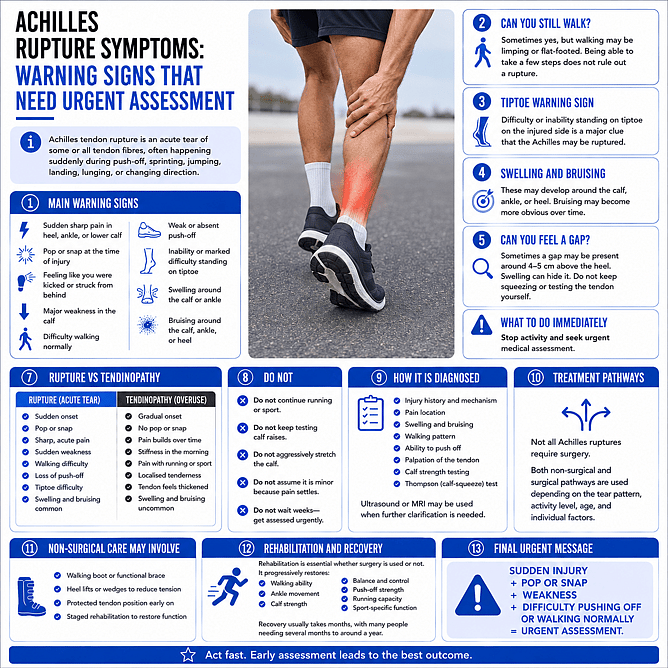
What Is an Achilles Tendon Rupture?
The Achilles tendon connects the calf muscles to the heel bone and helps generate the push-off needed for walking, running, jumping and standing on tiptoe. A rupture occurs when the tendon tears partially or completely.
A complete rupture disrupts the continuity of the tendon. Without an intact tendon, normal push-off through the foot can be significantly impaired. Partial tears can also occur, although complete ruptures are more common in acute Achilles rupture presentations.
The injury can occur around the middle of the tendon or, less commonly, close to its attachment at the heel.
The important distinction is that an Achilles rupture is generally an acute injury, unlike Achilles tendinopathy, which more often develops gradually.
The Classic Warning Sign: A Pop or Snap Behind the Leg
One of the best-known Achilles rupture symptoms is hearing or feeling a sudden pop or snap.
Patients may describe:
A loud pop
A snapping sensation
A sudden tearing feeling
Feeling as though something struck the calf
Feeling as though someone kicked them from behind
Both Health New Zealand and Cambridge University Hospitals describe this “hit or kicked from behind” sensation as characteristic of Achilles rupture.
It often happens during movements involving sudden calf contraction or rapid loading, such as:
Sprinting
Jumping
Lunging
Changing direction
Pushing off suddenly
Landing from a jump
Achilles ruptures can also occur when the foot is unexpectedly forced upwards at the ankle.
Not everyone remembers hearing a clear pop, however. The combination of sudden pain, weakness and difficulty using the leg normally is more important than one symptom alone.
Does an Achilles Rupture Always Cause Severe Pain?
No.
This is an important point because people sometimes assume that a serious rupture must remain extremely painful.
The initial pain may be sudden and severe but can then reduce to a dull ache or even settle considerably. Cambridge University Hospitals specifically notes that pain following Achilles rupture may decrease substantially after the initial injury.
That means this pattern:
Severe pain → pain settles → therefore the tendon must be fine
is not reliable.
The loss of normal function can be more revealing than the amount of pain.
Pay particular attention to:
Push-off weakness
Difficulty walking normally
Difficulty climbing stairs
Inability to rise properly onto the toes
Swelling or bruising
A sudden change in calf strength
If these symptoms followed an acute injury, assessment should not be delayed simply because the pain has improved.
Can You Walk With a Ruptured Achilles?
Sometimes.
Being able to take a few steps does not reliably rule out an Achilles rupture.
Cambridge University Hospitals notes that walking is usually difficult after rupture and may become flat-footed because the normal push-off mechanism has been disrupted.
Some people can therefore still get off the court, field or pavement and assume the injury cannot be serious.
The more useful question is:
Can you walk normally and push off normally?
Warning signs include:
Limping
Flat-footed walking
Weak push-off
Difficulty climbing stairs
Difficulty standing on tiptoe
The fact that some walking is possible should not be used as a home test to rule out rupture.
Difficulty Standing on Tiptoe Is an Important Warning Sign
The Achilles tendon plays a major role in lifting the heel from the ground.
With a complete tear, standing on the toes of the injured leg may become impossible or markedly weaker. The American Academy of Orthopaedic Surgeons lists inability to stand on the toes of the affected leg among the characteristic features of Achilles tendon rupture.
Health New Zealand also includes inability to stand on tiptoe among recognised rupture symptoms.
However, repeatedly testing the injured tendon yourself is not recommended when a rupture is suspected.
If the injury occurred suddenly and the leg feels substantially weaker, stop the activity and seek urgent assessment.
Swelling and Bruising After an Achilles Rupture
Swelling can develop around the calf, ankle or heel after the tendon tears.
Bruising may also appear in the lower leg as the injury evolves. Health New Zealand lists both calf swelling and lower-leg bruising among possible Achilles rupture symptoms.
Cambridge University Hospitals similarly describes swelling and bruising through the calf and ankle following rupture.
The absence of dramatic bruising immediately after injury does not necessarily exclude rupture.
Some signs develop over time, while the sudden loss of normal push-off and the injury mechanism may be more obvious early clues.
Can You Feel a Gap in the Achilles Tendon?
Sometimes a gap can be felt where the tendon has ruptured.
Cambridge University Hospitals notes that a palpable gap may occur approximately 4–5 cm above the heel bone in a complete rupture.
However, swelling can make this difficult to identify.
Patients should not repeatedly squeeze, stretch or manipulate a newly injured Achilles trying to find the gap themselves.
Clinical examination is more reliable.
Achilles Rupture vs Achilles Tendinopathy
These conditions affect the same tendon, but their typical presentation is very different.
Achilles Tendinopathy
More commonly involves:
Gradual onset
Morning stiffness
Pain developing over time
Pain associated with increasing activity
Tendon tenderness
Possible tendon thickening
Symptoms that may repeatedly flare with running or sport
Achilles Rupture
More commonly involves:
Sudden onset
Pop or snap
Sharp acute pain
Sudden weakness
Difficulty pushing off
Difficulty walking normally
Swelling or bruising
Difficulty standing on tiptoe
Health New Zealand specifically advises urgent medical assessment when a person experiences sudden severe pain at the back of the leg accompanied by difficulty walking, a snap or crack, or the sensation of being hit in the leg.
This distinction is important because gradual Achilles tendinopathy rehabilitation is completely different from managing a suspected acute rupture.
What if You Already Had Achilles Tendinopathy?
Previous Achilles symptoms may be relevant to rupture risk, although a rupture can also occur unexpectedly.
The AAOS notes that previous Achilles tendon problems can be considered during assessment, and Cambridge University Hospitals states that long-standing Achilles tendon problems may sometimes weaken the tendon.
Medication and medical history may also be relevant. Certain fluoroquinolone antibiotics and corticosteroid exposure have been associated with increased tendon rupture risk.
That does not mean a person with tendinopathy is destined to rupture their Achilles.
It does mean that a sudden major change in symptoms should not simply be dismissed as another tendinopathy flare-up.
What Should You Do if You Think Your Achilles Ruptured?
If you experience sudden Achilles pain with a pop, major weakness or difficulty walking, stop the activity and seek urgent medical assessment.
Do not:
Continue running
Continue playing sport
Perform repeated calf raises to test it
Aggressively stretch the calf
Assume the injury is minor because the pain settles
Wait several weeks hoping it will improve
Health New Zealand advises urgent healthcare assessment for suspected rupture symptoms.
Early assessment is important because the injured tendon needs to be appropriately protected and a treatment pathway established.
How Is an Achilles Rupture Diagnosed?
A clinician will usually begin with the injury history and physical examination.
Assessment may include:
How the injury happened
Whether there was a pop or snap
Pain location
Swelling and bruising
Walking pattern
Push-off ability
Palpation of the tendon
Calf strength
A calf-squeeze test
A commonly used examination is the Thompson test, sometimes called the calf-squeeze test. The clinician squeezes the calf and observes whether the foot moves appropriately. Reduced or absent movement may indicate disruption of the Achilles tendon.
Clinical examination can often identify a complete rupture. Imaging may then be used when further clarification is required.
Does an Achilles Rupture Need an Ultrasound or MRI?
Not every suspected rupture automatically needs every form of imaging.
Ultrasound can show whether the tendon is torn and help assess the location or behaviour of the tear. MRI provides more detailed soft-tissue imaging and may help assess the amount and location of tendon damage or exclude other injuries.
Imaging may be useful when:
The clinical diagnosis is uncertain
The tear pattern needs clarification
A partial tear is suspected
The presentation is unusual
Treatment planning requires more information
The scan supports the clinical examination rather than replacing it.
Do All Achilles Ruptures Need Surgery?
No.
This is an important correction to outdated or overly simplified Achilles advice.
Both non-operative and surgical treatment pathways are used for Achilles tendon rupture. AAOS states that complete tears can be managed non-surgically in some patients and that the decision regarding surgery depends on factors such as the tear, activity level, age and occupation.
Cambridge University Hospitals also uses both pathways and reports that most of its patients are treated conservatively with functional bracing, while surgery is considered for selected presentations such as delayed cases, re-rupture, unusual tear patterns or some elite athletes.
That means the correct message is not:
“Complete rupture = surgery.”
The correct message is:
“A confirmed Achilles rupture needs prompt specialist assessment so the most appropriate surgical or non-surgical pathway can be selected.”
What Does Non-Surgical Treatment Involve?
Non-operative treatment commonly involves protecting the Achilles while the torn tendon heals.
Depending on the clinical protocol, this may use:
A specialised walking boot
Heel wedges
An ankle position that brings the tendon ends closer together
Gradual progression through rehabilitation
The exact weight-bearing and boot protocol varies between services, so patients should follow the instructions given by the treating orthopaedic and rehabilitation team rather than copying another person's programme.
Rehabilitation is then progressed carefully as healing develops.
When Might Surgery Be Considered?
Surgical repair remains appropriate for selected Achilles ruptures.
Factors that may influence the recommendation can include:
Tear characteristics
Delayed presentation
Re-rupture
Activity requirements
Competitive sporting demands
Occupation
Individual risks and goals
AAOS describes the surgical-versus-non-surgical decision as complex and individualised, while Cambridge University Hospitals lists selected circumstances in which surgery may be considered.
A blog should therefore never promise that one pathway is automatically superior for every patient.
Rehabilitation Is Important Whether Surgery Is Used or Not
Achilles rupture treatment does not finish once the tendon has been immobilised or repaired.
Rehabilitation is needed to progressively restore:
Walking
Ankle movement
Calf strength
Balance
Push-off strength
Lower-limb control
Running capacity
Sport-specific function
AAOS notes that strengthening is gradually introduced as recovery progresses and that returning to sport may require functional testing to determine readiness.
Cambridge University Hospitals describes a staged programme moving from protection and basic movement through strengthening, balance, jogging, running, change-of-direction work and sport-specific rehabilitation.
Progression should follow the treatment protocol and healing stage rather than pain alone.
How Long Does Achilles Rupture Recovery Take?
Achilles rupture recovery takes months rather than weeks.
AAOS notes that complete recovery may take approximately a year for some patients and that returning fully to previous activity levels can take considerably longer in others.
Cambridge University Hospitals reports that return to sport may range from several months to around a year depending on the sport, strength and functional recovery.
These are not guaranteed timelines.
Recovery depends on factors such as:
Injury severity
Treatment pathway
Healing
Strength
Rehabilitation progression
Sport
Occupation
Individual goals
A safe return should therefore be based on recovery milestones and function, not simply the number of weeks since injury.
Can an Achilles Rupture Tear Again?
Re-rupture is a recognised complication following Achilles rupture under both surgical and non-surgical pathways.
This is why early rehabilitation usually protects the healing tendon from sudden excessive stretching or loading.
As recovery progresses, rehabilitation gradually rebuilds the qualities required for:
Normal walking
Calf strength
Running
Jumping
Acceleration
Deceleration
Sport-specific movement
Trying to accelerate the programme beyond the recommended stage can place unnecessary stress on a healing tendon.
Achilles Rupture Symptoms in Sport
Achilles ruptures are commonly associated with activities involving sudden push-off, landing, sprinting or change of direction.
A typical sports scenario might involve:
Starting a sprint
Chasing a ball
Jumping
Landing
Lunging
Rapidly changing direction
The athlete may immediately look behind them because it feels as though another player kicked or struck the calf.
If that happens alongside sudden weakness or difficulty walking normally, the session should end and the injury should be urgently assessed.
When Achilles Pain Is Probably Not a Rupture
Not every Achilles symptom indicates rupture.
Gradually developing symptoms such as:
Morning stiffness
Recurring pain with running
Tenderness 2–6 cm above the heel
Pain directly at the heel attachment
Gradually increasing tendon thickening
Pain that has built over weeks or months
may fit an Achilles tendinopathy presentation more closely.
However, a sudden change in a previously chronic tendon should still be taken seriously.
A person who has had tendinopathy for months and suddenly experiences a pop, major weakness or difficulty walking should not assume it is simply another flare-up.
Achilles Rupture Assessment in Auckland
oot Foundation currently provides foot and ankle care across four Auckland clinics:
Remuera – Suite 5/102 Remuera Road
Smales Farm – 74 Taharoto Road, Takapuna
Pinehill – 50 Greville Road
Botany – 110 Michael Jones Drive, Flat Bush
These are Foot Foundation's current Auckland locations.
For gradual Achilles problems, patients can book a routine Foot Foundation assessment. A suspected acute rupture with sudden pain, a pop or snap, major weakness or difficulty walking should be treated as urgent and directed to appropriate urgent medical assessment rather than waiting for a routine appointment.
Foot Foundation can then support appropriate foot and ankle rehabilitation following the medical or orthopaedic treatment pathway where clinically suitable.
Achilles Rupture Care in Hamilton
Foot Foundation's Hamilton locations are:
Hamilton Central – 7/127 Collingwood Street
Hamilton East – 16 Beale Street
Both locations are listed within Foot Foundation's current clinic network.
Patients recovering from Achilles injury may require progressive foot and ankle rehabilitation once the appropriate treatment pathway has been established.
For a newly suspected rupture, urgent medical assessment comes first.
Achilles Rupture Care in Tauranga
Foot Foundation's Tauranga clinic is:
Tauranga Bethlehem – 253A State Highway 2
This clinic is part of Foot Foundation's current Auckland, Hamilton and Tauranga network.
Rehabilitation support may be appropriate during recovery depending on clinician and service availability, but acute rupture warning signs should first be assessed urgently.
When Should You Seek Urgent Assessment?
Seek urgent medical assessment if you experience:
Sudden severe Achilles or calf pain
A pop or snap at the back of the ankle
Feeling as though someone kicked your calf
Sudden difficulty walking normally
Major push-off weakness
Difficulty standing on tiptoe
Rapid swelling
Bruising following the injury
Health New Zealand specifically recommends urgent assessment for sudden severe pain at the back of the leg with walking difficulty, particularly when a snap, crack or “being hit” sensation occurs.
Do not wait for bruising to become dramatic or for the pain to remain severe.
A ruptured tendon can still be present even when the initial pain has started to settle.
What to Remember if You Think You Ruptured Your Achilles
The most important Achilles rupture symptoms are not just pain.
The pattern matters:
Sudden injury + pop or snap + weakness + difficulty pushing off or walking normally = urgent assessment.
An Achilles rupture can sometimes still allow limited walking, and the original severe pain may reduce after the injury.
Diagnosis is usually based on the injury history and clinical examination, with ultrasound or other imaging used where appropriate.
Both surgical and non-surgical treatment pathways are available, and structured rehabilitation is an important part of recovery regardless of which pathway is selected.
Frequently Asked Questions
What Are the Most Common Achilles Rupture Symptoms?
Typical symptoms include sudden sharp pain, a pop or snap, swelling, bruising, difficulty walking, weakness during push-off and difficulty standing on tiptoe.
Can You Walk if Your Achilles Is Ruptured?
Some people can still walk, but walking is often abnormal or flat-footed because normal push-off is impaired. Being able to take several steps does not rule out rupture.
Does an Achilles Rupture Always Hurt Badly?
The initial pain may be severe but can later reduce to a dull ache or even settle significantly. Reduced pain does not prove that the tendon is intact.
Does an Achilles Rupture Always Make a Pop?
A popping or snapping sensation is common, but diagnosis should be based on the overall injury pattern and examination rather than requiring every patient to have heard a noise.
How Does a Clinician Test for an Achilles Rupture?
The clinical examination may include checking tendon continuity, push-off function and performing a Thompson or calf-squeeze test. Ultrasound or MRI can be considered when further information is required.
Does Every Achilles Rupture Need Surgery?
No. Both surgical and non-surgical treatment are used. The appropriate pathway depends on the tear and individual factors such as activity level, occupation and treatment goals.
How Long Does Achilles Rupture Recovery Take?
Recovery generally takes months. AAOS notes that full recovery can take around 12 months for some patients, with some requiring longer to reach all of their goals.
When Should Achilles Pain Be Treated as Urgent?
Sudden severe pain accompanied by a pop or snap, weakness, difficulty walking or inability to stand normally on tiptoe requires urgent assessment for possible Achilles rupture.