Why Retrocalcaneal Bursitis and Achilles Tendinopathy Are Easy to Confuse
Pain at the back of the heel can be difficult to understand because several structures sit close together.
Two commonly confused conditions are retrocalcaneal bursitis and Achilles tendinopathy.
Retrocalcaneal bursitis affects a small fluid-filled bursa located between the Achilles tendon and the heel bone. Achilles tendinopathy affects the Achilles tendon itself. The tendon connects the calf muscles to the heel bone and can develop symptoms either in its mid-portion or directly where it attaches to the heel.
This creates an important problem for patients.
Both conditions may cause:
Pain behind the heel
Tenderness
Pain during walking
Difficulty with running
Symptoms on hills
Discomfort around footwear
Reduced ability to push up onto the toes
They may also occur close together anatomically, so pain location alone does not always provide a reliable diagnosis.
The goal of assessment is therefore not simply to label all posterior heel pain as “Achilles tendonitis”. It is to determine which structure is painful and what is contributing to it.
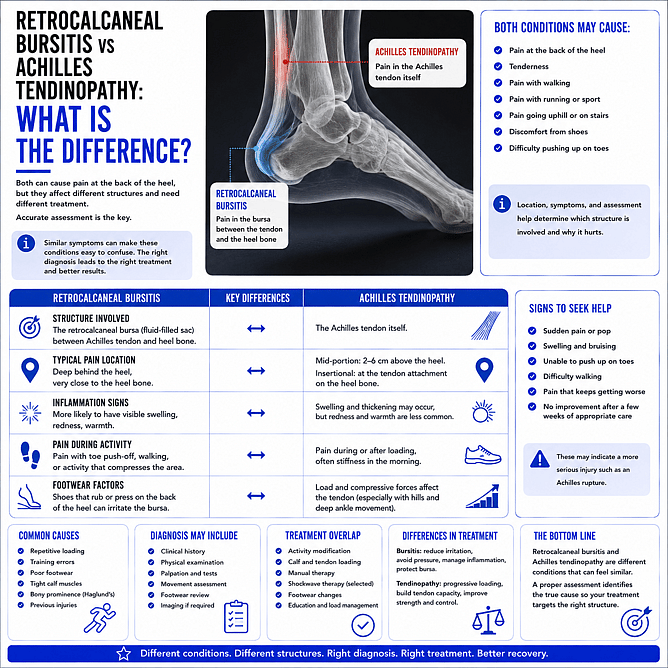
What Is Retrocalcaneal Bursitis?
A bursa is a small fluid-filled sac that helps reduce friction between tissues.
The retrocalcaneal bursa sits between:
The Achilles tendon
The heel bone, or calcaneus
It allows the Achilles tendon to move near the heel bone with less friction. When this bursa becomes irritated or inflamed, the condition is called retrocalcaneal bursitis.
Retrocalcaneal bursitis often develops gradually rather than from one specific injury. Repetitive stress from walking and running can contribute to irritation in the space between the Achilles tendon and heel bone.
Possible symptoms include:
Pain at the back of the heel
Swelling
Redness
Warmth
Pain when pushing onto the toes
Difficulty walking
Limping when symptoms are more irritated
These features can overlap with Achilles tendon problems, which is why the diagnosis may not be obvious from symptoms alone.
What Is Achilles Tendinopathy?
Achilles tendinopathy affects the Achilles tendon itself.
The Royal National Orthopaedic Hospital describes tendinopathy as pain, swelling or impaired function affecting a tendon and divides Achilles tendinopathy into two main types.
Mid-Portion Achilles Tendinopathy
This usually affects the tendon:
Approximately 2–6 cm above its attachment to the heel
Through the central portion of the Achilles
Common symptoms may include:
Tendon pain
Morning stiffness
Tenderness
Thickening
Pain during or after activity
The pain location is generally higher than the area affected by retrocalcaneal bursitis.
Insertional Achilles Tendinopathy
This affects:
The lowest portion of the Achilles
Directly where the tendon attaches to the heel bone
Because this area is so close to the retrocalcaneal bursa, insertional Achilles tendinopathy is the Achilles condition most likely to be confused with retrocalcaneal bursitis.
The Biggest Difference: Bursa vs Tendon
The clearest difference is the tissue involved.
Retrocalcaneal Bursitis
The painful structure is primarily:
The retrocalcaneal bursa
Between the Achilles tendon and heel bone
The condition involves irritation or inflammation within this small fluid-filled sac.
Achilles Tendinopathy
The painful structure is primarily:
The Achilles tendon itself
In mid-portion tendinopathy, symptoms occur higher in the tendon. In insertional tendinopathy, symptoms occur directly at the tendon-to-bone attachment.
This distinction matters because treatment should be directed towards the structure and loading problem involved rather than treating every form of back-of-heel pain identically.
Where Does Retrocalcaneal Bursitis Hurt?
Retrocalcaneal bursitis usually causes pain deep behind the heel, close to the space between the Achilles tendon and the heel bone.
Patients may describe:
Deep pain behind the Achilles
Swelling around the heel
Tenderness close to the tendon attachment
Redness or warmth
Pain when rising onto tiptoes
Difficulty walking comfortably
The swelling may sometimes make the area look visibly irritated.
That visible inflammatory appearance can be one clue that bursitis may be involved, although insertional Achilles tendinopathy can also occasionally produce redness or warmth.
Where Does Achilles Tendinopathy Hurt?
The location depends on the type.
Mid-Portion Achilles Pain
Usually:
Approximately 2–6 cm above the heel
Through the tendon itself
This is clearly higher than the retrocalcaneal bursa.
Insertional Achilles Pain
Usually:
Directly where the Achilles meets the heel bone
Very low at the back of the heel
Insertional tendinopathy therefore overlaps much more closely with the location of retrocalcaneal bursitis.
A useful location guide is:
2–6 cm above the heel: mid-portion Achilles tendinopathy becomes more likely
Directly at the tendon attachment: insertional Achilles tendinopathy becomes more relevant
Deep between the tendon and heel bone: retrocalcaneal bursitis becomes an important possibility
These are clues rather than a diagnosis.
Does Swelling Mean Retrocalcaneal Bursitis?
Not necessarily.
Retrocalcaneal bursitis commonly causes swelling, redness or warmth around the back of the heel.
However, Achilles tendinopathy can also involve swelling, tenderness or tendon thickening.
The appearance of swelling can still provide useful information.
With bursitis, the irritation may feel deeper around the space between the tendon and heel.
With Achilles tendinopathy, swelling or thickening may feel more closely associated with the tendon itself.
A clinical examination may help determine which structure is producing the symptoms.
What Does Morning Stiffness Suggest?
Morning stiffness is particularly common in Achilles tendinopathy.
Patients may report:
Stiffness during the first steps after getting out of bed
Pain after sitting for a long period
Symptoms easing after several minutes of walking
Pain returning after prolonged activity
RNOH identifies morning stiffness as a common symptom of Achilles tendinopathy, while Kent Community Health reports a similar pattern specifically with insertional Achilles tendinopathy.
Morning stiffness therefore supports an Achilles tendon presentation, but it does not completely rule out bursitis or overlapping conditions.
The full symptom pattern still matters.
Can Both Conditions Hurt When Walking?
Yes.
Retrocalcaneal bursitis can make walking uncomfortable and can lead to a limping gait when symptoms are more irritated.
Insertional Achilles tendinopathy can also become increasingly painful with prolonged walking, even when symptoms initially ease after the first few minutes of movement.
This is another reason symptoms cannot reliably be distinguished by simply asking:
“Does walking hurt?”
More useful questions include:
Exactly where does it hurt?
Is there swelling?
Is the area warm or red?
Is morning stiffness present?
Does footwear pressure aggravate it?
Are hills worse than flat walking?
Is the tendon itself tender?
Did symptoms begin gradually or suddenly?
Why Hills Can Aggravate Both Conditions
Hills can be particularly uncomfortable when the problem is close to the heel attachment.
Insertional Achilles tendinopathy involves compression between the Achilles tendon and heel bone, and incline walking can increase that compression. Kent Community Health specifically notes that uphill walking and small inclines can aggravate insertional Achilles symptoms.
Retrocalcaneal bursitis can also be aggravated by running and repetitive loading, with NHS musculoskeletal guidance noting that hill running may be particularly difficult during an irritated stage.
A patient may therefore experience pain during:
Uphill walking
Hill running
Stairs
Repeated push-off
Longer periods of walking
The fact that hills hurt does not automatically tell you which of the two conditions is present.
Why Shoes Can Aggravate Back-of-Heel Pain
Footwear is another major area of overlap.
Retrocalcaneal bursitis can be aggravated by pressure against the back of the heel. NHS guidance recommends supportive footwear and suggests that cushioned shoes with a softer heel area may be easier to tolerate, while very hard heel areas can aggravate symptoms.
Achilles tendinopathy can also be affected by footwear. RNOH lists footwear among the factors associated with Achilles tendinopathy and notes that a painful tendon lump may rub against shoes or boots.
Insertional Achilles symptoms may be particularly sensitive to footwear because the painful tendon attachment sits directly at the back of the heel.
If shoes consistently aggravate the area, useful things to review include:
Heel-counter pressure
Cushioning
Overall shoe fit
Heel position
Whether the shoe rubs the painful area
Whether symptoms differ significantly between shoes
Footwear can be a contributor without necessarily being the whole cause.
Can Retrocalcaneal Bursitis and Achilles Tendinopathy Occur Together?
Yes, they can affect neighbouring structures and may form part of the same posterior heel pain presentation.
The Achilles insertion sits immediately beside the retrocalcaneal bursa, meaning irritation in this region does not always respect neat textbook boundaries. Haglund-related posterior heel problems are also described as involving combinations of a bony prominence, insertional Achilles pathology and retrocalcaneal bursitis.
This means a patient may have:
Mainly insertional Achilles tendinopathy
Mainly retrocalcaneal bursitis
Features of both
Another posterior heel condition contributing at the same time
That overlap is one of the strongest reasons not to self-diagnose persistent pain behind the heel based on a single symptom.
What About Haglund’s Deformity?
A prominent area of bone at the back of the heel can contribute to irritation around the Achilles insertion and retrocalcaneal bursa.
NHS orthopaedic guidance describes Haglund’s syndrome as involving a combination that can include a bony prominence, insertional Achilles tendinopathy and retrocalcaneal bursitis.
This can become particularly relevant when patients report:
A visible bump behind the heel
Pain from closed-backed shoes
Recurrent swelling
Tenderness around the Achilles insertion
Difficulty finding comfortable footwear
The presence of a bump does not automatically determine which structure is producing the pain.
Clinical assessment is still needed.
How Are Retrocalcaneal Bursitis and Achilles Tendinopathy Diagnosed?
Both conditions are often assessed clinically before imaging is considered.
NHS musculoskeletal guidance states that retrocalcaneal bursitis can usually be diagnosed through physical examination and that scans are not routinely required unless symptoms fail to improve or more invasive treatment is being considered.
RNOH similarly states that clinical examination is usually sufficient for Achilles tendinopathy, with ultrasound or MRI considered when clinically indicated.
Assessment may include:
Exact pain location
Palpation of the tendon
Assessment around the bursa
Swelling
Redness or warmth
Morning stiffness
Heel-raise function
Walking tolerance
Hills and stairs
Footwear pressure
Running or sports activity
Calf strength
Ankle movement
Previous treatment
The goal is to determine not simply where the heel hurts, but which structure is actually producing the symptoms.
Does Retrocalcaneal Bursitis Need a Scan?
Not always.
Physical examination is commonly sufficient for retrocalcaneal bursitis. Imaging may become more relevant when symptoms fail to improve, the diagnosis remains unclear, or procedures such as injection or surgery are being considered.
That means every patient with swelling behind the heel does not automatically need an ultrasound or MRI.
Imaging should answer a clinical question rather than simply being ordered because pain exists.
Does Achilles Tendinopathy Need a Scan?
Again, not automatically.
RNOH notes that Achilles tendinopathy is usually diagnosed clinically. Ultrasound or MRI may be considered where the clinical presentation requires further clarification.
Imaging may become more relevant when:
The diagnosis is uncertain
A significant tendon injury is suspected
Symptoms are not improving as expected
There was a sudden injury
Another condition needs to be ruled out
A scan supports the assessment rather than replacing it.
Is Treatment Different?
Yes, although there can be overlap.
Both conditions may involve:
Load modification
Appropriate footwear
Rehabilitation
Gradual return to activity
But the emphasis can differ depending on the structure involved.
Retrocalcaneal Bursitis Treatment May Focus On
Reducing irritation around the bursa
Temporarily reducing activities that aggravate symptoms
Avoiding unnecessary pressure against the back of the heel
Supportive footwear
Rehabilitation of surrounding muscles
Insoles where appropriate
Gradual reintroduction of activity
NHS Bexley guidance recommends load management, supportive footwear, rehabilitation, and insoles in selected cases.
Achilles Tendinopathy Treatment May Focus On
Managing contributing loads
Progressive strengthening
Tendon-loading rehabilitation
Balance and stability
Footwear
Orthotics where appropriate
Shockwave therapy in selected cases
Gradual return to sport
RNOH includes physiotherapy, strengthening, orthotics where biomechanics contribute, and shockwave among conservative treatment options.
The correct treatment should therefore follow the diagnosis.
Why Rehabilitation Still Matters With Bursitis
It may be tempting to think of bursitis only as inflammation that needs rest.
However, prolonged rest is not automatically the complete solution.
NHS Bexley recommends relative rest during more irritated stages but also advises against resting for too long. Exercise should then be reintroduced gradually, and rehabilitation of surrounding muscles is considered an important component of treatment.
This creates a similar principle to many Achilles conditions:
reduce excessive irritation → maintain appropriate movement → rebuild capacity → gradually return to normal activity.
The specific exercises and progression should still match the individual presentation.
Is Shockwave Therapy Used for Both Conditions?
Shockwave therapy is recognised as one potential conservative option for Achilles tendinopathy, including selected persistent cases. RNOH lists shockwave as one of its treatment options for Achilles tendinopathy, while Kent Community Health also includes it in management of insertional Achilles tendinopathy.
Shockwave should not be treated as proof that two conditions are identical or as a stand-alone solution.
The diagnosis, load management, rehabilitation, footwear and other contributing factors still matter.
For this comparison blog, keep shockwave as a supporting treatment topic and link readers to the dedicated Shockwave Therapy page rather than trying to make this another shockwave article.
What About Steroid Injection for Retrocalcaneal Bursitis?
Steroid injection may sometimes be discussed for persistent retrocalcaneal bursitis, but this area requires caution because of the neighbouring Achilles tendon.
NHS Bexley specifically warns that steroid injection around retrocalcaneal bursitis carries a risk of Achilles tendon tear or rupture and describes it as something generally reserved for later consideration when symptoms have not settled adequately.
This is not something this blog should promote as a routine first-line treatment.
The page should encourage proper assessment and discussion of risks and alternatives.
What if the Pain Is 2–6 cm Above the Heel?
If the pain is clearly several centimetres above the heel rather than deep at the back of the heel, mid-portion Achilles tendinopathy becomes more relevant.
RNOH defines mid-portion Achilles tendinopathy as occurring approximately 2–6 cm above the tendon’s heel attachment.
Typical clues may include:
Pain within the tendon
Morning stiffness
Tendon tenderness
Thickening
Symptoms associated with running or jumping
This is a different search pathway from retrocalcaneal bursitis.
Link patients with this pain pattern to the dedicated Pain 2–6 cm Above the Heel blog and the Mid-Portion Achilles Tendinopathy service page.
What if the Pain Is Directly Where the Achilles Meets the Heel?
Pain directly at the tendon-to-bone attachment is more consistent with insertional Achilles tendinopathy than mid-portion tendinopathy.
Common clues include:
Pain directly at the attachment
Stiffness after rest
Pain with prolonged walking
Symptoms during hills
Occasional redness or warmth
Because the retrocalcaneal bursa sits immediately beside this region, assessment may still be needed to distinguish tendon involvement from bursal irritation.
Link this section to the Pain Where the Achilles Meets the Heel blog and the Insertional Achilles Tendinopathy service page.
What if the Heel Is Red, Hot and Swollen?
Redness, warmth and swelling can occur with retrocalcaneal bursitis and can occasionally occur around insertional Achilles tendinopathy.
However, marked or rapidly worsening swelling, redness, severe pain, systemic illness, or an unexplained sudden change deserves medical assessment rather than assuming the problem is a routine overuse injury.
Similarly, sudden Achilles pain combined with major weakness or difficulty walking raises concern for a more significant tendon injury.
When Sudden Achilles Pain Needs Urgent Assessment
Retrocalcaneal bursitis and tendinopathy usually develop more gradually.
A sudden Achilles injury is different.
Seek urgent assessment if you experience:
A sudden pop or snap
Severe sudden pain
A sensation of being struck in the back of the leg
Major weakness
Difficulty walking
Difficulty bearing weight
Inability to stand normally on tiptoe
Rapid bruising or swelling
Health New Zealand advises urgent assessment for sudden severe Achilles pain accompanied by difficulty walking, especially when there has been a snap, crack or sensation of being hit in the leg, because these features can indicate an Achilles rupture.
Do not continue exercising simply to test whether the tendon still works.
What an Assessment for Back-of-Heel Pain May Include
Assessment may consider:
Exact location of the pain
Whether pain feels superficial or deep
Tendon tenderness
Bursal tenderness
Visible swelling
Redness or warmth
Morning stiffness
Pain after rest
Walking tolerance
Tiptoe or heel-raise function
Hills and stairs
Running and sports demands
Footwear
Calf strength
Ankle movement
Existing orthotics
Previous treatment
Both retrocalcaneal bursitis and Achilles tendinopathy can often be assessed clinically before imaging is required.
The aim is to answer:
Is the pain mainly coming from the bursa, the Achilles tendon, or a combination of structures?
Retrocalcaneal Bursitis and Achilles Pain Care in Auckland
oot Foundation currently has four Auckland clinic locations:
Remuera – Suite 5/102 Remuera Road
Smales Farm – 74 Taharoto Road, Takapuna
Pinehill – 50 Greville Road
Botany – 110 Michael Jones Drive, Flat Bush
Foot Foundation provides podiatry, foot and ankle care and rehabilitation services across its clinic network.
Patients experiencing pain or swelling behind the heel can seek assessment to help distinguish between Achilles tendon involvement, retrocalcaneal bursitis and other causes of posterior heel pain.
Retrocalcaneal Bursitis and Achilles Pain Care in Hamilton
Foot Foundation's Hamilton locations are:
Hamilton Central – 7/127 Collingwood Street
Hamilton East – 16 Beale Street
These are both listed among Foot Foundation's current clinic network.
Patients experiencing persistent back-of-heel pain, Achilles symptoms, walking discomfort or recurring foot and ankle concerns can seek assessment, with specific treatment and rehabilitation availability confirmed when booking.
Retrocalcaneal Bursitis and Achilles Pain Care in Tauranga
Foot Foundation's Tauranga clinic is:
Tauranga Bethlehem – 253A State Highway 2
The Bethlehem clinic is part of Foot Foundation's current network across Auckland, Hamilton and Tauranga.
Patients experiencing pain behind the heel, Achilles-related symptoms, footwear discomfort or persistent walking pain can book an assessment to identify the appropriate treatment pathway.
When Should You Book a Back-of-Heel Pain Assessment?
Consider an assessment if:
Pain behind the heel persists
Swelling keeps returning
Shoes repeatedly aggravate the area
Hills or stairs are becoming difficult
Morning stiffness is increasing
Running repeatedly causes symptoms
You cannot tell whether the pain is tendon or bursa related
Rest only gives temporary improvement
Previous exercises have not helped
Symptoms interfere with walking, work or sport
Both Achilles tendinopathy and retrocalcaneal bursitis can often improve with conservative management, but the appropriate programme depends on identifying the structure involved.
Sudden pain with a pop, major weakness or difficulty walking should be treated as a separate urgent problem rather than routine bursitis or tendinopathy.
Book an Assessment for Pain Behind the Heel
Retrocalcaneal bursitis and Achilles tendinopathy can feel similar because the affected structures sit immediately beside one another.
The central difference is:
Retrocalcaneal bursitis affects the bursa between the Achilles tendon and heel bone.
Achilles tendinopathy affects the Achilles tendon itself.
Pain higher in the tendon may suggest mid-portion Achilles tendinopathy. Pain directly at the heel attachment may suggest insertional Achilles tendinopathy. Deeper pain and swelling around the space between the tendon and heel can make retrocalcaneal bursitis more relevant.
Because these presentations can overlap, assessment is often more useful than repeatedly treating the area based on symptoms alone.
Foot Foundation provides podiatry and foot and ankle care across its Auckland, Hamilton and Tauranga clinic network.
Frequently Asked Questions
What Is the Main Difference Between Retrocalcaneal Bursitis and Achilles Tendinopathy?
Retrocalcaneal bursitis affects the fluid-filled bursa between the Achilles tendon and heel bone. Achilles tendinopathy affects the tendon itself.
Where Does Retrocalcaneal Bursitis Hurt?
The retrocalcaneal bursa sits between the Achilles tendon and the heel bone, so pain is generally felt deep at the back of the heel. Swelling, redness or warmth can also occur.
Where Does Insertional Achilles Tendinopathy Hurt?
Insertional Achilles tendinopathy affects the lower Achilles directly where it attaches to the heel bone.
Where Does Mid-Portion Achilles Tendinopathy Hurt?
Mid-portion Achilles tendinopathy typically affects the tendon approximately 2–6 cm above the heel attachment.
Can Bursitis and Achilles Tendinopathy Happen Together?
They can affect neighbouring structures, and posterior heel presentations such as Haglund-related problems may involve both insertional Achilles pathology and retrocalcaneal bursitis.
Does Redness Mean I Have Bursitis?
Not necessarily. Redness and warmth are recognised features of retrocalcaneal bursitis, but they can occasionally occur around insertional Achilles tendinopathy as well.
Do Shoes Make Both Conditions Worse?
They can. Pressure against the back of the heel may aggravate retrocalcaneal bursitis, while footwear is also recognised as a factor in Achilles tendinopathy and may rub against a tender or thickened tendon.
Do I Need a Scan to Tell the Difference?
Not always. Both conditions can often be assessed clinically. Imaging may be considered if the diagnosis is unclear, symptoms are not improving or another injury needs to be ruled out.
When Is Back-of-Heel Pain Urgent?
A sudden pop or snap, severe pain, major weakness, difficulty walking or inability to use the foot normally warrants urgent assessment for a possible Achilles rupture or other significant injury.