Why Footwear Matters With Insertional Achilles Tendinopathy
Insertional Achilles tendinopathy causes pain where the Achilles tendon attaches directly to the heel bone. Unlike mid-portion Achilles tendinopathy, which typically affects the tendon several centimetres higher, insertional symptoms occur at the lowest part of the tendon close to the back of the heel.
This location makes footwear particularly relevant.
A shoe can place direct pressure against the painful area, while the shape and heel position of the shoe can also change how the Achilles insertion is loaded.
Royal United Hospitals Bath specifically advises that the heel cup of a shoe can contribute to persistent heel pain and that softer heel cups which do not rub or press against the back of the heel can be helpful. Well-fitted footwear that supports the foot and cushions the heel may also improve comfort.
That does not mean there is one perfect shoe for everyone with insertional Achilles tendinopathy.
The right footwear depends on:
Where the shoe contacts the heel
How irritable the tendon is
Walking and running demands
Foot shape
Existing orthotics
Work requirements
Sport
Current rehabilitation stage
Footwear can help reduce aggravation, but it is usually only one part of managing insertional Achilles pain.
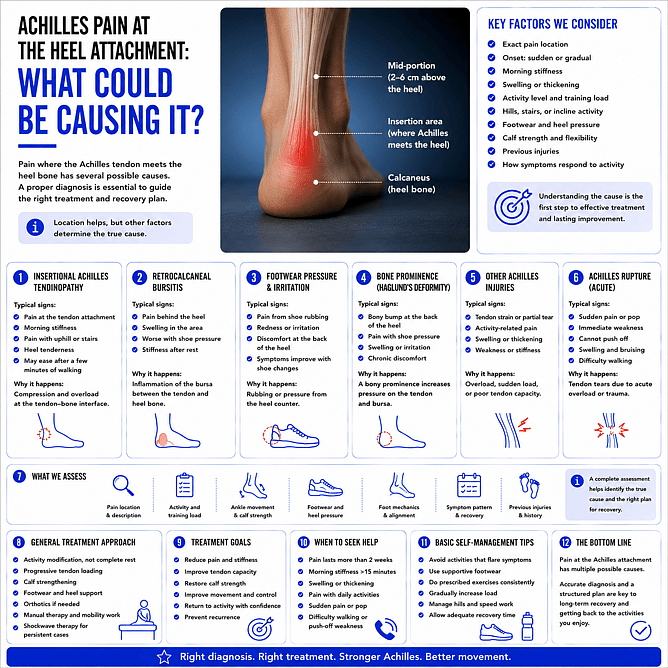
What Is Insertional Achilles Tendinopathy?
Insertional Achilles tendinopathy affects the lower Achilles tendon where it attaches to the heel bone. Mid-portion tendinopathy, by comparison, occurs approximately 2–6 cm above that attachment.
Common symptoms may include:
Pain directly at the back of the heel
Morning stiffness
Tenderness at the tendon attachment
Pain when first walking after rest
Pain after prolonged walking
Symptoms with hills or stairs
Discomfort from pressure against the back of the shoe
Swelling or thickening around the heel
Kent Community Health NHS describes insertional Achilles symptoms as pain and stiffness at the back of the heel where the tendon joins the heel bone. Symptoms may initially ease after a few minutes of walking but return with prolonged activity.
The important point is that footwear pressure can aggravate the condition without necessarily being the only reason it developed.
How Can Shoes Aggravate the Achilles Insertion?
There are several ways footwear can contribute to symptoms.
Pressure From the Heel Cup
The rear section of a shoe wraps around the heel.
If that area is:
Very rigid
Poorly fitted
Pressing directly against the Achilles insertion
Rubbing during walking
Compressing a swollen or prominent heel
it may continually irritate an already sensitive area.
Royal United Hospitals Bath advises that softer heel cups that avoid rubbing or direct pressure can be helpful for insertional Achilles pain.
This is particularly relevant when the patient says:
“My Achilles is not too bad barefoot, but my shoes make it hurt.”
That information can be useful during assessment.
Can Very Flat Shoes Make Insertional Achilles Pain Worse?
They can for some patients.
Clinical guidance from NHS services notes that very flat footwear may aggravate insertional Achilles symptoms. A modest heel elevation or heel lift may sometimes be used to reduce stress and compression around the Achilles insertion.
The reason relates partly to ankle position.
When the ankle moves further upwards into dorsiflexion, the insertional Achilles can be compressed more strongly against the heel bone. Raising the heel slightly may reduce this compression in selected patients.
This does not mean everyone with insertional Achilles pain should permanently wear high-heeled shoes.
It means that extremely flat footwear may not be comfortable during a painful stage and that heel height can be one factor considered during footwear assessment.
What Shoe Features May Help?
There is no universal “best shoe”, but certain features may make footwear easier to tolerate.
A Softer Heel Cup
This is one of the most important features when direct shoe pressure aggravates symptoms.
Look for footwear where the back of the shoe:
Does not dig into the tendon
Does not rub the painful area
Has softer padding
Fits securely without excessive pressure
Does not sit directly on a prominent tender area
Royal United Hospitals Bath specifically recommends softer heel cups that avoid rubbing or pressing against the back of the heel.
Good Heel Cushioning
Cushioning may improve comfort during walking and standing.
RUH advises well-fitted footwear that supports the foot and cushions the heel, and notes that some people obtain relief from gel heel cups or pads placed inside footwear.
The aim is not simply to find the softest shoe available.
Too much softness without adequate stability may not suit every person or activity.
Comfort, support, fit, and function all need to be considered.
A Modest Heel-to-Toe Difference
For some people, footwear with a modest elevation under the heel may feel better than completely flat shoes.
NHS insertional Achilles guidance notes that flat footwear may aggravate symptoms and that heel elevation or a heel lift can sometimes reduce tendon stress.
This may be particularly relevant during:
Walking
Work
Early rehabilitation
Flare-ups
Activities that repeatedly aggravate symptoms
The exact amount should be individualised rather than treating one measurement as correct for everyone.
Secure Fit
Shoes should fit well enough that the foot is not sliding around inside them.
A poor fit can increase:
Heel movement
Friction
Rubbing
Pressure
Compensatory movement
RUH recommends well-fitted shoes that provide support and heel cushioning.
The shoe should feel secure without clamping painfully against the Achilles insertion.
Are Open-Backed Shoes Better?
Removing pressure from the back of the heel can sometimes feel more comfortable during an irritable stage.
However, open-backed footwear is not automatically the best long-term answer.
Different activities need different levels of:
Stability
Protection
Grip
Support
Secure fastening
A sandal that removes Achilles pressure may feel comfortable around the house but may be unsuitable for running, long-distance walking, physical work, or uneven ground.
The better principle is:
reduce unnecessary pressure at the painful insertion while still choosing footwear suitable for the activity.
What About Running Shoes?
Runners with insertional Achilles pain should not assume they need to stop using running shoes or immediately change brands.
Instead, review whether the current shoe is contributing.
Questions to ask include:
Does the heel counter press against the painful area?
Is the shoe very flat?
Did symptoms start after changing shoes?
Is the shoe worn out?
Is the heel lining damaged?
Does one pair hurt substantially more than another?
Does the shoe fit securely?
Are orthotics changing how the heel sits inside the shoe?
Footwear is one recognised factor associated with Achilles tendinopathy, but activity changes and other mechanical or health factors can also contribute.
The shoe should therefore be reviewed in context rather than blamed automatically.
Should You Change Running Shoes Immediately?
Not necessarily.
Changing too many things at once can make it difficult to understand what actually affects symptoms.
For example, a runner might simultaneously:
Buy different shoes
Add heel lifts
Begin orthotics
Stop running
Start new exercises
Change running technique
Then it becomes difficult to identify which change helped or aggravated the Achilles.
A clearer process is:
Confirm the Achilles presentation.
Review current footwear.
Identify direct pressure or obvious shoe-related aggravation.
Adjust the most relevant factors.
Monitor symptoms.
Progress rehabilitation alongside footwear changes.
This creates a much more controlled treatment pathway.
Can Heel Lifts Help Insertional Achilles Pain?
Heel lifts may help selected patients.
Kent Community Health NHS notes that a heel lift can reduce compression and overall tension on the tendon, which may help reduce pain. Their guidance also advises wearing a heel raise in both shoes rather than only on the painful side.
Potential reasons for using a heel lift may include:
Reducing compression at the insertion
Temporarily reducing tendon demand
Improving comfort during walking
Helping during a painful rehabilitation stage
But heel lifts should not become a substitute for rebuilding tendon capacity.
They are better viewed as a load-management tool, not a cure.
Should Heel Lifts Be Permanent?
Not automatically.
The role of a heel lift depends on:
Symptoms
Footwear
Current rehabilitation stage
Activity demands
Ankle movement
Long-term footwear needs
A heel lift may be useful temporarily while symptoms settle and rehabilitation progresses.
Some people may have reasons to continue using one for longer.
The decision should be reviewed rather than assuming that everyone with insertional Achilles tendinopathy needs a permanent heel lift.
Can Gel Heel Cups Help?
Some people may find heel cups or pads useful for comfort.
Royal United Hospitals Bath notes that gel heel cups or pads inserted into shoes may help some people with heel pain.
These may:
Add cushioning
Modify how the heel sits in the shoe
Reduce local irritation
Make certain footwear easier to tolerate
However, adding anything inside the shoe also takes up space.
If the shoe is already tight around the heel, inserting a pad may sometimes increase pressure rather than reduce it.
This is why the full shoe fit needs to be considered.
Can Orthotics Help?
Orthotics may be appropriate when foot mechanics contribute to Achilles loading.
The Royal National Orthopaedic Hospital notes that altered foot biomechanics, including very high or low arches, can contribute to Achilles tendon strain and that an orthotic may be appropriate in selected cases.
Orthotics may potentially support:
Foot mechanics
Pressure distribution
Walking comfort
Load management
But orthotics should not automatically be prescribed simply because someone has insertional Achilles tendinopathy.
Assessment should determine whether they have a meaningful role.
Can Orthotics Make the Shoe Fit Differently?
Yes.
Adding an orthotic changes the internal space of the shoe.
This can affect:
Heel height
Heel position
Shoe depth
Pressure around the Achilles
How securely the heel sits
For someone with insertional Achilles pain, this matters because an orthotic that raises the heel slightly may change where the shoe collar contacts the tendon.
The footwear and orthotic should therefore work together.
A good orthotic inside the wrong shoe can still create problems.
Should You Avoid Hard Heel Counters?
A rigid heel counter is not inherently bad.
Many supportive shoes use structured heel counters to improve stability.
The issue is whether that structure is pressing directly against the patient's painful Achilles insertion.
If the back of the shoe repeatedly:
Rubs the tendon
Creates redness
Causes tenderness
Produces pain soon after walking
then a softer or differently shaped heel area may be worth considering.
The goal is not to label all structured footwear as bad.
The goal is to eliminate unnecessary direct pressure on an already irritated area.
What About Work Boots?
Work boots can be challenging because they may have:
Rigid heel counters
Thick seams
Heavy materials
Limited cushioning
Safety requirements
Less flexibility in footwear choice
Someone who can comfortably manage symptoms in trainers may still develop pain during a full workday in boots.
An assessment may therefore need to consider:
Required workplace footwear
Heel-counter position
Internal padding
Insoles or orthotics
Heel support
Wear patterns
Possibility of footwear modification
Footwear recommendations must be realistic. Telling someone to avoid work boots completely is useless if their job legally requires safety footwear.
Why Hills and Shoes Can Be a Difficult Combination
Insertional Achilles tendinopathy can be aggravated by compression around the heel attachment.
Very flat footwear can place the ankle into a position that may increase stress on the Achilles, while uphill walking also increases ankle dorsiflexion. NHS insertional Achilles guidance therefore includes reducing incline activity and reviewing footwear as part of symptom management.
A patient may therefore notice:
Flat walking is manageable
Hills cause pain
Flat shoes make hills worse
A more suitable shoe reduces discomfort
This pattern can provide useful information during assessment.
Footwear Alone Does Not Rehabilitate the Tendon
This is the most important message on the page.
The right shoe may reduce irritation.
It does not automatically rebuild:
Calf strength
Achilles tendon capacity
Endurance
Movement control
Running tolerance
Walking capacity
Conservative management for Achilles tendinopathy commonly includes rehabilitation and progressive strengthening, with footwear or orthotics used as supporting components where appropriate.
RUH also recommends several months of consistent strengthening exercises for insertional Achilles tendinopathy, showing that footwear changes and rehabilitation work together rather than replacing one another.
What Should Rehabilitation Include?
The exact programme depends on symptoms and clinical assessment.
Rehabilitation may progressively address:
Calf strength
Achilles loading
Muscular endurance
Walking tolerance
Balance
Return to running
Return to sport
Insertional Achilles programmes often need to manage compression differently from mid-portion Achilles programmes. RNOH specifically warns that some exercises should be avoided for insertional presentations, reinforcing why exercises should match the pain location and diagnosis.
That is why generic online Achilles programmes should be used cautiously.
Do You Need to Stop Walking or Running?
Not everyone needs complete inactivity.
During an irritable stage, aggravating activities may need to be reduced temporarily. RUH advises limiting aggravating activity in the short term and then progressively rebuilding activity as symptoms improve.
Depending on symptoms, modifications may involve:
Shorter walks
Reduced running
Fewer hills
Less stair training
Reduced jumping
More recovery between sessions
The goal is usually to find a manageable level of activity and progressively build from there.
When Footwear Changes Are Not Enough
Get the Achilles assessed if:
Several pairs of shoes cause pain
Symptoms persist even without footwear pressure
Morning stiffness is increasing
The heel remains swollen
Pain returns whenever walking increases
Hills or stairs are becoming difficult
You cannot progress running
Heel lifts only give temporary relief
Previous exercises have not helped
You are unsure whether the pain is tendon or bursa related
Footwear may be a contributor without being the main driver of the problem.
A proper assessment can help determine what else needs attention.
Could It Be Retrocalcaneal Bursitis Instead?
Yes.
Pain from the retrocalcaneal bursa can occur in a similar area behind the heel.
Insertional Achilles tendinopathy affects the tendon where it attaches to the heel bone, while retrocalcaneal bursitis involves the bursa between the tendon and heel.
Both may be aggravated by footwear.
Clues that another structure may be involved include:
More obvious swelling
Redness or warmth
Deep heel pain
Pain from squeezing around the back of the heel
Because the symptoms can overlap, persistent posterior heel pain should not automatically be labelled insertional Achilles tendinopathy.
What About a Bony Bump at the Back of the Heel?
A prominent area at the back of the heel can create additional problems with footwear.
The Royal Orthopaedic Hospital notes that insertional Achilles tendinopathy may occur alongside Haglund's deformity and that conservative management may include alterations to footwear, orthoses, physiotherapy and shockwave therapy before surgery is considered.
The practical footwear problem is straightforward:
A prominent heel occupies more space and may contact the back of the shoe more aggressively.
This may make:
Rigid heel counters
Narrow heel cups
Tight boots
Hard seams
more difficult to tolerate.
Assessment can help determine whether the bump itself is clinically relevant to the symptoms.
Does Insertional Achilles Tendinopathy Need a Scan?
Not automatically.
RNOH states that clinical examination is usually sufficient for Achilles tendinopathy, although ultrasound or MRI may be used when imaging is clinically indicated.
Imaging may be considered if:
The diagnosis is unclear
A significant tendon injury is suspected
Symptoms have not improved as expected
There was a sudden injury
Another condition needs to be ruled out
Footwear assessment is important, but it should still sit within the wider clinical picture.
Warning Signs That Are Not Just a Shoe Problem
A painful shoe does not explain every Achilles injury.
Seek urgent assessment if symptoms involve:
Sudden severe pain
A pop or snapping sensation
Sudden loss of push-off strength
Major difficulty walking
Inability to stand on tiptoe
Rapid swelling or bruising
Health New Zealand identifies these types of symptoms as warning signs of an Achilles rupture, which requires urgent assessment rather than simply changing footwear.
Shoes for Insertional Achilles Tendinopathy in Auckland
Foot Foundation provides assessment for insertional Achilles pain and footwear-related heel concerns across its Auckland clinics:
Remuera
Smales Farm
Botany
Pinehill
Patients may seek assessment for:
Pain from shoe pressure against the Achilles
Insertional Achilles tendinopathy
Pain at the back of the heel
Recurring heel irritation
Running-related Achilles pain
Work footwear concerns
Orthotic or heel-lift needs
Difficulty returning to activity
Insertional Achilles Care in Hamilton
Foot Foundation provides foot and ankle care in Hamilton at:
Hamilton Central – 7/127 Collingwood Street
Hamilton East – 16 Beale Street
Patients experiencing Achilles pain from footwear, heel attachment pain, walking discomfort, running-related tendon symptoms, or persistent posterior heel pain can access assessment and treatment support.
Service and clinician availability should be confirmed when booking.
Insertional Achilles Care in Tauranga
Foot Foundation provides podiatry care in Tauranga at:
Tauranga Bethlehem – 253A State Highway 2
Patients experiencing pain where shoes contact the Achilles, recurring heel irritation, walking pain, running-related Achilles symptoms or difficulty finding comfortable footwear can book an assessment to identify the appropriate management pathway.
Service and clinician availability should be confirmed when booking.
What Should You Bring to a Footwear Assessment?
Bring the actual shoes that matter.
Useful footwear may include:
Everyday shoes
Running shoes
Work shoes
Safety boots
Walking shoes
Sports footwear
Current orthotics
Heel lifts already being used
This makes it easier to assess:
Where the heel counter sits
Whether the tendon is being rubbed
Shoe wear
Available internal space
Orthotic compatibility
Whether the heel is slipping
Whether the footwear suits the activity
Do not rely only on describing the shoe.
Seeing the footwear itself is more useful.
Book an Assessment for Insertional Achilles Pain From Shoes
Footwear can make a meaningful difference when insertional Achilles pain is aggravated by direct pressure against the back of the heel.
Features that may help include:
A softer heel cup
Good fit
Heel cushioning
Reduced direct pressure against the Achilles
Avoiding very flat footwear where it aggravates symptoms
Heel support where clinically appropriate
Orthotics where foot mechanics contribute
But changing shoes alone does not rebuild tendon capacity.
The strongest treatment pathway may combine:
Footwear assessment
Activity modification
Progressive Achilles rehabilitation
Strengthening
Heel support where appropriate
Orthotic therapy where appropriate
Gradual return to walking, running, or sport
Foot Foundation provides assessment and treatment for insertional Achilles pain across Auckland, Hamilton, and Tauranga.
Frequently Asked Questions
What Shoes Are Best for Insertional Achilles Tendinopathy?
There is no single best shoe for everyone. Footwear that fits well, cushions the heel, and avoids direct pressure or rubbing against the painful Achilles insertion may be easier to tolerate. RUH specifically recommends softer heel cups and well-fitted supportive footwear.
Should I Avoid Flat Shoes With Insertional Achilles Tendinopathy?
Very flat footwear may aggravate symptoms for some people. NHS insertional Achilles guidance notes that heel elevation or a heel lift may sometimes reduce Achilles stress and compression.
Should Shoes Have a Soft Back?
If pressure from the heel cup is aggravating the tendon, a softer heel cup may help reduce rubbing and direct pressure against the painful area.
Do Heel Lifts Help Insertional Achilles Tendinopathy?
Heel lifts may reduce compression and tension on the tendon in selected patients. Kent Community Health NHS advises using them in both shoes rather than only on one side.
Can I Wear Running Shoes With Insertional Achilles Tendinopathy?
Potentially. The key considerations are fit, heel-counter pressure, cushioning, heel position, and whether the shoe aggravates symptoms. There is no universal requirement to stop wearing running shoes.
Are Orthotics Helpful?
Orthotics may be appropriate when foot mechanics contribute to Achilles loading. RNOH lists orthotics among conservative options for selected patients with altered biomechanics.
Can Changing Shoes Fix Insertional Achilles Tendinopathy?
Footwear changes may reduce irritation, but Achilles rehabilitation commonly also involves progressive strengthening and management of other contributing factors.
What if Every Shoe Hurts My Achilles?
Persistent pain across different footwear, worsening morning stiffness, swelling, or difficulty walking or running suggests the condition deserves clinical assessment rather than endless shoe changes.