What Does Achilles Pain at the Heel Attachment Mean?
Pain directly where the Achilles tendon meets the heel bone is different from pain several centimetres higher up the tendon.
One common cause is insertional Achilles tendinopathy, which affects the lower portion of the Achilles where it attaches to the heel bone. By comparison, mid-portion Achilles tendinopathy typically affects an area approximately 2–6 cm higher up the tendon.
However, insertional Achilles tendinopathy is not the only possible cause of pain in this area.
Pain behind the heel can also be associated with:
Retrocalcaneal bursitis
Pressure from footwear
A prominent back of the heel
Other Achilles tendon injuries
Acute rupture in a sudden injury
Other causes of heel pain
That is why Achilles pain at the heel attachment should not be diagnosed from location alone. NHS guidance notes that several different conditions can cause heel pain, while sudden pain with swelling, a popping or snapping sensation, and difficulty walking may indicate a more serious injury such as an Achilles rupture.
At Foot Foundation, the aim is to identify which structure is causing the symptoms before deciding on the most appropriate treatment or rehabilitation pathway.
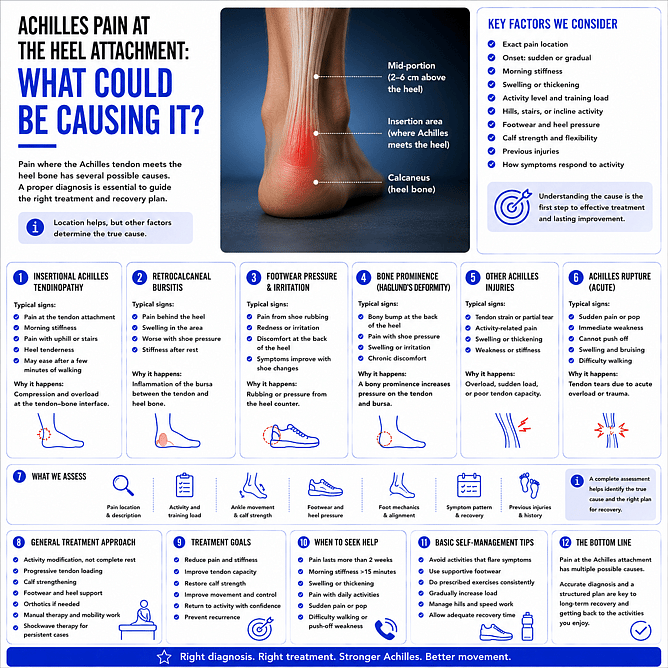
Where Does the Achilles Tendon Attach?
The Achilles tendon connects the calf muscles to the heel bone and plays an important role when walking, running, jumping and rising onto the toes. The lower portion of the tendon attaches directly to the back of the calcaneus, or heel bone.
This attachment area experiences substantial forces during everyday movement and sport.
Pain can be especially noticeable during activities involving:
Walking uphill
Running uphill
Climbing stairs
Squatting
Pushing off
Running
Jumping
Repeated loading of the calf and Achilles
For insertional Achilles tendinopathy specifically, compression between the tendon and the heel bone is considered an important contributor, particularly during uphill or incline activity.
What Is Insertional Achilles Tendinopathy?
Insertional Achilles tendinopathy affects the lower section of the Achilles tendon where it attaches to the heel bone.
This is an important distinction because it differs from mid-portion Achilles tendinopathy.
Mid-Portion Achilles Tendinopathy
Usually affects:
The central Achilles tendon
Approximately 2–6 cm above the heel attachment
Insertional Achilles Tendinopathy
Usually affects:
The lowest portion of the Achilles
Directly where the tendon meets the heel bone
The Royal National Orthopaedic Hospital specifically separates these two presentations by their location.
That difference also affects rehabilitation. Some exercises that may be used for a mid-portion problem can place excessive compression on the heel attachment and may need modification for insertional Achilles tendinopathy. RNOH specifically advises avoiding some of its deeper-range exercises when insertional tendinopathy is present.
Common Symptoms of Insertional Achilles Tendinopathy
Insertional Achilles tendinopathy commonly causes pain and stiffness directly at the back of the heel where the tendon attaches to the bone. Symptoms may be particularly noticeable during the first steps after rest, ease after walking for a short period, and then increase again with prolonged activity.
Possible symptoms include:
Pain directly at the Achilles attachment
Morning stiffness
Tenderness at the back of the heel
Pain after sitting or resting
Pain during prolonged walking
Pain with uphill walking
Pain during running
Pain climbing stairs
Discomfort from shoes pressing against the heel
Occasional redness or warmth
Thickening or swelling around the heel attachment
The key clue is where the symptoms are concentrated.
If the pain is several centimetres above the heel instead, mid-portion Achilles tendinopathy becomes a more relevant possibility.
Why Does the Achilles Hurt Where It Meets the Heel?
Insertional Achilles pain can develop when the lower Achilles repeatedly experiences more mechanical demand than it tolerates well.
One important factor is compression.
As the ankle bends upwards, particularly during uphill walking or similar movements, the Achilles insertion can be compressed against the heel bone. Kent Community Health NHS identifies this tendon-to-bone compression as a key factor in insertional Achilles tendinopathy.
Symptoms may therefore become more noticeable with:
Hills
Inclines
Stairs
Deep ankle positions
High training loads
Repetitive running
Shoes that irritate the back of the heel
This is one reason the location of Achilles pain matters so much. A rehabilitation plan developed for pain higher up the tendon cannot automatically be copied for pain at the insertion.
Why Hills Can Aggravate Pain at the Achilles Attachment
Hills are a common complaint among people with insertional Achilles pain.
Walking or running uphill increases the amount the ankle bends upwards. This can increase compression between the Achilles insertion and the heel bone. Kent Community Health NHS specifically recommends avoiding uphill walking or inclines during more painful stages of insertional Achilles tendinopathy.
Patients may notice that:
Flat walking is manageable
Stairs hurt more
Uphill walking causes symptoms quickly
Hill running causes a flare-up
Deep squatting feels uncomfortable behind the heel
This pattern is useful information during assessment.
It does not independently prove insertional Achilles tendinopathy, but it can help distinguish it from other pain presentations.
Why Shoes Can Make Achilles Attachment Pain Worse
Footwear can be particularly important when pain is located directly at the back of the heel.
The area may become irritated when footwear places pressure around an already sensitive Achilles insertion.
A footwear review may consider:
Heel-counter stiffness
Pressure against the painful area
Shoe fit
Cushioning
Heel height
Whether footwear is excessively flat
Wear patterns
Suitability for work or sport
Kent Community Health NHS advises avoiding completely flat footwear during insertional Achilles rehabilitation and describes modest heel elevation as one strategy that may reduce compression between the tendon and heel bone.
This does not mean every patient should independently add a large heel lift or replace all of their shoes.
The footwear change should match:
The diagnosis
Current symptoms
Activity demands
Existing footwear
Any orthotic requirements
The broader rehabilitation plan
Could the Pain Be Retrocalcaneal Bursitis?
Yes.
Retrocalcaneal bursitis is another important consideration when pain occurs behind the heel.
A bursa is a fluid-filled structure that helps reduce friction between tissues. The retrocalcaneal bursa sits between the Achilles tendon and the heel bone.
Bursitis can produce:
Pain at the back of the heel
Swelling
Redness
Tenderness
Discomfort from footwear
Pain during activity
NHS guidance lists bursitis among the recognised causes of heel pain, particularly when redness, swelling and a dull aching pain are present.
Insertional Achilles tendinopathy and retrocalcaneal bursitis can produce symptoms in very similar locations.
That means the question should not only be:
“Does my heel hurt?”
The assessment needs to consider which structure is actually painful.
Insertional Achilles Tendinopathy vs Retrocalcaneal Bursitis
These two conditions are easy to confuse.
Insertional Achilles Tendinopathy
The main problem involves:
The Achilles tendon
Directly at its attachment to the heel
Common clues include:
Tendon tenderness
Stiffness after rest
Pain with loading
Pain during prolonged walking
Symptoms with hills and inclines
Retrocalcaneal Bursitis
The main problem involves:
The bursa between the Achilles and heel bone
Possible clues include:
Deeper pain
Swelling around the back of the heel
Redness or warmth
Pain from footwear pressure
A person may also have more than one structure irritated at the same time.
That is why persistent posterior heel pain deserves a proper assessment rather than being labelled automatically as “Achilles tendonitis”.
Could a Prominent Heel Bone Be Contributing?
Some patients have a noticeable bony prominence at the back of the heel.
A prominent heel can increase pressure around the Achilles insertion, particularly inside rigid footwear.
This may be relevant when a patient reports:
A visible bump
Shoe rubbing
Persistent redness
Pain wearing closed-backed shoes
Symptoms directly around the Achilles insertion
Repeated bursitis-type symptoms
The presence of a heel prominence does not automatically explain every symptom. The clinician still needs to determine whether the painful structure is primarily the tendon, bursa, footwear interface, or a combination.
Imaging may sometimes be considered when symptoms are persistent or the diagnosis needs clarification. RNOH notes that Achilles tendinopathy is often diagnosed clinically, with ultrasound or MRI considered where clinically indicated.
Could Pain at the Heel Attachment Be a Rupture?
A rupture is a different presentation and requires much greater urgency.
Insertional Achilles tendinopathy usually develops more gradually.
An Achilles rupture is more likely to involve:
Sudden onset
A pop or snapping sensation
Severe initial pain
Feeling as though someone kicked the back of the leg
Sudden weakness
Difficulty walking
Reduced push-off
Swelling or bruising
Health New Zealand advises urgent assessment when sudden severe Achilles-region pain occurs with difficulty walking, particularly when there has been a snap, crack or sensation of being struck in the leg.
The pain from a rupture can also reduce after the initial injury, so improvement in pain alone does not rule it out. Cambridge University Hospitals notes that pain after rupture may settle to a dull ache or even disappear despite the tendon injury.
Do not continue exercising to test a suspected rupture.
What if the Pain Is Under the Heel Instead?
Pain directly underneath the heel is less typical of insertional Achilles tendinopathy.
Other causes become more relevant, including plantar heel pain or plantar fasciitis.
NHS guidance distinguishes plantar fasciitis-type symptoms, which commonly affect the area between the heel and arch, from Achilles-related pain at the back of the heel.
A simple location guide is:
2–6 cm above heel: consider mid-portion Achilles tendinopathy
Directly at back of heel attachment: consider insertional Achilles tendinopathy
Deep behind Achilles near heel bone: bursitis may be relevant
Underneath heel: plantar heel pain becomes more relevant
Sudden heel/calf pain with pop and weakness: urgent rupture assessment
These are clues, not diagnoses.
Should You Rest Insertional Achilles Pain?
Reducing aggravating activity may help during a more painful stage, particularly activities that repeatedly compress the tendon at the heel. Kent Community Health NHS recommends activity modification and reducing uphill or incline walking when insertional symptoms are irritated.
However, rehabilitation does not normally end with rest.
Loading exercises performed in an appropriate range are also part of conservative management. Kent’s insertional Achilles programme uses heel-raise loading from a flat surface rather than lowering the heel deeply below a step.
The broader goal is usually:
Settle excessive irritation
Reduce aggravating compression
Maintain appropriate activity
Build strength progressively
Improve tendon load tolerance
Return gradually to normal activity
The exact progression should be personalised.
Why Generic Achilles Exercises Can Be a Problem
Searching online for “Achilles exercises” can produce programmes designed for different types of Achilles pain.
This matters because insertional and mid-portion tendinopathy are not identical.
Some deeper heel-drop or stretching positions may increase compression at the Achilles insertion. RNOH specifically distinguishes insertional tendinopathy when providing its exercise recommendations.
Before following a generic programme, it is worth establishing:
Where the pain is located
Which Achilles condition is present
How irritable the tendon is
Current strength
What movements aggravate symptoms
What activity the patient wants to return to
The right exercise is only useful when it is being used for the right problem.
What Treatment May Include
If assessment confirms insertional Achilles tendinopathy, conservative management may involve several components.
Activity Modification
This may involve temporarily reducing:
Hills
Inclines
High-volume running
Repeated jumping
Activities causing repeated flare-ups
The aim is usually to reduce excessive irritation while maintaining suitable activity where possible.
Modified Loading Exercises
Progressive strengthening can help restore tendon function.
For insertional symptoms, loading may initially be performed from a flat surface to avoid unnecessarily increasing compression at the heel attachment.
Footwear Modification
Changes may help reduce irritation from:
Flat footwear
Rigid heel counters
Direct pressure against the heel
Footwear needs to suit both the condition and the patient's daily or sporting requirements.
Heel Support
Heel cushions or lifts may be considered in selected cases to modify load and compression. They should be integrated into the overall footwear and rehabilitation plan rather than treated as a stand-alone fix.
Orthotic Therapy
Orthotics may be considered when foot mechanics are contributing to Achilles loading. Both Kent Community Health NHS and RNOH include orthotic devices among conservative management options for selected Achilles tendinopathy presentations.
Shockwave Therapy
Shockwave therapy may be considered for selected persistent cases. Kent Community Health NHS lists shockwave therapy as one treatment option for insertional Achilles tendinopathy.
It should be part of a broader plan rather than replacing diagnosis, strength work, activity management and footwear assessment.
Does Insertional Achilles Tendinopathy Need a Scan?
Not automatically.
Clinical examination is often sufficient to diagnose Achilles tendinopathy. Imaging such as ultrasound or MRI may be used when clinically indicated.
Kent Community Health NHS notes that imaging is not always needed initially for insertional Achilles tendinopathy and suggests ultrasound may be considered when symptoms have not responded as expected to a loading programme or when more significant tendon injury needs to be excluded.
Imaging may be more useful when:
The diagnosis is unclear
Symptoms are not progressing
A partial tear is suspected
There was a specific injury
Strength has substantially reduced
Another structure may be involved
Surgery or specialist referral is being considered
A scan should support the clinical assessment rather than replace it.
What an Achilles Heel Attachment Assessment May Include
An assessment may consider:
Exact pain location
How symptoms started
Morning stiffness
Pain after rest
Tendon tenderness
Heel swelling
Footwear pressure
Walking tolerance
Hills and stairs
Running or sport demands
Calf strength
Heel-raise function
Ankle movement
Foot mechanics
Existing orthotics
Previous treatment
Rehabilitation already attempted
Clinical assessment is often sufficient to identify Achilles tendinopathy, with imaging added when the presentation requires it.
The goal is not simply to identify that the back of the heel hurts.
The goal is to determine why.
Achilles Pain at the Heel Attachment in Auckland
Foot Foundation provides Achilles pain assessment and treatment across its Auckland clinics:
Remuera
Smales Farm
Botany
Pinehill
Patients experiencing pain directly where the Achilles meets the heel can seek assessment for concerns including:
Insertional Achilles tendinopathy
Retrocalcaneal bursitis
Persistent posterior heel pain
Running-related Achilles symptoms
Footwear-related heel irritation
Difficulty returning to activity
Achilles Pain Care in Hamilton
Foot Foundation provides foot and ankle care in Hamilton at:
Hamilton Central – 7/127 Collingwood Street
Hamilton East – 16 Beale Street
Patients experiencing pain at the back of the heel, Achilles stiffness, walking discomfort, sports-related tendon symptoms or persistent heel pain can access assessment and treatment support.
Service and clinician availability should be confirmed when booking.
Achilles Pain Care in Tauranga
Foot Foundation provides podiatry care in Tauranga at:
Tauranga Bethlehem – 253A State Highway 2
Patients with pain where the Achilles attaches to the heel, walking or running discomfort, persistent heel pain or recurring tendon symptoms can book an assessment to identify the appropriate management pathway.
Service and clinician availability should be confirmed when booking.
When Should You Book an Achilles Assessment?
Consider an assessment if:
Pain is directly where the Achilles meets the heel
Symptoms keep returning
Morning stiffness is becoming more noticeable
Hills or stairs repeatedly trigger pain
Shoes press painfully against the heel
There is swelling around the Achilles attachment
Running causes repeated flare-ups
Rest only gives temporary relief
Previous exercises have not worked
You are unsure whether the problem is tendon or bursa related
Symptoms prevent normal walking, work or sport
NHS guidance recommends clinical review for heel pain that is worsening, keeps returning, becomes severe enough to restrict normal activities, or does not improve with initial self-care.
Sudden pain with a pop, snap, substantial weakness or difficulty walking requires urgent assessment rather than a routine Achilles appointment.
Book an Assessment for Achilles Pain at the Heel Attachment
Pain directly where the Achilles meets the heel is commonly associated with insertional Achilles tendinopathy, but it is not the only possible cause.
Assessment can help determine whether symptoms involve:
The Achilles tendon insertion
The retrocalcaneal bursa
Footwear-related pressure
Another heel condition
A more significant Achilles injury
Treatment can then be matched to the diagnosis rather than applying the same generic Achilles programme to every patient.
Foot Foundation provides assessment and treatment for Achilles and heel pain across Auckland, Hamilton and Tauranga.
Frequently Asked Questions
Why Does My Achilles Hurt Where It Meets My Heel?
One possible cause is insertional Achilles tendinopathy, which affects the lower Achilles directly where it attaches to the heel bone.
Other causes can produce pain in a similar area, so location alone does not confirm the diagnosis.
Is Pain at the Achilles Attachment Different From Pain Above the Heel?
Yes. Mid-portion Achilles tendinopathy typically occurs approximately 2–6 cm above the heel attachment, while insertional tendinopathy affects the tendon directly where it meets the heel bone.
Why Does My Achilles Hurt More on Hills?
Uphill activity can increase compression between the Achilles insertion and the heel bone, which may aggravate insertional Achilles tendinopathy.
Can Shoes Cause Pain at the Achilles Attachment?
Footwear pressure may aggravate symptoms around the back of the heel. Footwear selection is therefore one part of conservative management for insertional Achilles pain.
Is It Achilles Tendinopathy or Bursitis?
Both can cause pain behind the heel. Insertional tendinopathy involves the Achilles tendon at its attachment, while bursitis involves an irritated bursa. Redness and swelling can occur with bursitis, but clinical assessment is needed to differentiate overlapping symptoms.
Should I Stretch Insertional Achilles Tendinopathy?
Generic Achilles stretches should not automatically be applied to insertional tendinopathy. Some deeper-range positions can increase compression around the heel attachment, and RNOH specifically modifies its exercise recommendations for insertional cases.
Does Insertional Achilles Pain Need a Scan?
Not always. Achilles tendinopathy is commonly diagnosed through clinical examination. Ultrasound or MRI may be considered when imaging is clinically indicated or the diagnosis needs clarification.
When Is Achilles Heel Pain Urgent?
Sudden severe pain with a pop or snap, marked weakness, swelling or difficulty walking needs urgent assessment for possible rupture or another serious injury.