Can You Keep Running With Achilles Tendinopathy?
For some people with appropriately diagnosed Achilles tendinopathy, running does not need to stop completely.
The 2024 clinical practice guideline for mid-portion Achilles tendinopathy advises that complete rest is generally not indicated and that people should continue activities within their pain tolerance while completing progressive tendon-loading rehabilitation.
Oxford University Hospitals similarly advises that some people can continue running when discomfort remains limited, although running may aggravate symptoms and can make rehabilitation take longer for some patients.
That does not mean everyone with Achilles pain should simply keep training normally.
The right answer depends on:
The exact Achilles condition
Pain location
Symptom severity
Morning stiffness
Swelling or tendon thickening
Running volume
Running intensity
Hills and speed work
Calf strength
Tendon load tolerance
Previous injuries
How the tendon responds after training
The goal is not necessarily to choose between full running and complete rest.
For many runners, the better approach is to find a level of running the tendon can currently tolerate while gradually rebuilding strength and capacity.
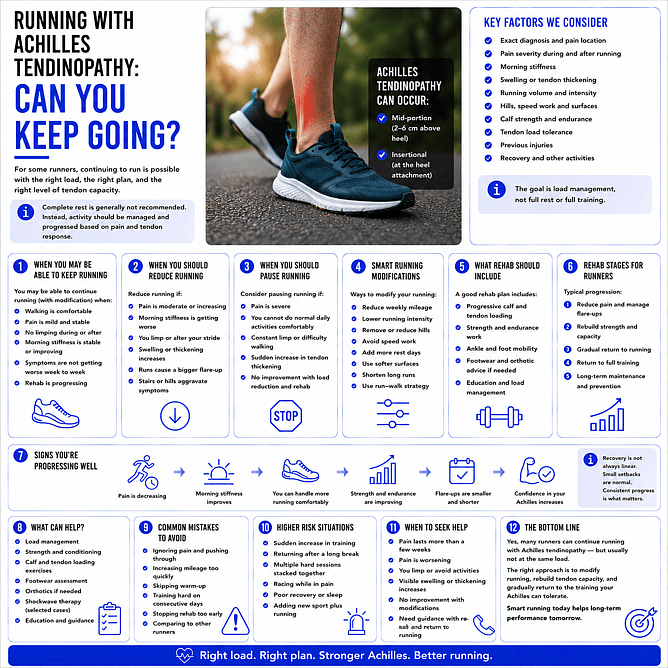
What Is Achilles Tendinopathy?
Achilles tendinopathy is a condition that can cause pain, stiffness, swelling, and reduced function in the Achilles tendon. It commonly affects people involved in running and jumping sports, although it can also occur in people who are less active.
There are two important locations.
Mid-Portion Achilles Tendinopathy
Mid-portion Achilles tendinopathy affects the tendon several centimetres above the heel attachment.
Symptoms may include:
Pain through the middle section of the tendon
Morning stiffness
Tenderness
Thickening
Pain during or after running
Reduced calf endurance
Insertional Achilles Tendinopathy
Insertional Achilles tendinopathy affects the lower tendon where it attaches directly to the heel bone.
It may be particularly aggravated by:
Uphill running
Stairs
Deep ankle dorsiflexion
Pressure from shoes
Activities that compress the tendon against the heel
The distinction matters because running and rehabilitation modifications may differ between the two presentations.
This blog focuses on the general question of running with Achilles tendinopathy, but the treatment plan should always match the diagnosis.
Why Complete Rest Is Not Always the Answer
Rest can reduce Achilles pain because it temporarily removes the aggravating load.
But rest does not automatically rebuild:
Calf strength
Tendon capacity
Endurance
Running tolerance
Push-off strength
Sport-specific function
That creates a common cycle.
The runner stops.
The pain improves.
Nothing progressively rebuilds the tendon.
The runner returns to the previous mileage.
The pain returns.
Current evidence-based guidance for mid-portion Achilles tendinopathy places progressive tendon-loading exercise at the centre of rehabilitation and specifically advises against relying on complete rest.
The aim is therefore usually load management, not permanent load avoidance.
Running Is Load — and the Achilles Needs the Right Amount
The Achilles tendon needs load to function.
Running places repeated force through the calf-Achilles system. If that load is appropriate, the tendon can adapt. If the running demand consistently exceeds the tendon’s current capacity, symptoms may increase.
Problems may develop when runners suddenly change:
Weekly mileage
Running frequency
Intensity
Hill volume
Sprinting
Race preparation
Training surface
Footwear
Gym training
Other sports
Achilles tendinopathy is strongly associated with load and overuse patterns, and changes in training can contribute to symptoms.
This is why the question should not only be:
“Can I run?”
It should also be:
“How much running can my Achilles currently tolerate?”
Signs You May Be Able to Continue Running
Some runners may be able to continue at a reduced or modified level when symptoms are relatively controlled.
Running may be more reasonable when:
Walking is comfortable
Pain during running remains limited
You are not limping
Symptoms do not progressively worsen through the week
Morning stiffness is stable or improving
Swelling is not increasing
Calf function remains good
Running load can be modified
Rehabilitation is progressing
Oxford University Hospitals advises that running may continue with little discomfort, while also warning that symptoms can be aggravated and rehabilitation may take longer.
That is a much better message than telling everyone either to stop completely or to ignore the pain.
Signs You Should Reduce Running
Running load may need to come down when the Achilles is showing signs that the current demand is too high.
Consider reducing training if:
Pain is increasing from run to run
Morning stiffness lasts longer
The tendon is becoming more swollen
Normal walking begins to hurt
You start limping
The tendon feels progressively worse the next day
Running distance is becoming harder to tolerate
Symptoms continue to increase despite rehabilitation
Oxford University Hospitals specifically advises reducing exercise repetitions when morning stiffness becomes longer during rehabilitation, demonstrating that next-day symptoms can be useful when judging whether loading is excessive.
The same principle can be useful when reviewing running load.
Do not judge the Achilles only by how it feels halfway through the run.
Look at the full response.
Why Morning Stiffness Matters for Runners
Morning stiffness is a common Achilles tendinopathy symptom and can provide useful information about how the tendon is responding to training.
For example:
Monday:
Easy run
Mild symptoms
Tuesday morning:
Normal stiffness
Wednesday:
Faster run
Hills added
Thursday morning:
Much greater stiffness
Walking uncomfortable
That change may suggest Wednesday's load was more than the tendon currently tolerated well.
Monitoring morning symptoms can help runners and clinicians adjust:
Distance
Speed
Hills
Training frequency
Strength work
Recovery days
The aim is not to achieve zero sensation after every session. It is to avoid a pattern of steadily worsening symptoms and function.
Why Achilles Pain May Improve While You Run
Achilles tendinopathy can produce a frustrating “warm-up” pattern.
A runner may experience:
Stiffness at the start
Less discomfort after warming up
A relatively comfortable middle of the run
Increasing symptoms afterwards
More stiffness the following morning
This is one reason runners sometimes assume everything is fine because the tendon felt good once they got moving.
Oxford University Hospitals notes that running can be tolerated in some cases but may still aggravate symptoms and extend the rehabilitation period.
The tendon’s response after the run is therefore just as important as the sensation during it.
Should You Run Through Pain?
The answer is not a simple yes or no.
Some discomfort may occur during Achilles rehabilitation. Progressive loading exercises themselves may produce manageable discomfort as the tendon adapts. Oxford University Hospitals uses a pain-monitoring approach within its rehabilitation programme and advises reducing the load when symptoms become excessive.
However, pain should not be interpreted as something that must always be ignored.
Be cautious if:
Pain becomes sharp
Pain rapidly increases
You start altering your running form
You limp
Strength suddenly decreases
Swelling increases significantly
Symptoms are substantially worse the following morning
The goal is controlled loading, not forcing the tendon through escalating symptoms.
Modify the Run Before Abandoning Running Completely
or some runners, adjusting the most demanding parts of training can reduce Achilles irritation without removing all running.
Depending on the individual, changes may include:
Reduce Distance
A shorter run may be easier for the tendon to tolerate than the runner's normal distance.
Reduce Running Frequency
Running every second or third day may allow more recovery than running on consecutive days.
Reduce Speed Work
Fast running increases the demands placed on the calf-Achilles system.
Temporary reduction of:
Intervals
Tempo running
Sprinting
may help during a more sensitive stage.
Reduce Hills
Hill running can increase Achilles demand, and insertional presentations may be particularly sensitive to activities that increase compression around the tendon attachment.
Temporary reduction of:
Hill repeats
Steep inclines
Uphill sprinting
Stair sessions
may be appropriate depending on pain location.
Remove Sudden Load Spikes
Avoid jumping directly from reduced training to your previous volume.
A gradual return allows the tendon to adapt progressively.
Do Not Change Everything at Once
When Achilles pain develops, runners often panic and simultaneously:
Stop running
Buy new shoes
Add heel lifts
Buy orthotics
Start multiple exercises
Change running technique
Begin stretching more
Add shockwave therapy
The problem is that nobody can then identify which change actually helped or aggravated symptoms.
A stronger approach is:
Confirm the Achilles presentation.
Identify the largest load contributors.
Make targeted adjustments.
Start appropriate rehabilitation.
Monitor response.
Progress gradually.
That creates a much clearer rehabilitation process.
Strengthening Is Central to Achilles Tendinopathy Rehabilitation
Progressive tendon-loading exercise is a first-line treatment for mid-portion Achilles tendinopathy according to the 2024 clinical practice guideline.
Rehabilitation may progressively address:
Calf strength
Soleus strength
Achilles load tolerance
Single-leg strength
Muscular endurance
Running-specific capacity
The exact programme should be based on the individual's symptoms, strength, diagnosis, and goals.
It should not simply be:
“Do the same heel raises forever.”
Running places repeated loads through the tendon. Rehabilitation eventually needs to prepare the tendon for those demands.
Why Calf Strength Matters
The Achilles tendon connects the calf muscles to the heel and plays a major role in pushing the body forward.
During running, the calf-Achilles system repeatedly contributes to:
Push-off
Propulsion
Shock management
Speed
Uphill movement
Reduced calf strength or endurance can therefore affect the tendon’s ability to tolerate running.
Assessment may look at:
Single-leg heel raises
Number of repetitions
Height of each repetition
Differences between sides
Straight-knee strength
Bent-knee strength
Fatigue
Pain response
Oxford University Hospitals lists weak calf muscles and poor calf endurance among factors associated with Achilles tendinopathy.
Can You Keep Fitness While Running Less?
Yes. Reducing running does not automatically mean losing all cardiovascular fitness.
Relative rest may include alternative forms of exercise such as:
Swimming
Cycling
Aqua jogging
Suitable gym conditioning
Oxford University Hospitals specifically recommends these types of alternatives when the Achilles needs reduced running load.
Cross-training can help maintain fitness while allowing running volume to decrease temporarily.
However, remember that other exercise still adds to total training load. A heavy gym session followed by cycling and sport is not necessarily a rest day for the lower limb.
Does Footwear Matter?
Footwear can influence Achilles symptoms for some runners.
A review may consider:
Shoe fit
Cushioning
Heel-counter pressure
Shoe wear
Stability
Current training shoes
Recent changes in shoe type
Whether the pain is insertional or mid-portion
Footwear is particularly relevant when insertional Achilles pain is aggravated by pressure against the back of the heel.
There is no single running shoe that is best for every person with Achilles tendinopathy.
The shoe needs to suit:
The runner
Their foot
The Achilles presentation
The running surface
Their training demands
Can Heel Lifts Help?
Heel lifts may sometimes be used temporarily to alter Achilles loading and reduce irritation in selected patients.
They are not automatically necessary for every runner.
The decision may depend on:
Pain location
Footwear
Ankle movement
Tendon irritability
Running demands
The rest of the treatment plan
A heel lift should not replace progressive rehabilitation.
If the Achilles cannot tolerate running because strength and capacity are inadequate, simply lifting the heel does not rebuild those qualities.
Can Orthotics Help Runners With Achilles Tendinopathy?
Orthotics may be considered when foot mechanics or pressure distribution appear to contribute to the overall problem.
They may be useful for selected patients, but they should not automatically be prescribed to every runner with Achilles pain.
The broader plan may still need:
Tendon loading
Calf strengthening
Running modifications
Footwear review
Recovery planning
Gradual return to full training
Orthotics should support the rehabilitation plan rather than become the entire plan.
What About Shockwave Therapy?
Shockwave therapy may be considered for selected persistent Achilles tendinopathy cases.
However, it should not replace progressive rehabilitation.
Importantly, the 2024 APTA guideline specifically states that extracorporeal shockwave therapy falls outside the scope of that physical therapy guideline, while the guideline itself focuses on evidence-based physical therapy management of mid-portion Achilles tendinopathy.
For this blog, keep the message clear:
Shockwave therapy may be considered in selected cases, but running-load management and progressive tendon rehabilitation still matter.
How Do You Know When to Increase Running Again?
Increasing running should be based on response, not impatience.
Useful things to monitor include:
Pain during running
Symptoms afterwards
Morning stiffness
Walking comfort
Tendon swelling
Calf strength
Ability to complete rehabilitation
Recovery between sessions
Progression may involve gradually increasing:
Running duration
Distance
Frequency
Speed
Hills
Sport-specific intensity
Oxford University Hospitals recommends gradual return to sport and notes that return should be guided by symptoms and the demands of the activity.
Do not increase every training variable at the same time.
When Can Speed Work Return?
Speed work creates greater demands than easy running.
Before reintroducing:
Intervals
Sprinting
Fast finishes
Competitive race pace
the runner should ideally have built enough strength and tolerance for easier running first.
A sensible sequence often moves from:
Easy running → longer easy running → increased frequency → controlled faster work → hills or higher-intensity demands.
The exact order depends on symptoms, event goals, and the Achilles presentation.
What About Returning to Hills?
Hills should usually be treated as a progression rather than assumed to be equal to flat running.
This is particularly important when:
Hills were the original trigger
Pain is located at the heel attachment
Calf endurance remains poor
Running uphill consistently increases symptoms
A runner may tolerate flat running well before being ready for repeated hill sessions.
How Long Does Achilles Tendinopathy Take to Recover?
There is no single recovery timeline.
Oxford University Hospitals notes that its eccentric rehabilitation programme may take approximately three to six months to significantly improve symptoms, although individual recovery differs.
Recovery depends on factors including:
How long the condition has been present
Pain severity
Tendon capacity
Training demands
Strength
Consistency with rehabilitation
Whether training load is repeatedly increased too quickly
The goal should not be racing against an arbitrary calendar date.
Better markers include improvements in:
Pain
Morning stiffness
Strength
Running tolerance
Recovery
Function
When Running With Achilles Pain Is Not Appropriate
This entire discussion assumes a gradual Achilles tendinopathy presentation.
Sudden Achilles injuries are different.
Stop training and seek urgent assessment if you experience:
A sudden pop or snap
Sudden sharp or severe pain
A sensation of being struck in the calf or heel
Significant weakness
Difficulty walking
Difficulty bearing weight
Inability to stand on tiptoe
Rapid swelling or bruising
Health New Zealand lists sudden severe pain, calf swelling, walking difficulty, reduced weight-bearing, bruising, and inability to stand on tiptoe among features of Achilles tendon rupture.
Do not continue running to see whether a suspected rupture improves.
What if Achilles Pain Is Not Improving?
Assessment is worth considering when:
Pain continues despite reducing running
Symptoms return whenever training increases
Morning stiffness is worsening
The tendon is becoming thickened or swollen
You cannot progress rehabilitation
You repeatedly need to stop running
Pain location is unclear
You are uncertain whether the condition is insertional or mid-portion
Previous treatment has not worked
A clinical assessment can help determine whether the problem is actually Achilles tendinopathy and what factors are limiting recovery.
What an Achilles Running Assessment May Include
Assessment may include:
Exact Achilles pain location
Symptom history
Running history
Recent training changes
Current weekly mileage
Training frequency
Speed work
Hills
Other sport or gym activity
Calf strength
Single-leg heel raises
Ankle mobility
Foot mechanics
Footwear
Existing orthotics
Rehabilitation completed so far
The aim is not simply to tell the runner whether they are “allowed” to run.
The aim is to determine:
What the tendon currently tolerates
What is causing overload
What capacity needs rebuilding
How training should be modified
How the runner can progressively return to full activity
Running With Achilles Tendinopathy in Auckland
Foot Foundation provides Achilles pain assessment and treatment across its Auckland clinics:
Remuera
Smales Farm
Botany
Pinehill
Runners and active patients can seek assessment for:
Mid-portion Achilles tendinopathy
Insertional Achilles pain
Recurring Achilles symptoms
Pain after running
Morning tendon stiffness
Difficulty increasing mileage
Return-to-running concerns
Achilles Tendinopathy Care in Hamilton
Foot Foundation provides foot and ankle care in Hamilton at:
Hamilton Central – 7/127 Collingwood Street
Hamilton East – 16 Beale Street
Patients experiencing Achilles pain during running, recurring tendon symptoms, heel pain, walking discomfort, or difficulty returning to activity can access assessment and treatment support.
Service and clinician availability should be confirmed when booking.
Achilles Tendinopathy Care in Tauranga
Foot Foundation provides podiatry care in Tauranga at:
Tauranga Bethlehem – 253A State Highway 2
Runners and active patients experiencing Achilles pain, recurring tendon stiffness, difficulty with hills, running-related heel pain, or trouble returning to normal training can book an assessment to identify the appropriate treatment pathway.
Service and clinician availability should be confirmed when booking.
When Should You Book an Achilles Assessment?
Consider an assessment if:
You have been running with Achilles pain for several weeks
Training repeatedly causes flare-ups
You cannot increase mileage without symptoms returning
Morning stiffness is worsening
The Achilles is swollen or thickened
You are losing calf strength
You repeatedly stop and restart running
You are unsure what amount of pain is acceptable
You do not know whether the problem is insertional or mid-portion
You want a structured return-to-running plan
Seek urgent medical assessment instead when symptoms begin suddenly with a pop or snap, significant weakness, difficulty walking, or inability to stand on tiptoe.
Book an Assessment for Running With Achilles Tendinopathy
You do not automatically have to give up running because you have Achilles tendinopathy.
For appropriately diagnosed mid-portion Achilles tendinopathy, current evidence supports continued activity within tolerance alongside progressive tendon-loading rehabilitation rather than relying on complete rest.
But continuing exactly the same training while symptoms progressively worsen is not a rehabilitation plan either.
The stronger approach is:
Confirm the diagnosis
Identify the current load tolerance
Modify aggravating training
Rebuild calf and tendon strength
Monitor symptoms
Review footwear where needed
Progress running gradually
Foot Foundation provides Achilles pain assessment and rehabilitation across Auckland, Hamilton, and Tauranga.
Frequently Asked Questions
Can You Keep Running With Achilles Tendinopathy?
Some people with appropriately diagnosed Achilles tendinopathy can continue running at a modified level. Complete rest is not generally recommended for mid-portion Achilles tendinopathy, while progressive loading remains an important part of treatment.
Will Running Make Achilles Tendinopathy Worse?
Running can aggravate symptoms when the training load exceeds what the tendon currently tolerates. Oxford University Hospitals notes that running may continue with little discomfort in some cases but may prolong rehabilitation by aggravating pain.
Should I Completely Stop Running?
Not automatically. Running may instead need to be modified by reducing distance, frequency, speed, hills, or other demanding training. The appropriate level depends on symptoms and diagnosis.
Should I Run if I Am Limping?
Running while your gait is significantly altered by pain suggests the current load may be too high and should be reassessed. A worsening loss of function also warrants clinical review.
Why Is My Achilles Worse the Morning After Running?
Morning stiffness is a recognised feature of Achilles tendinopathy. If stiffness becomes progressively longer after training, that may indicate the current loading programme needs adjusting.
Can I Cycle or Swim Instead?
Cycling, swimming, and aqua jogging are examples of alternative activities Oxford University Hospitals recommends for maintaining fitness while reducing Achilles running load.
How Do I Know if My Achilles Is Ruptured?
Sudden severe pain, a pop or snap, difficulty walking or bearing weight, calf swelling, bruising, or inability to stand on tiptoe requires urgent assessment for possible Achilles rupture.