What Does Pain Above the Heel Mean?
Pain at the back of the lower leg, a few centimetres above the heel, can be a sign of mid-portion Achilles tendinopathy.
The exact location matters.
Mid-portion, or non-insertional, Achilles tendinopathy typically affects the tendon approximately 2–6 cm above where it attaches to the heel bone. Insertional Achilles tendinopathy is different because it affects the lower part of the tendon directly where it meets the heel.
If you have gradual pain above the heel, morning stiffness, tenderness when squeezing the tendon, or symptoms that become worse with running, jumping, walking, or sport, mid-portion Achilles tendinopathy may be one possible explanation. However, location alone does not confirm the diagnosis.
Other Achilles and lower-leg problems can produce pain in a similar area, and a sudden injury with a pop, snap, major weakness, or difficulty walking needs urgent assessment for a possible Achilles rupture.
At Foot Foundation, the goal is to determine which Achilles condition is present, understand what is contributing to the problem, and develop an appropriate treatment and rehabilitation pathway.
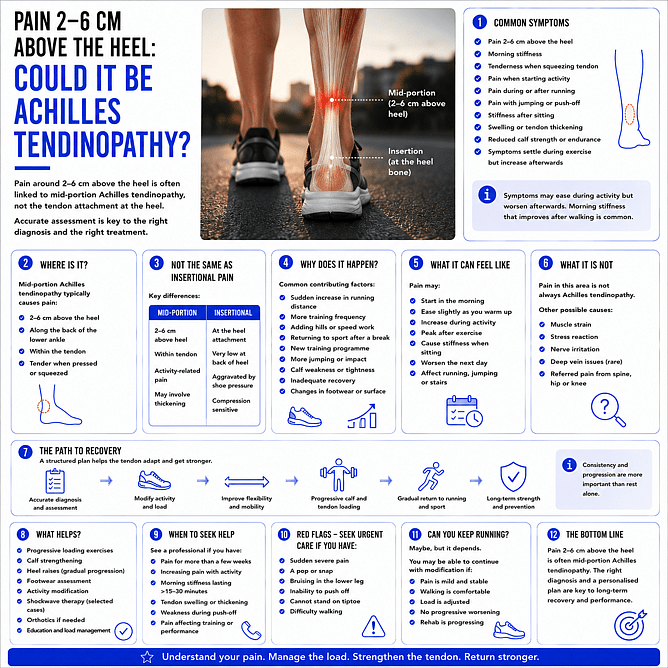
Where Is Mid-Portion Achilles Tendinopathy Pain Usually Felt?
Mid-portion Achilles tendinopathy affects the central section of the Achilles tendon rather than the point where it attaches to the heel.
The typical painful area is:
Around 2–6 cm above the heel bone
Along the back of the lower ankle
Within the Achilles tendon itself
Tender when the tendon is pressed or gently squeezed
The Royal National Orthopaedic Hospital describes non-insertional or mid-portion Achilles tendinopathy as affecting the tendon between approximately 2 and 6 cm above its attachment to the heel bone.
This location is one of the most useful clues when distinguishing mid-portion Achilles tendinopathy from insertional Achilles tendinopathy.
Mid-Portion Achilles Pain
Usually:
2–6 cm above the heel
Within the tendon
Associated with activity-related pain
May involve thickening or swelling
Insertional Achilles Pain
Usually:
Directly at the heel attachment
Very low at the back of the heel
May be aggravated by pressure from shoes
May be affected by compression against the heel bone
These conditions both involve the Achilles tendon, but they should not automatically receive the same rehabilitation programme.
What Is Mid-Portion Achilles Tendinopathy?
Achilles tendinopathy is a condition involving pain, impaired function, and sometimes swelling or thickening of the Achilles tendon.
The exact biological process is complex. It should not simply be described as inflammation or “wear and tear”. Current clinical guidance treats Achilles tendinopathy as a condition that requires individual assessment and evidence-based management rather than assuming one single tissue process explains every case.
Mid-portion Achilles tendinopathy develops in the section of the tendon several centimetres above the heel.
It is particularly common in people exposed to repeated tendon loading, including activities involving running and jumping. Changes in activity, training surfaces, footwear, and other health or mechanical factors may also contribute.
Common Symptoms of Mid-Portion Achilles Tendinopathy
Symptoms can vary, but commonly include:
Pain approximately 2–6 cm above the heel
Morning stiffness
Tenderness when pressing or squeezing the tendon
Pain when beginning activity
Pain during or after running
Pain with jumping or pushing off
Stiffness after sitting
Swelling or tendon thickening
Reduced calf strength or endurance
Symptoms that settle during exercise but increase afterwards
The Royal National Orthopaedic Hospital notes that Achilles tendinopathy may cause aching around the heel that worsens with activity or pressure. Some people can exercise through symptoms, only for the pain to increase afterwards. Morning stiffness that eases after several minutes of walking is also common.
Why Does the Achilles Hurt 2–6 cm Above the Heel?
The Achilles tendon must repeatedly tolerate substantial forces during normal movement.
It helps transfer force from the calf muscles into the heel during:
Walking
Running
Climbing stairs
Jumping
Sprinting
Pushing off
Sport
Problems can develop when the tendon is unable to adapt adequately to the amount or type of load being placed on it.
Common situations that may contribute include:
Suddenly increasing running distance
Increasing training frequency
Adding hill running
Adding sprinting or speed work
Returning to sport after time off
Starting a new training programme
Increasing jumping activities
Changes in footwear
Changes in training surface
Reduced calf strength
Poor recovery between demanding sessions
It is often the change in load that matters, not simply the fact that someone exercises.
Why Runners Commonly Develop Pain Above the Heel
Running repeatedly loads the calf-Achilles system.
That does not mean running is harmful to the Achilles. Healthy tendons are designed to tolerate load.
Problems may arise when training demands increase faster than the tendon can adapt.
For example:
A runner increases from 20 km to 35 km per week
Hill sessions are suddenly added
Speed work begins after months of easy running
Someone returns immediately to their previous mileage after injury
Running is combined with increased gym or court-sport loading
Recovery time between hard sessions becomes inadequate
Mid-portion Achilles tendinopathy is particularly common among active people involved in repetitive running and jumping activities.
The aim of treatment is therefore not automatically to eliminate all activity. It is to understand what the tendon currently tolerates and progressively build its capacity.
Why Achilles Pain Can Be Worse in the Morning
Morning stiffness is one of the common symptoms associated with Achilles tendinopathy.
You may notice:
Pain during the first few steps
Stiffness immediately after getting out of bed
Stiffness after sitting for a long time
Symptoms easing after walking for several minutes
Increased stiffness after a harder day of activity
The Royal National Orthopaedic Hospital notes that morning stiffness often eases after several minutes of walking, although it may last longer in some patients.
Morning symptoms can also be useful when monitoring rehabilitation.
If morning stiffness becomes progressively worse after increases in exercise or running, it may indicate that the current load needs reviewing.
Why the Tendon Can Hurt More After Exercise Than During It
Achilles tendinopathy can produce a confusing symptom pattern.
You may start a run feeling stiff or sore, then notice that the tendon warms up and feels more comfortable.
Later, however, you may experience:
Increased tenderness
Stiffness after sitting
Pain that evening
Worse symptoms the next morning
This “warm-up” response is recognised in Achilles tendinopathy. Pain can settle during exercise but increase again afterwards.
That means how the tendon feels halfway through a run is not the only thing that matters.
You also need to consider how it responds:
Later that day
The next morning
During walking
During the next training session
Is Pain Above the Heel Always Achilles Tendinopathy?
No.
Although gradual pain 2–6 cm above the heel is characteristic of mid-portion Achilles tendinopathy, other problems can affect a similar area.
Possible alternatives include:
Achilles tendon partial injury
Achilles rupture
Calf muscle injury
Referred pain
Other tendon or soft tissue problems
Some people may also experience symptoms involving more than one section of the Achilles tendon.
This is why a search for “pain above heel Achilles tendon” should lead towards assessment rather than self-diagnosis based purely on the location.
Mid-Portion vs Insertional Achilles Tendinopathy
This distinction is particularly important.
Mid-Portion Achilles Tendinopathy
Pain is usually:
2–6 cm above the heel attachment
Within the central portion of the tendon
Associated with running, jumping, and repeated tendon loading
Insertional Achilles Tendinopathy
Pain is usually:
Directly where the tendon attaches to the heel
Lower than mid-portion pain
Close to the back of the heel bone
The Royal National Orthopaedic Hospital clearly distinguishes the two types according to location.
Why does this matter?
Because some exercises and loading positions suitable for mid-portion tendinopathy may not suit an insertional presentation. The RNOH patient guidance specifically excludes some exercises for people with insertional Achilles tendinopathy.
The diagnosis should therefore come before the exercise programme.
Could Pain 2–6 cm Above the Heel Be an Achilles Rupture?
It can be important to consider this because a rupture may occur within a similar region of the tendon.
The difference is usually in how the symptoms started and how the tendon functions, not just where the pain is located.
Achilles tendinopathy more commonly develops gradually.
A rupture is more likely to involve:
Sudden pain
A pop or snapping sensation
Feeling as though someone kicked the back of the leg
Sudden weakness
Difficulty walking
Loss of normal push-off
Inability to stand on tiptoe
Swelling or bruising
Health New Zealand advises urgent assessment when severe Achilles pain occurs suddenly with walking difficulty, a snap or crack, or the sensation of being struck in the leg.
A tendon gap can sometimes be felt several centimetres above the heel after a complete rupture, which is another reason location alone should not be used for diagnosis.
If the injury was sudden, do not continue exercising to see whether it settles.
Should You Rest Achilles Tendinopathy?
Short-term activity modification can help when symptoms are irritated, but complete long-term rest is generally not the objective of Achilles tendinopathy rehabilitation.
The 2024 clinical practice guideline for mid-portion Achilles tendinopathy provides updated evidence-based recommendations for rehabilitation and supports tailored clinical decision-making. Progressive tendon-loading exercise remains central to management.
That means treatment is usually more sophisticated than:
Pain → stop everything → wait → restart everything.
A better pathway may involve:
Reducing aggravating load temporarily
Identifying a tolerable activity level
Beginning appropriate tendon loading
Rebuilding calf strength
Progressing resistance
Gradually rebuilding running or sport
Monitoring symptoms during progression
The programme should match the individual condition and stage of recovery.
Why Strengthening Matters
The calf muscles and Achilles tendon work together every time you push through the ground.
That includes:
Walking
Running
Jumping
Sprinting
Climbing stairs
Standing on tiptoe
Strengthening programmes may use different forms of calf and tendon loading depending on the patient.
The Royal National Orthopaedic Hospital describes strengthening exercises that can progressively become more challenging by increasing load as rehabilitation develops.
The right exercises and progression depend on:
Pain irritability
Strength
Tendon function
Current activity
Sport
Age
Recovery goals
Whether the condition is mid-portion or insertional
The goal is not simply to perform heel raises.
The goal is to restore the tendon’s ability to tolerate the forces required by normal life or sport.
Do Orthotics Help Mid-Portion Achilles Tendinopathy?
Orthotics may be appropriate for selected patients when foot mechanics are considered relevant to the overall presentation.
RNOH guidance includes orthotics as a potential option where altered biomechanics, such as high or low arches, are present.
However, orthotics should not automatically replace rehabilitation.
A treatment plan may combine:
Exercise rehabilitation
Activity modification
Footwear assessment
Orthotics where appropriate
Heel lifts where appropriate
Strengthening
Return-to-activity planning
The decision should be based on assessment rather than prescribing the same treatment to everyone.
What About Shockwave Therapy?
Shockwave therapy may be considered in selected persistent Achilles tendinopathy cases as part of a broader management plan. RNOH includes shockwave among potential conservative treatment options.
However, it should not be positioned as a replacement for tendon rehabilitation.
Importantly, the 2024 APTA mid-portion Achilles guideline does not evaluate extracorporeal shockwave therapy because it falls outside the scope of that physical therapy guideline.
For Foot Foundation content, the safest positioning is:
Shockwave therapy may be considered for selected persistent cases, while progressive rehabilitation, load management, and appropriate clinical assessment remain important parts of care.
Does Achilles Tendinopathy Need a Scan?
Not automatically.
Clinical assessment is often sufficient to identify Achilles tendinopathy. When imaging is required, ultrasound or MRI may be considered depending on the clinical situation.
Imaging may be considered when:
The diagnosis is uncertain
Symptoms are unusual
A partial tear is suspected
Pain started suddenly
Weakness is significant
Treatment has not progressed as expected
Another condition needs to be ruled out
A scan should complement the clinical assessment rather than replace it.
What an Achilles Tendinopathy Assessment May Include
A detailed assessment may consider:
Exact pain location
How symptoms began
Morning stiffness
Tendon tenderness
Swelling or thickening
Walking tolerance
Running or sports activity
Recent training changes
Calf strength
Single-leg heel-raise function
Ankle mobility
Foot mechanics
Footwear
Existing orthotics
Previous treatment
Rehabilitation already attempted
Clinical examination is commonly sufficient for diagnosis, with imaging considered when indicated.
The goal is to determine whether the symptoms genuinely fit mid-portion Achilles tendinopathy and what factors are contributing.
Treatment for Pain 2–6 cm Above the Heel
If the pain is confirmed as mid-portion Achilles tendinopathy, treatment may include:
Activity and training modification
Progressive tendon-loading exercises
Calf strengthening
Foot and ankle rehabilitation
Footwear assessment
Orthotics where clinically appropriate
Heel lifts in selected cases
Manual therapy where appropriate
Shockwave therapy in selected persistent cases
Gradual return to running
Return-to-sport planning
There is no single rehabilitation programme that is right for every patient.
The 2024 clinical guideline specifically emphasises evidence-based, tailored decision-making for mid-portion Achilles tendinopathy.
How Long Can Achilles Tendinopathy Take to Improve?
Achilles tendinopathy can require patience.
RNOH advises that conservative treatment can take several months or longer for some patients.
Recovery time can vary depending on:
How long symptoms have been present
Tendon irritability
Current strength
Running or sport demands
Work demands
Training load
Consistency with rehabilitation
Other contributing factors
The better goal is not to chase an exact number of weeks.
The goal is progressive improvement in:
Pain
Morning stiffness
Strength
Walking tolerance
Running tolerance
Function
Confidence
When Can You Return to Running or Sport?
Return to activity should usually be gradual.
RNOH advises that return to sport should be guided by symptoms and the demands of the sport, with a gradual progression to reduce the risk of re-aggravating symptoms.
A return-to-running plan may progressively rebuild:
Walking tolerance
Running duration
Running distance
Training frequency
Speed
Hills
Higher-intensity sessions
Sport-specific loading
The tendon should be prepared for the activity rather than simply rested until pain disappears.
ACHILLES TENDINOPATHY CARE IN AUCKLAND
Foot Foundation provides Achilles pain assessment and treatment across its Auckland clinics:
Remuera
Smales Farm
Botany
Pinehill
Patients experiencing pain 2–6 cm above the heel, morning Achilles stiffness, tendon thickening, recurring running-related symptoms, or difficulty returning to sport can book an assessment to determine the appropriate treatment pathway.
ACHILLES TENDINOPATHY CARE IN HAMILTON
Foot Foundation provides foot and ankle care in Hamilton at:
Hamilton Central – 7/127 Collingwood Street
Hamilton East – 16 Beale Street
Patients experiencing persistent Achilles pain, pain above the heel, walking discomfort, running-related tendon symptoms, or recurring foot and ankle problems can access assessment and treatment support.
Service and clinician availability should be confirmed when booking.
ACHILLES TENDINOPATHY CARE IN TAURANGA
Foot Foundation provides podiatry care in Tauranga at:
Tauranga Bethlehem – 253A State Highway 2
Patients experiencing Achilles pain above the heel, tendon stiffness, walking pain, sports-related symptoms, or recurring tendon problems can book an assessment to identify the appropriate management pathway.
Service and clinician availability should be confirmed when booking.
When Should You Book an Achilles Assessment?
Consider booking an assessment if:
Pain is consistently located 2–6 cm above the heel
Symptoms have lasted more than a few weeks
Morning stiffness keeps returning
The tendon is tender or thickened
Running repeatedly triggers pain
Pain returns whenever activity increases
Rest has only helped temporarily
You are unsure whether the pain is mid-portion or insertional
Previous exercises have not worked
You cannot return to your normal sport or activity
Seek urgent medical assessment instead if symptoms begin suddenly with a pop or snap, severe pain, major weakness, difficulty walking, or inability to stand on tiptoe.
BOOK AN ASSESSMENT FOR PAIN ABOVE THE HEEL
Gradual pain around 2–6 cm above the heel can be consistent with mid-portion Achilles tendinopathy, particularly when it is accompanied by morning stiffness, tendon tenderness, or symptoms linked with running and activity.
However, pain location alone cannot confirm the diagnosis.
A proper assessment can help determine:
Whether the Achilles tendon is involved
Whether the problem is mid-portion or insertional
How well the tendon tolerates load
Whether calf strength is reduced
Whether training or activity needs changing
Whether footwear or orthotics may be relevant
Whether imaging or referral is needed
How rehabilitation should progress
Foot Foundation provides assessment and treatment for Achilles pain across Auckland, Hamilton, and Tauranga.
FREQUENTLY ASKED QUESTIONS
Is Pain 2–6 cm Above the Heel Achilles Tendinopathy?
Gradual pain approximately 2–6 cm above the heel attachment is a characteristic location for mid-portion Achilles tendinopathy. However, a clinical assessment is needed because other injuries can affect a similar area.
Why Does My Achilles Hurt Just Above My Heel?
One possible cause is mid-portion Achilles tendinopathy, particularly if symptoms developed gradually and are associated with activity, morning stiffness, tenderness, or tendon thickening.
What Is the Difference Between Mid-Portion and Insertional Achilles Tendinopathy?
Mid-portion Achilles tendinopathy occurs approximately 2–6 cm above the tendon attachment. Insertional tendinopathy affects the lower tendon directly where it meets the heel bone.
Can I Keep Running With Achilles Tendinopathy?
Return to or continuation of running depends on the stage of recovery, symptoms, and individual capacity. RNOH advises gradual return to sport and notes that running may be resumed later in rehabilitation when discomfort is limited.
Does Achilles Tendinopathy Need Complete Rest?
Long-term complete rest is not generally the aim of mid-portion Achilles tendinopathy rehabilitation. Current guidance supports progressive loading and individualised management.
Does Achilles Tendinopathy Need an Ultrasound or MRI?
Not always. Clinical examination is often sufficient. Ultrasound or MRI may be considered when imaging is clinically indicated or the diagnosis needs clarification.
What If the Pain Started With a Pop?
A sudden pop or snap with severe pain, weakness, difficulty walking, or inability to stand on tiptoe needs urgent assessment for possible Achilles rupture.