Achilles Pain After Running Does Not Always Mean You Must Stop
Achilles pain after running is common among runners and active adults, but deciding whether to continue training is not as simple as choosing between running normally and stopping completely.
For appropriately diagnosed Achilles tendinopathy, current rehabilitation guidance supports progressive tendon-loading exercise, and complete rest is not generally the goal. Training may instead need to be reduced or modified according to symptoms, current tendon capacity, and the activities that trigger pain.
Oxford University Hospitals also advises that some people with Achilles tendinopathy may continue running when discomfort is limited, although running can aggravate symptoms and potentially extend rehabilitation. Lower-impact activities such as cycling or swimming may be considered when running load needs to be reduced.
That does not mean every runner with Achilles pain should keep running.
The first step is determining what is actually causing the pain.
At Foot Foundation, assessment may consider:
Where the Achilles hurts
Whether symptoms started gradually or suddenly
Morning stiffness
Tendon swelling or thickening
Current running distance
Training frequency
Hills and speed work
Calf strength
Ankle movement
Footwear
Foot mechanics
Previous Achilles injuries
Recovery between sessions
The goal is to work out what the tendon currently tolerates and what needs to change before full training resumes.
Why Does My Achilles Hurt After Running?
The Achilles tendon transfers force between the calf and heel during walking, running, jumping and pushing off.
Running increases repeated load through this tendon. Achilles tendinopathy commonly develops when the tendon is exposed to demands that exceed its current ability to tolerate load, particularly after changes or increases in activity. Health New Zealand lists increased activity and exercise among factors associated with Achilles tendinopathy and recommends gradually rebuilding activity as symptoms improve.
Running-related flare-ups may follow:
Increasing weekly distance
Running more frequently
Adding speed sessions
Adding hills
Returning after a break
Starting a new training programme
Increasing sport and running at the same time
Training hard on consecutive days
Changing footwear
Increasing gym-based calf work alongside running
The problem is not necessarily that running itself is bad for the Achilles.
The issue may be that the current running demand is greater than the tendon is prepared to tolerate.
Why Can Achilles Pain Feel Better While Running but Worse Afterwards?
This pattern can be confusing.
Some runners notice pain or stiffness during their first few minutes of running. The tendon then begins to feel easier as they warm up, allowing them to finish the session.
Later, symptoms return.
Patients may notice:
Pain after the run
Stiffness once they sit down
Pain later that evening
Increased morning stiffness
Tenderness the following day
Pain when walking downstairs
Symptoms during the next training session
NHS guidance describes Achilles tendinopathy symptoms that may ease with movement but become worse again following prolonged activity or afterwards. Morning stiffness is also a recognised feature.
This means judging a run only by how the tendon feels halfway through the session can be misleading.
The response after the session matters too.
Should You Stop Running With Achilles Pain?
Not Always
For gradual Achilles tendinopathy that has been appropriately assessed, completely stopping all activity is not automatically necessary.
Progressive loading remains a central component of evidence-based management for mid-portion Achilles tendinopathy.
Running may sometimes continue at a modified level if:
Symptoms remain manageable
Walking is comfortable
The running load has been adjusted
Symptoms are not progressively worsening
There is no sudden loss of strength
There are no signs of an acute rupture
Rehabilitation is progressing
Oxford University Hospitals advises that running may continue with limited discomfort, while acknowledging that ongoing running may aggravate symptoms and make rehabilitation take longer for some patients.
Sometimes You Should Reduce or Pause Running
A temporary reduction may be appropriate when:
Pain is becoming progressively worse
Running causes significant limping
Normal walking is painful
Morning stiffness keeps increasing
The tendon is increasingly swollen
Each run causes a larger flare-up
Training modifications are not helping
The diagnosis is uncertain
In those cases, reducing running does not mean doing nothing.
The aim may be to replace some running with suitable alternative activity while rehabilitation builds tendon and calf capacity.
When You Should Stop Training and Seek Urgent Assessment
There is an important difference between gradual Achilles tendinopathy and an acute Achilles rupture.
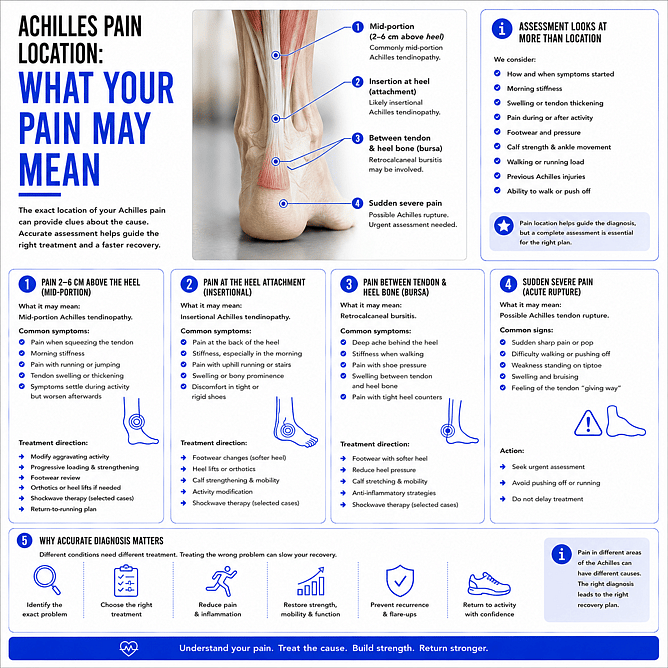
Stop activity and seek urgent medical assessment if you experience:
A sudden pop or snap
Sudden severe pain behind the ankle or calf
A feeling that someone kicked or struck the back of your leg
Sudden difficulty walking
Inability to put normal weight through the leg
Major loss of push-off strength
Inability to stand on tiptoe
Rapid swelling or bruising
Health New Zealand identifies sudden severe pain, difficulty walking or weight-bearing, calf swelling, bruising, and inability to stand on tiptoe as warning signs of Achilles rupture.
Do not try another run to “test it”.
That is no longer a training-load question. It needs urgent assessment.
Where Your Achilles Hurts Matters
Not all Achilles pain after running is the same.
Two common Achilles tendinopathy presentations are mid-portion and insertional tendinopathy.
Pain 2–6 cm Above the Heel
Pain approximately 2–6 cm above the heel attachment is commonly associated with mid-portion Achilles tendinopathy.
Common symptoms may include:
Morning stiffness
Tenderness through the tendon
Tendon thickening
Pain during or after running
Pain with jumping or pushing off
This presentation usually needs a progressive tendon-loading and strength programme rather than indefinite rest.
Pain Directly Where the Achilles Meets the Heel
Pain at the point where the Achilles attaches to the heel bone may indicate insertional Achilles tendinopathy.
This condition may be more sensitive to:
Hills
Inclines
Deep ankle dorsiflexion
Flat footwear
Pressure around the back of the heel
Compression between the tendon and heel bone is considered an important contributor in insertional tendinopathy, particularly during uphill activity.
That distinction matters because the rehabilitation approach may need to differ from mid-portion Achilles tendinopathy.
What Should You Change in Your Running First?
When Achilles pain develops, the answer does not always need to be “zero running”.
Instead, the first step may be reducing the parts of training that are creating the biggest demand.
Depending on the individual assessment, this may involve modifying:
Weekly distance
Running frequency
Speed sessions
Hills
Sprinting
Repeated jumping
Back-to-back training days
Long runs
Court or field sport alongside running
The exact changes depend on the runner.
Someone preparing for a marathon has different demands from someone running twice a week for fitness.
A football player combining running, sprinting, jumping and change of direction also has different Achilles loading demands from a recreational walker.
The training plan should reflect the person, not just the diagnosis.
Be Careful With Hills
Hills can be particularly relevant for Achilles symptoms.
Uphill running increases ankle dorsiflexion and may aggravate some Achilles presentations. Insertional Achilles tendinopathy can be especially sensitive to compression where the tendon meets the heel bone during uphill walking or running.
If symptoms are consistently triggered by hills, a rehabilitation plan may temporarily reduce:
Hill repeats
Steep inclines
Uphill sprinting
Stair training
Flatter running may sometimes be easier to tolerate while strength and capacity are rebuilt.
This should still be personalised according to pain location and diagnosis.
Do Not Change Everything at Once
Runners sometimes respond to Achilles pain by changing five things simultaneously:
New running shoes
New orthotics
New exercises
Completely different running technique
No running for several weeks
Then nobody knows which change helped or aggravated the tendon.
A more structured approach is to identify the likely contributors, make sensible changes, and monitor the response.
This can make progression easier to understand and adjust.
Why Calf Strength Matters for Runners
The calf-Achilles system plays a major role in push-off during running.
Rehabilitation for Achilles tendinopathy commonly uses progressive tendon-loading and calf-strengthening exercises. The 2024 clinical practice guideline for mid-portion Achilles tendinopathy recommends tendon-loading exercise as a first-line intervention to improve pain and function.
Assessment may consider:
Single-leg heel-raise strength
Calf endurance
Straight-knee calf strength
Bent-knee calf strength
Control through repeated repetitions
Differences between legs
A runner might be pain-free during normal walking but still lack enough calf strength or endurance for repeated running loads.
That is one reason pain can return when training resumes.
Rehabilitation Needs to Match Running
Rehabilitation should eventually prepare the Achilles for the activity the patient wants to perform.
For a runner, basic exercises may need to progress towards:
Greater calf strength
Increased resistance
Single-leg work
Endurance
Faster loading
Running tolerance
Higher-impact activity
Return-to-speed work
Sport-specific demands where relevant
The 2024 guideline supports tendon-loading exercise at tolerable intensities rather than prescribing one universal exercise method for everyone.
The goal is not simply completing exercises.
The goal is increasing the tendon’s ability to tolerate the demands of running.
What About Pain During Rehabilitation?
Some discomfort can occur during Achilles rehabilitation.
Oxford University Hospitals advises that exercise-related discomfort can occur during a tendon-loading programme and recommends adjusting the programme when symptoms become excessive or when morning stiffness begins lasting longer.
Rather than focusing on one pain number for every patient, useful things to monitor include:
Pain during exercise
Pain after exercise
Walking afterwards
Morning stiffness
Swelling
Limping
Strength
Whether symptoms are trending better or worse
Sharp pain, sudden weakness, or a significant change from the usual symptom pattern should not simply be pushed through.
Can You Cross-Train While Reducing Running?
For some runners, yes.
When running needs to be temporarily reduced, alternative exercise may help maintain cardiovascular fitness while decreasing repetitive running load.
Oxford University Hospitals lists options such as cycling and swimming during Achilles rehabilitation.
Depending on the condition and individual tolerance, alternatives may include:
Cycling
Swimming
Suitable gym training
Strength training
Other lower-impact cardiovascular exercise
The important point is that cross-training still counts as physical load.
The full weekly activity schedule should be considered rather than assuming anything that is not running is automatically harmless.
Could Your Running Shoes Be Contributing?
Footwear may influence Achilles symptoms for some runners.
Changes in shoes can alter how load is experienced through the foot and Achilles. NHS guidance identifies footwear changes or unsupportive footwear among factors associated with Achilles tendinopathy.
A footwear assessment may consider:
Shoe fit
Cushioning
Shoe wear
Heel-counter pressure
Stability
Current training shoe
Recent footwear changes
Whether symptoms differ between shoes
Whether the problem is insertional or mid-portion
For insertional pain, pressure from the shoe around the back of the heel may be particularly relevant.
There is no single “best Achilles running shoe” for every runner.
The footwear needs to fit the person, condition and activity.
Do Orthotics or Heel Lifts Help Achilles Pain?
Orthotics or temporary heel lifts may be considered for selected patients when foot mechanics, footwear, or tendon loading suggests they may be useful.
They should not automatically replace rehabilitation.
A broader plan may include:
Progressive strengthening
Tendon loading
Training modifications
Footwear changes
Orthotic therapy where appropriate
Heel lifts where appropriate
Return-to-running planning
The role of any device should be based on assessment rather than giving every runner the same solution.
Does Shockwave Therapy Help Runners With Achilles Pain?
Shockwave therapy may be considered in selected persistent Achilles cases, but it should not become the entire treatment plan.
Foot Foundation’s approach is to use shockwave where clinically appropriate alongside the factors that usually matter for recovery, such as:
Progressive rehabilitation
Calf strengthening
Load management
Footwear
Orthotic support where needed
Return-to-running planning
The 2024 APTA mid-portion Achilles clinical guideline specifically focuses on physical therapy management and does not cover extracorporeal shockwave therapy, so shockwave should not be presented as a replacement for evidence-based loading rehabilitation.
Why Achilles Pain Can Return After a Running Break
Taking several weeks away from running may settle symptoms.
But if the runner then returns directly to the previous distance, speed or frequency, the Achilles may not be ready for that demand.
This creates a common cycle:
Running causes Achilles pain
Running stops
Pain settles
No progressive loading is completed
Previous training resumes
Pain returns
This is why rehabilitation should bridge the gap between rest and running.
The tendon needs to be progressively prepared for what comes next.
What an Achilles Running Assessment May Include
A detailed assessment for Achilles pain after running may include:
Exact pain location
Symptom history
Running history
Recent changes in training
Weekly running distance
Training frequency
Hills and speed work
Other sport or gym training
Calf strength testing
Single-leg heel raises
Ankle mobility
Foot mechanics
Walking or running assessment
Footwear review
Existing orthotic review
Previous treatment
Rehabilitation completed so far
Achilles tendinopathy is generally assessed through clinical history and physical examination, with further investigation considered when the diagnosis is unclear or another injury is suspected.
ACHILLES PAIN AFTER RUNNING IN AUCKLAND
Foot Foundation provides Achilles pain assessment and treatment across its Auckland clinics:
Remuera
Smales Farm
Botany
Pinehill
These locations may suit runners and active patients experiencing:
Achilles pain after running
Recurring Achilles pain
Mid-portion Achilles tendinopathy
Insertional Achilles pain
Running-related heel pain
Tendon pain that returns with training
Previous rehabilitation that has not worked
Return-to-running concerns
ACHILLES PAIN CARE IN HAMILTON
Foot Foundation provides foot and ankle care in Hamilton at:
Hamilton Central – 7/127 Collingwood Street
Hamilton East – 16 Beale Street
Patients can seek assessment for running-related Achilles pain, recurring tendon symptoms, heel pain, sports injuries, and foot or ankle problems affecting activity.
Service and clinician availability should be confirmed when booking.
ACHILLES PAIN CARE IN TAURANGA
Foot Foundation provides podiatry care in Tauranga at:
Tauranga Bethlehem – 253A State Highway 2
Runners and active patients experiencing Achilles pain after exercise, pain behind the heel, walking discomfort, or recurring tendon problems can book an assessment to identify the appropriate management pathway.
Service and clinician availability should be confirmed when booking.
WHEN SHOULD YOU BOOK AN ACHILLES ASSESSMENT?
Consider booking an assessment if:
Achilles pain repeatedly occurs after running
Symptoms are getting progressively worse
Morning stiffness keeps increasing
The tendon is swollen or thickened
Pain returns whenever training increases
Hills or speed sessions consistently cause symptoms
You are unsure whether the pain is mid-portion or insertional
Previous rehabilitation has not worked
You cannot return to your normal running volume
You keep cycling between rest and flare-ups
You want a structured return-to-running plan
Seek urgent assessment instead if symptoms started with sudden severe pain, a pop or snap, marked weakness, or difficulty walking.
BOOK AN ASSESSMENT FOR ACHILLES PAIN AFTER RUNNING
Achilles pain after running does not automatically mean you need to stop training completely.
But repeatedly running through worsening symptoms without understanding the cause is not a good rehabilitation strategy either.
The better approach is to determine:
Which Achilles condition is present
What running load the tendon currently tolerates
Whether strength needs improving
Whether footwear is contributing
Whether training volume needs changing
Whether orthotics or heel lifts may help
How running should be rebuilt safely
Foot Foundation provides Achilles pain assessment and rehabilitation across Auckland, Hamilton, and Tauranga, including complex running and return-to-sport rehabilitation with Cameron Collins at Remuera and Smales Farm.
FREQUENTLY ASKED QUESTIONS
Should I Stop Running if My Achilles Hurts?
Not automatically. For appropriately diagnosed Achilles tendinopathy, complete rest is not always required, and progressive loading is a key part of rehabilitation. Running may need to be reduced or modified depending on symptoms and function.
Can I Run Through Achilles Tendinopathy?
Some people may continue running with limited discomfort, but persistent or increasing symptoms can indicate that running load needs adjusting. Oxford University Hospitals notes that running may continue in some cases but can aggravate symptoms and potentially prolong rehabilitation.
Why Does My Achilles Hurt More After Running Than During It?
Achilles tendinopathy can sometimes feel easier once movement begins, then become more painful after prolonged activity or later during recovery. Morning stiffness may also increase following excessive loading.
Are Hills Bad for Achilles Pain?
They may aggravate some cases. Uphill activity can be particularly provocative for insertional Achilles tendinopathy because it increases compression around the tendon attachment at the heel.
Should I Stretch My Achilles Before Running?
There is no universal stretching prescription for every Achilles presentation. The correct approach depends partly on pain location. Insertional symptoms can be sensitive to movements that increase compression at the heel attachment, so generic deep stretching should not automatically be prescribed.
How Do I Know if My Achilles Is Ruptured?
Sudden severe pain, a pop or snap, calf swelling, difficulty walking, inability to put normal weight through the leg, or inability to stand on tiptoe requires urgent assessment for possible rupture.