Recurring Achilles Pain: Why Rest Is Not Enough
Rest can make Achilles pain feel better because it temporarily reduces the load placed on the tendon. Walking less, stopping running, avoiding hills, or taking time away from sport may reduce pain and morning stiffness.
The problem is that reduced pain does not always mean the tendon has regained the strength and capacity needed for normal activity.
When walking, running, training, or sport resumes, the tendon may once again be exposed to more load than it can currently tolerate. Symptoms then return, creating a frustrating pattern:
Activity causes pain
The patient rests
Pain settles
Normal activity resumes
Pain returns
The patient rests again
This cycle can continue for weeks or months when the tendon is repeatedly rested but never progressively prepared for the activity the patient wants to resume.
Current clinical guidance for mid-portion Achilles tendinopathy recommends tendon-loading exercise as a central treatment approach and discourages complete rest. Continued activity is generally modified according to pain tolerance rather than stopped indefinitely.
At Foot Foundation, recurring Achilles pain is assessed by looking at the tendon, calf strength, pain location, footwear, activity changes, training load, foot mechanics, ankle movement, and previous rehabilitation.
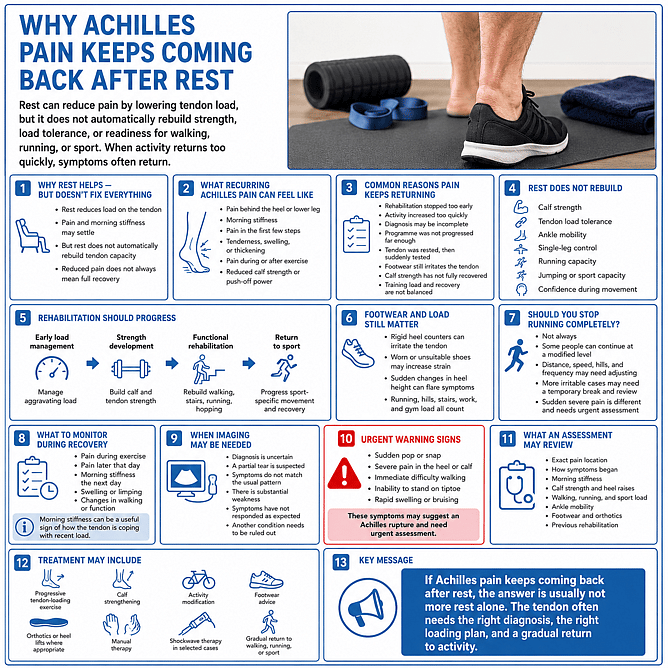
What Is Recurring Achilles Pain?
Recurring Achilles pain describes symptoms that settle or become manageable but repeatedly return.
It may happen:
After returning to running
When walking distance increases
During hills or stairs
After sprinting or jumping
When returning to weekend sport
After changing footwear
When rehabilitation exercises are stopped
After rapidly increasing training
Following a period of reduced activity
When work requires prolonged standing or walking
Symptoms may include:
Pain behind the heel or lower leg
Morning stiffness
Pain during the first few steps
Tendon tenderness
Swelling or thickening
Pain during or after exercise
Reduced calf strength
Difficulty pushing off
Symptoms that worsen the following morning
Health New Zealand describes Achilles tendinopathy as causing pain, stiffness, and swelling. Pain can occur during exercise but may become more noticeable after activity, while activity should generally be increased gradually as symptoms improve.
Rest Reduces Load but Does Not Automatically Rebuild Capacity
Rest may calm an irritated tendon because the aggravating load has been removed.
However, rest does not automatically improve:
Calf strength
Tendon load tolerance
Ankle mobility
Single-leg control
Running capacity
Jumping capacity
Sport-specific strength
Confidence during movement
Prolonged inactivity may also leave the calf and tendon less prepared for the demands of returning to full activity.
This does not mean rest is never useful. Short-term activity reduction may be appropriate during a painful flare-up. The mistake is treating rest as the complete rehabilitation plan.
Healthy tendons require appropriate load. Current NHS guidance advises against complete rest for Achilles tendinopathy and instead recommends activity modification and exercise to help restore the tendon’s ability to manage force.
The goal is usually to find a manageable level of activity and then progressively build from there.
Common Reasons Achilles Pain Keeps Returning
Rehabilitation Was Stopped When the Pain Improved
One of the most common mistakes is stopping rehabilitation as soon as pain settles.
Pain reduction is an important sign, but it is only one stage of recovery. The tendon may still need further work to rebuild:
Strength
Endurance
Movement control
Load tolerance
Running capacity
Jumping and landing ability
Sport-specific function
A few weeks of light exercises may help daily walking but may not prepare the tendon for running, football, netball, pickleball, tennis, hiking, or physical work.
Rehabilitation needs to progress towards the actual demands the patient wants to resume.
Activity Was Increased Too Quickly
Achilles symptoms commonly flare when activity increases faster than the tendon can adapt.
This may happen after:
Increasing running distance
Adding more training days
Starting speed sessions
Introducing hills
Returning to sport after a break
Changing from walking to running
Increasing gym-based calf work
Beginning a new sport
Returning to physical work
Training hard on consecutive days
Health New Zealand identifies sudden increases in activity as a contributor to Achilles tendon problems and advises gradually increasing activity as symptoms improve.
Training progress should consider both the amount of activity and the tendon’s response later that day and the following morning.
The Diagnosis May Be Incomplete
Not every recurring pain behind the heel is the same condition.
Possible causes include:
Mid-portion Achilles tendinopathy
Insertional Achilles tendinopathy
Retrocalcaneal bursitis
Partial tendon injury
Footwear pressure
Calf muscle injury
Referred pain
A combination of tendon and bursa irritation
Treatment that suits one condition may aggravate another.
For example, an exercise that moves the heel deeply below the edge of a step may be used in some mid-portion rehabilitation programmes but may increase compression at the heel attachment in an insertional presentation.
Assessment should identify:
Where the pain is located
How symptoms began
What activities cause pain
Whether there is swelling or thickening
Whether footwear pressure is involved
Whether the tendon can tolerate loading
Whether imaging or referral is appropriate
The treatment plan should follow the diagnosis rather than assuming every case is identical.
The Programme Was Not Progressed Far Enough
Achilles rehabilitation is not one exercise repeated forever.
A structured programme may need to progress through several stages.
Early Load Management
This stage may include:
Reducing aggravating activity
Avoiding sudden load spikes
Finding a manageable walking level
Adjusting sport or running temporarily
Using appropriate footwear
Beginning suitable exercises
Strength Development
This stage may include progressively challenging:
Calf strength
Soleus strength
Achilles tendon capacity
Single-leg control
Foot and ankle strength
Muscular endurance
Functional Rehabilitation
This may include:
Longer walking
Stair tolerance
Running progression
Hopping
Jumping
Landing
Change-of-direction work
Work-specific activity
Return to Sport
The final stage may consider:
Training volume
Training frequency
Running speed
Hills
Sprinting
Jumping
Sport-specific movement
Recovery between sessions
The exact programme should match the diagnosis, pain location, current ability, and patient goals. Generic exercises are not automatically suitable for every Achilles condition.
The Tendon Was Rested and Then Immediately Tested
Some patients move directly from complete rest to their previous activity level.
For example:
No running for three weeks
Then a full 5-kilometre run
No court sport for a month
Then a competitive match
Minimal walking during recovery
Then a full day of hiking
No calf strengthening
Then heavy gym loading
The tendon has not been progressively prepared for that jump in demand.
A better pathway usually introduces load in stages and reviews how the tendon responds.
The target is not simply completing one session. It is being able to tolerate repeated activity without a significant flare-up.
Footwear Is Still Irritating the Achilles
Footwear can contribute to recurring Achilles symptoms.
Potential issues include:
A rigid heel counter pressing on the tendon
Shoes that are excessively flat
Sudden changes in heel height
Worn-out running shoes
Poor cushioning
Shoes that do not suit the activity
Limited room around a prominent heel
Footwear that changes tendon load too quickly
Insertional Achilles pain and retrocalcaneal bursitis can be particularly sensitive to pressure from the back of a shoe.
A footwear assessment may consider:
Fit
Heel-counter firmness
Cushioning
Heel-to-toe difference
Stability
Wear pattern
Activity suitability
Compatibility with orthotics or heel lifts
Footwear changes may support recovery, but they should be matched to the individual rather than selected from a generic list.
Calf Strength Has Not Fully Recovered
The calf muscles and Achilles tendon work together during walking, running, jumping, and pushing off.
Reduced calf strength can increase the difficulty of:
Walking uphill
Climbing stairs
Running
Sprinting
Jumping
Standing on tiptoe
Repeated push-off
Maintaining performance when tired
A patient may feel comfortable during ordinary walking but still lack the strength or endurance required for sport.
Assessment may compare:
Single-leg heel-raise ability
Repetition quality
Endurance
Knee-straight calf strength
Knee-bent calf strength
Balance
Push-off control
Strength work should be progressed according to the patient’s condition and goals.
Training Load and Recovery Are Not Balanced
Recurring Achilles pain is not always caused by one bad movement. It can develop when the total workload repeatedly exceeds the tendon’s capacity.
Relevant load can include:
Running
Sport
Gym training
Walking
Standing at work
Stairs
Hills
Physical labour
Reduced sleep or recovery
Multiple demanding activities on consecutive days
A runner may reduce running but continue heavy calf training, long work shifts, and weekend sport. The tendon is still being loaded even though running distance has decreased.
A useful review considers the patient’s full week, not only the activity that appears to trigger pain.
Orthotics or Heel Lifts Were Used Without Rehabilitation
Orthotics or temporary heel lifts may help selected patients by changing load, supporting foot mechanics, or reducing strain.
However, they do not automatically rebuild:
Calf strength
Tendon capacity
Balance
Running tolerance
Sport-specific control
They may be useful components of care, but they should not automatically replace exercise rehabilitation.
A broader plan may combine:
Progressive tendon loading
Footwear advice
Orthotics where appropriate
Temporary heel lifts where appropriate
Manual therapy
Load management
Return-to-activity planning
The strongest approach is based on what the assessment identifies, not on prescribing the same device to every patient.
Should You Completely Stop Running?
Not every patient with recurring Achilles pain needs to stop running completely.
Some may be able to continue at a modified level by adjusting:
Distance
Speed
Hills
Running frequency
Training surface
Recovery days
Other high-load activities
Others may need a temporary break from running when symptoms are more irritable, walking is painful, function is declining, or the diagnosis is uncertain.
The 2024 clinical practice guideline for mid-portion Achilles tendinopathy advises clinicians to discourage complete rest and support continued activity within pain tolerance. Tendon-loading exercise is recommended to reduce pain and improve function.
However, this advice applies to appropriately assessed tendinopathy. Sudden severe pain, major weakness, or suspected rupture requires a different pathway.
How Much Pain Is Acceptable During Rehabilitation?
There is no single pain rule that suits every patient or every Achilles condition.
A clinician may consider:
Pain during exercise
Pain immediately afterwards
Symptoms later that day
Morning stiffness the following day
Swelling
Changes in walking
Reduced strength or function
Whether symptoms return to their usual level
A small, manageable response may be acceptable in some rehabilitation programmes. A large flare-up, increasing morning stiffness, limping, or worsening function may indicate that the load needs adjusting.
Patients should not be encouraged to ignore sharp pain or push through a sudden change in symptoms.
Why Morning Stiffness Matters
Morning stiffness can help indicate how the Achilles tendon is responding to recent activity.
Patients may notice:
More stiffness after a hard training day
Pain during the first few steps
Symptoms after sitting
Improvement once moving
Pain returning after activity
If morning stiffness is progressively worsening, the tendon may not be recovering well from the current load.
Health New Zealand identifies stiffness as a common feature of Achilles tendinopathy and notes that symptoms may become more noticeable after exercise.
Morning symptoms should be considered alongside strength, swelling, walking ability, and overall function.
When Shockwave Therapy May Be Considered
Shockwave therapy may be considered for selected persistent Achilles pain presentations.
However, it should not be used as a substitute for diagnosis or progressive rehabilitation.
A broader treatment plan may still need:
Tendon-loading exercise
Calf strengthening
Activity modification
Footwear assessment
Orthotic support where appropriate
Return-to-sport planning
Shockwave therapy may support the treatment plan in suitable cases, but applying treatment to the painful area without addressing load and capacity is unlikely to resolve every reason symptoms keep returning.
When Imaging May Be Needed
Many Achilles tendinopathy cases can be assessed through clinical history and examination.
Imaging may be considered when:
The diagnosis is uncertain
Symptoms do not match a typical pattern
A partial tear is suspected
Pain began suddenly
There is substantial weakness
Symptoms have not responded as expected
Surgery or specialist referral is being considered
Another condition needs to be ruled out
An ultrasound or MRI result should be interpreted alongside symptoms and functional testing. Imaging alone does not determine how much pain a patient experiences or what level of activity they can tolerate.
Warning Signs That Need Urgent Assessment
Recurring gradual pain is different from an acute rupture.
Seek urgent medical assessment if you experience:
A sudden pop or snap
Severe pain in the back of the heel or calf
A feeling of being kicked in the leg
Immediate difficulty walking
Sudden loss of push-off strength
Inability to stand on tiptoe
Rapid swelling or bruising
A noticeable gap in the tendon
Health New Zealand advises urgent assessment for sudden severe pain, difficulty walking, or a snap or crack because these symptoms may indicate an Achilles rupture.
Do not try to run through these symptoms or repeatedly test the tendon.
What an Assessment for Recurring Achilles Pain May Include
A detailed assessment may review:
Exact pain location
How symptoms began
Morning stiffness
Swelling or tendon thickening
Walking tolerance
Running or sport load
Calf strength
Single-leg heel-raise ability
Ankle mobility
Foot posture
Walking or running mechanics
Footwear
Existing orthotics or heel lifts
Previous treatment
Rehabilitation exercises already attempted
Recovery between activity sessions
The goal is to determine:
Which Achilles condition may be present
Why symptoms keep returning
What load the tendon can currently tolerate
Which factors are limiting recovery
What rehabilitation progression is appropriate
Whether imaging or referral is needed
Recurring Achilles Pain Treatment in Auckland
Foot Foundation provides assessment and treatment for recurring Achilles pain across its Auckland clinics:
Remuera
Smales Farm
Botany
Pinehill
These clinics may suit patients with:
Achilles pain that returns after rest
Running-related Achilles pain
Mid-portion Achilles tendinopathy
Insertional Achilles pain
Persistent heel pain
Recurring sports injuries
Previous rehabilitation that has not worked
Return-to-activity concerns
Service and clinician availability should be confirmed when booking.
Achilles Pain Care in Hamilton
Foot Foundation provides foot and ankle care in Hamilton at:
Hamilton Central – 7/127 Collingwood Street
Hamilton East – 16 Beale Street
Patients can book an assessment for recurring Achilles symptoms, heel pain, tendon concerns, walking pain, sports injuries, and other foot or ankle problems.
Service and clinician availability should be confirmed when booking.
Achilles Pain Care in Tauranga
Foot Foundation provides podiatry care in Tauranga at:
Tauranga Bethlehem – 253A State Highway 2
Patients experiencing recurring Achilles pain, pain behind the heel, walking discomfort, running-related symptoms, or activity-related tendon pain can book an assessment to identify the appropriate pathway.
Service and clinician availability should be confirmed when booking.
When Should You Book an Achilles Pain Assessment?
Consider booking an assessment if:
Achilles pain keeps returning after rest
Symptoms return whenever you resume running
Morning stiffness is becoming more noticeable
The tendon is swollen or thickened
Pain affects walking, work, exercise, or sport
You are unsure whether the pain is mid-portion or insertional
Footwear is pressing against the painful area
Previous exercises have not worked
You are repeatedly stopping and restarting activity
You need a structured return-to-sport plan
A proper assessment can help distinguish between a temporary flare-up, tendinopathy, bursitis, partial injury, or another condition.
Book an Assessment for Recurring Achilles Pain
If Achilles pain keeps coming back after rest, repeating the same rest-and-return cycle is unlikely to provide a complete solution.
Rest may settle symptoms, but recovery may also require:
An accurate diagnosis
Appropriate tendon loading
Calf strengthening
Activity modification
Footwear assessment
Orthotics or heel lifts where appropriate
A gradual return to walking, running, or sport
Foot Foundation provides Achilles pain assessment and rehabilitation across Auckland, Hamilton, and Tauranga, including complex rehabilitation planning with Cameron Collins at Remuera and Smales Farm.
FREQUENTLY ASKED QUESTIONS
Why Does My Achilles Feel Better With Rest but Hurt Again When I Run?
Rest temporarily reduces the load placed on the tendon. If strength and load tolerance have not been rebuilt, returning to running may again exceed what the tendon can currently manage.
Can Too Much Rest Make Achilles Pain Harder to Recover From?
Prolonged complete rest may leave the tendon and calf less prepared for activity. Current guidance generally supports activity modification and progressive tendon loading rather than indefinite complete rest for appropriately diagnosed Achilles tendinopathy.
Should I Stop Running With Achilles Pain?
Not every patient must stop completely. Some may continue with modified distance, speed, hills, or frequency. More irritable or uncertain presentations may require a temporary break and clinical assessment.
Why Is My Achilles Pain Worse the Morning After Exercise?
The tendon may react to the previous day’s activity. Increased morning stiffness can be a sign that the current load is more than the tendon is tolerating well.
Are Heel Raises Enough to Fix Recurring Achilles Pain?
Heel raises may be part of rehabilitation, but the programme needs to match the pain location, strength level, diagnosis, and activity goal. Footwear, training load, mobility, and return-to-sport progression may also need attention.
Can Orthotics Help Recurring Achilles Pain?
Orthotics may help selected patients when foot mechanics or pressure distribution contributes to tendon load. They are usually most useful as part of a broader plan rather than as an automatic replacement for rehabilitation.
When Is Recurring Achilles Pain Urgent?
Seek urgent assessment when pain begins suddenly with a pop or snap, major weakness, rapid swelling, difficulty walking, or inability to stand on tiptoe. These symptoms may indicate a rupture.