Achilles Pain Location Can Help Guide the Diagnosis
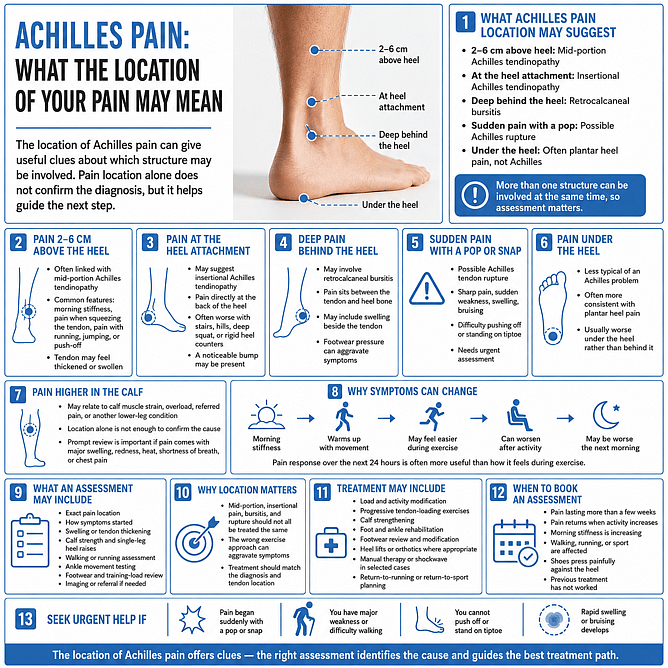
Achilles pain can occur in several different areas at the back of the heel, ankle or lower leg. The exact location of the pain can provide useful clues about which part of the tendon or surrounding tissue may be involved.
Pain approximately 2–6 cm above the heel may suggest mid-portion Achilles tendinopathy. Pain directly where the tendon attaches to the heel bone may be more consistent with insertional Achilles tendinopathy. Deeper pain between the tendon and the heel bone may involve the retrocalcaneal bursa.
A sudden severe pain in the heel or calf, particularly with a popping sensation and difficulty walking or standing on tiptoe, requires urgent assessment for a possible Achilles rupture.
However, pain location alone cannot confirm the diagnosis.
Several conditions can cause symptoms in similar areas. Some patients may also have more than one problem at the same time, such as insertional Achilles tendinopathy combined with retrocalcaneal bursitis.
A proper assessment considers:
The precise location of the pain
Whether symptoms started suddenly or gradually
Morning stiffness
Swelling or tendon thickening
Pain during or after activity
Footwear pressure
Calf strength
Ankle movement
Walking or running load
Previous Achilles injuries
Ability to walk, push off or stand on tiptoe
At Foot Foundation, the goal is to identify which structure is involved and why it has become painful before recommending a treatment pathway.
Understanding the Achilles Tendon
The Achilles tendon is the strong structure connecting the calf muscles to the heel bone. It helps transfer force from the calf into the foot during walking, running, jumping and pushing off.
Because the tendon extends from the lower calf to the heel bone, different sections may be affected by different problems.
The main areas to understand are:
The mid-portion of the tendon
The tendon attachment at the heel bone
The bursa between the tendon and heel bone
The broader heel and calf region
The tendon fibres in an acute rupture
A patient may describe all of these as “Achilles pain”, even though the diagnosis and treatment needs can be different.
Achilles Pain 2–6 cm Above the Heel
What This Location May Mean
Pain approximately 2–6 cm above the heel bone is commonly associated with mid-portion Achilles tendinopathy.
This condition affects the central section of the tendon rather than the attachment at the heel. NHS clinical guidance distinguishes non-insertional or mid-portion tendinopathy from insertional pain using this approximate 2–6 cm location.
Common Symptoms
Patients may experience:
Pain when squeezing the tendon
Morning stiffness
Pain when beginning to walk
Pain during or after running
Discomfort with jumping or pushing off
Tendon swelling or thickening
Symptoms that settle during activity but worsen afterwards
Reduced calf strength or endurance
Achilles tendinopathy commonly causes pain, swelling and stiffness. Symptoms may be aggravated by running, jumping or increased activity, while some patients notice morning stiffness or worsening symptoms after exercise.
Why It May Develop
Mid-portion Achilles tendinopathy can develop when the load placed on the tendon exceeds its current capacity.
Contributing factors may include:
Sudden increases in running distance
Increased training intensity
More hill or speed work
Returning to sport after a break
Reduced calf strength
Limited recovery between sessions
Changes in footwear
Previous Achilles pain
Poorly planned return to activity
This does not mean every patient must completely stop activity. The appropriate response depends on symptom severity, tendon function and the demands being placed on it.
Treatment Direction
Treatment may include:
Temporary modification of aggravating activity
Progressive calf and Achilles strengthening
Tendon-loading rehabilitation
Footwear assessment
Heel lifts where appropriate
Orthotic therapy where mechanics contribute
Shockwave therapy in selected persistent cases
Return-to-running or return-to-sport planning
Health New Zealand recommends initially modifying aggravating activity and gradually strengthening the tendon as symptoms improve.
The full mid-portion Achilles tendinopathy service page should provide detailed diagnosis and treatment information. This blog should direct readers there rather than duplicating the complete service content.
Pain Where the Achilles Attaches to the Heel
What This Location May Mean
Pain directly where the Achilles tendon attaches to the back of the heel bone may suggest insertional Achilles tendinopathy.
This is different from mid-portion tendinopathy because the painful area is at the tendon-to-bone attachment rather than several centimetres above it.
Common Symptoms
Patients may notice:
Pain directly at the back of the heel
Tenderness at the tendon attachment
Pain from rigid heel counters
Difficulty wearing closed-backed shoes
Pain during uphill walking
Pain while climbing stairs
Pain with deep squatting
Swelling or thickening at the heel attachment
A noticeable bump at the back of the heel
Insertional pain is often aggravated when the ankle moves further into dorsiflexion, particularly during hills, stairs or deep squatting. Pressure from footwear may also irritate the area.
Why the Location Matters
Insertional Achilles tendinopathy is exposed to both pulling force through the tendon and compression where the tendon meets the heel bone.
That means exercises used for mid-portion tendinopathy may need to be modified. For example, repeatedly lowering the heel far below the level of a step may increase compression at the attachment and may not suit every insertional presentation.
Treatment should match the location rather than applying the same Achilles programme to everyone.
Treatment Direction
Care may include:
Modified tendon-loading exercises
Temporary reduction of high-compression activities
Footwear with a softer heel counter
Heel lifts where appropriate
Orthotic therapy where mechanics contribute
Calf strengthening
Manual therapy where clinically suitable
Shockwave therapy in selected persistent cases
Referral or imaging for complex presentations
The insertional Achilles tendinopathy page should own detailed treatment information. This location blog should introduce the distinction and link readers to that page.
Deep Pain Between the Achilles and Heel Bone
What This Location May Mean
Pain that feels deep at the back of the heel, between the Achilles tendon and the heel bone, may involve the retrocalcaneal bursa.
The retrocalcaneal bursa is a small fluid-filled structure positioned between the Achilles tendon and the calcaneus. Its role is to reduce friction as the tendon moves near the heel bone.
When the bursa becomes irritated, the condition is called retrocalcaneal bursitis.
Common Symptoms
Possible symptoms include:
Deep pain at the back of the heel
Swelling on either side of the Achilles tendon
Tenderness near the tendon attachment
Pain with shoes pressing against the heel
Pain during uphill walking or running
Discomfort when moving the ankle
Redness or warmth during a more irritated stage
NHS information notes that pain may occur at the back of the heel when the ankle moves, with swelling sometimes visible on both sides of the Achilles tendon.
How It Differs From Insertional Tendinopathy
Insertional Achilles tendinopathy affects the tendon fibres where they attach to the heel.
Retrocalcaneal bursitis affects the fluid-filled bursa positioned between the tendon and the heel bone.
The two conditions can occur together, which is why self-diagnosis based only on pain location can be unreliable.
Assessment may consider:
Exact tenderness location
Visible swelling
Pain from footwear
Pain during ankle movement
Tendon strength
Tendon thickening
Possible Haglund’s deformity
Whether imaging is needed
Treatment Direction
Treatment may include:
Reducing pressure from footwear
Using footwear with softer heel counters
Temporary heel lifts where appropriate
Padding or strapping
Load modification
Calf and ankle rehabilitation
Orthotics where foot mechanics contribute
Further referral where symptoms remain unresolved
The dedicated retrocalcaneal bursitis page should own the full diagnosis and treatment topic.
Sudden Pain With a Pop or Snapping Sensation
What This Location May Mean
Sudden severe pain in the back of the heel, ankle or lower calf may indicate an Achilles tendon rupture.
Patients frequently describe:
A popping or snapping sensation
Feeling as though someone struck or kicked the back of the leg
Sudden sharp pain
Difficulty walking
Reduced ability to push off
Inability to stand on tiptoe
Calf or ankle swelling
Bruising
A possible gap in the tendon
Health New Zealand advises urgent assessment when sudden severe pain is accompanied by walking difficulty, a snap or crack, or the sensation of being hit in the back of the leg.
Pain Can Reduce After a Rupture
A dangerous misconception is that severe pain must continue if the tendon is ruptured.
The initial pain can settle into a dull ache or reduce significantly. That does not mean the injury is minor. Walking may still be possible, although push-off strength and normal gait are often affected.
What to Do
Seek urgent medical assessment if you experience:
A sudden pop or snap
Severe pain in the heel or calf
Immediate weakness
Difficulty bearing weight
Inability to push off normally
Inability to stand on tiptoe
Rapid swelling or bruising
Do not continue playing sport or repeatedly test the tendon.
Both surgical and non-surgical pathways may be considered after a rupture. The appropriate pathway depends on the injury, the patient’s health, activity requirements and specialist recommendations. Rehabilitation is required to rebuild tendon strength and return safely to activity.
Pain Under the Heel Rather Than Behind It
What This Location May Mean
Pain underneath the heel is less typical of an Achilles tendon condition.
It may instead be related to plantar heel pain or plantar fasciitis, particularly when pain is worse during the first steps after getting out of bed or after sitting for an extended period.
Health New Zealand describes plantar fascia pain as occurring under or around the heel during standing and walking.
Why Patients Confuse the Conditions
The Achilles tendon and plantar fascia both connect close to the heel bone, so patients may describe either problem as heel pain.
The distinction matters:
Achilles problems usually cause pain behind the heel or above it.
Plantar fascia problems usually cause pain underneath the heel.
Retrocalcaneal bursitis produces pain deeper behind the heel.
A rupture commonly causes sudden pain in the heel or calf with weakness.
A foot and ankle assessment can help determine which structure is involved.
Pain Higher in the Calf
Pain well above the usual mid-portion Achilles region may involve the upper tendon, calf muscles or another lower-leg structure.
Possible contributors may include:
Calf muscle strain
Muscle overload
Referred pain
Cramping
A higher Achilles injury
Another vascular, nerve or musculoskeletal condition
Location alone is not enough to determine the cause.
Seek prompt medical advice for unexplained calf pain accompanied by:
Significant swelling
Redness or heat
Shortness of breath
Chest pain
Sudden worsening
Symptoms not linked to a clear activity or injury
These symptoms should not be treated as routine Achilles tendinopathy.
Can Achilles Pain Occur in More Than One Location?
Yes. A patient may experience symptoms in more than one part of the tendon or heel.
Examples include:
Mid-portion tendinopathy with calf weakness
Insertional tendinopathy with retrocalcaneal bursitis
Achilles pain with a prominent heel bone
Achilles pain combined with plantar heel pain
Long-standing tendinopathy followed by an acute injury
Some patients also change the way they walk to avoid pain. This may create symptoms in another area of the foot, ankle, calf, knee or hip.
A broader assessment is especially important when:
Pain moves between locations
Several areas are tender
Symptoms keep returning
Treatment has not worked
The diagnosis remains unclear
There has been a sudden change in symptoms
Why Achilles Pain Is Often Worse in the Morning
Morning stiffness is frequently associated with Achilles tendinopathy.
Patients may notice:
Stiffness during the first few steps
Pain after getting out of bed
Symptoms after sitting for a long period
Initial improvement as the tendon warms up
Pain returning later after activity
Morning stiffness can provide useful information, but it does not identify the exact Achilles condition by itself. The clinician still needs to determine whether symptoms involve the mid-portion, insertion, bursa or another structure. Achilles tendinopathy commonly causes morning stiffness that may ease after several minutes of walking.
Why Achilles Pain May Feel Better During Exercise but Worse Afterwards
Some patients can continue running or training because the tendon feels easier once warmed up.
Symptoms may then increase:
After the session
Later in the day
The following morning
After sitting
During the next training session
This pattern can create the false impression that the injury is recovering because pain improves temporarily during exercise.
Pain response during the following 24 hours, changes in morning stiffness, swelling and reduced function can provide more useful information than pain during the activity alone.
A structured load review can help determine whether activity needs to be:
Continued at the current level
Reduced temporarily
Changed to a lower-impact alternative
Rebuilt gradually
Paused while a more serious injury is assessed
What an Achilles Pain Assessment May Include
A detailed assessment may include:
Discussion of where the pain is located
Review of how symptoms began
Palpation of the tendon and heel
Calf strength and endurance testing
Single-leg heel raises
Walking or running assessment
Ankle range-of-motion testing
Foot posture and biomechanical assessment
Footwear review
Training-load review
Previous treatment review
Imaging or referral where clinically indicated
Health New Zealand notes that Achilles tendinopathy is usually diagnosed by discussing symptoms and examining the lower leg, ankle and foot.
Imaging is not automatically required for every patient. It may be considered when the diagnosis is unclear, symptoms are resistant, a partial tear is suspected, or another condition needs to be ruled out.
Treatment Depends on the Location and Diagnosis
There is no single treatment plan for every type of Achilles pain.
Treatment may include:
Activity and load modification
Progressive tendon-loading exercises
Calf strengthening
Foot and ankle rehabilitation
Footwear assessment and modification
Heel lifts where appropriate
Orthotic therapy
Manual therapy
Shockwave therapy in selected cases
Return-to-running planning
Return-to-sport rehabilitation
Imaging or specialist referral
Urgent rupture management where needed
The location matters because mid-portion tendinopathy, insertional tendinopathy, bursitis and rupture should not all receive the same treatment.
A generic exercise downloaded online may be unsuitable if the diagnosis or location is wrong.
Achilles Pain Assessment in Auckland
Foot Foundation provides assessment and treatment for Achilles pain across its Auckland clinics:
Remuera
Smales Farm
Botany
Pinehill
These locations may suit patients with:
Mid-portion Achilles pain
Pain at the heel attachment
Retrocalcaneal bursitis
Recurring tendon pain
Running-related Achilles pain
Return-to-sport concerns
Complex or unresolved symptoms
Achilles Pain Care in Hamilton
Foot Foundation provides foot and ankle assessment in Hamilton at:
Hamilton Central – 7/127 Collingwood Street
Hamilton East – 16 Beale Street
Patients can seek assessment for Achilles pain, heel pain, tendon concerns, recurring sports injuries and foot or ankle problems affecting walking and activity.
Service and clinician availability should be confirmed when booking.
Achilles Pain Care in Tauranga
Foot Foundation provides podiatry care in Tauranga at:
Tauranga Bethlehem – 253A State Highway 2
Patients experiencing pain behind the heel, pain above the heel, walking discomfort, running-related Achilles symptoms or recurring tendon problems can book an assessment to identify the appropriate management pathway.
Service and clinician availability should be confirmed when booking.
When Should You Book an Achilles Pain Assessment?
Consider booking an assessment if:
Pain has lasted more than a few weeks
Pain returns whenever you increase activity
Morning stiffness is becoming more noticeable
The tendon is swollen or thickened
Pain affects walking, running or sport
Shoes cause pain against the heel
You are unsure where the pain is coming from
Previous treatment has not worked
You have recurring Achilles symptoms
You need a safe return-to-activity plan
Seek urgent assessment rather than a routine appointment if the pain began suddenly with a pop, snap, major weakness or difficulty walking.
Book an Assessment for Achilles Pain
The location of Achilles pain can provide useful clues, but it cannot confirm the diagnosis on its own.
Pain 2–6 cm above the heel may suggest mid-portion Achilles tendinopathy. Pain directly at the heel attachment may point towards insertional tendinopathy. Deep pain and swelling near the heel may involve the retrocalcaneal bursa. Sudden pain with a pop and loss of function needs urgent assessment for a possible rupture.
A detailed assessment can help identify the painful structure, contributing factors and most appropriate treatment pathway.
Foot Foundation provides Achilles pain assessment, rehabilitation, footwear advice, orthotic therapy, shockwave treatment where appropriate and return-to-activity planning across Auckland, Hamilton and Tauranga.
FREQUENTLY ASKED QUESTIONS
Where Is Achilles Tendon Pain Usually Felt?
Achilles tendon pain is usually felt at the back of the lower leg or heel.
Mid-portion tendinopathy commonly affects the tendon approximately 2–6 cm above the heel. Insertional tendinopathy affects the point where the tendon attaches to the heel bone.
What Causes Pain Directly Where the Achilles Meets the Heel?
Pain at the attachment may be caused by insertional Achilles tendinopathy. Retrocalcaneal bursitis, footwear pressure and a prominent heel bone may produce symptoms in a similar area.
Assessment is needed because more than one condition may be present.
What Causes Pain Above the Heel?
Gradual pain approximately 2–6 cm above the heel may be associated with mid-portion Achilles tendinopathy, particularly when accompanied by morning stiffness, activity-related pain or tendon thickening.
Can Achilles Pain Be Felt in the Calf?
Achilles-related symptoms may extend towards the lower calf. However, pain higher in the calf may also come from a muscle injury or another condition and should be assessed if the cause is unclear.
How Do I Know Whether I Ruptured My Achilles?
Warning signs include sudden severe pain, a pop or snapping sensation, difficulty walking, reduced push-off strength, swelling, bruising and inability to stand on tiptoe. Seek urgent medical assessment if these symptoms occur.
Does Achilles Pain Always Need a Scan?
No. Achilles tendinopathy can often be diagnosed through the symptom history and clinical examination. Imaging may be considered when the diagnosis is uncertain, symptoms are complex or resistant, or a tear or another condition is suspected.