Can Nail Fungus Be Permanently Removed?
Nail fungus can be frustrating because it is slow to improve and can return even after treatment. Many people try pharmacy products, home remedies, nail trimming, or antifungal creams, only to find that the nail stays thick, yellow, brittle, crumbly, or lifted.
So, can nail fungus be permanently removed?
The honest answer is: nail fungus can often be treated and cleared, but permanent removal cannot be guaranteed for every patient. Fungal nail infections can come back, especially if the source of reinfection is not managed.
At Foot Foundation, fungal nail care starts with proper assessment. The goal is to confirm whether the nail is actually fungal, reduce thickened nail material where appropriate, recommend suitable treatment options, and help reduce the risk of recurrence.
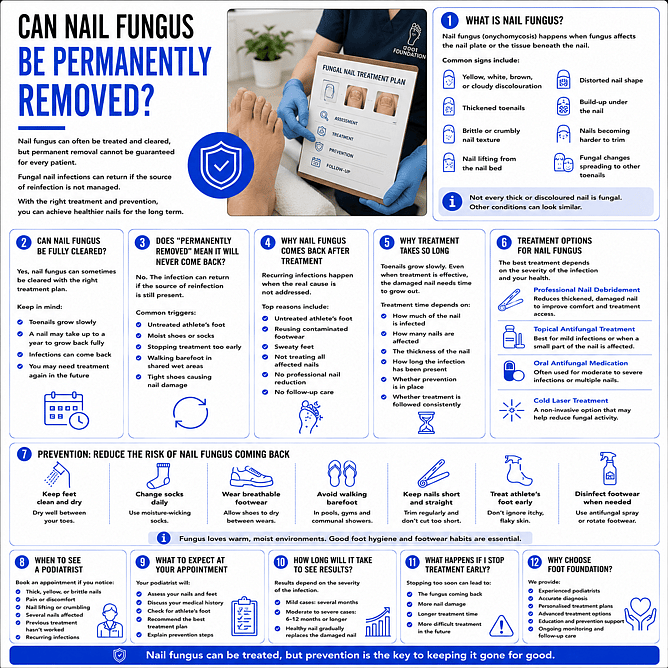
What Is Nail Fungus?
Nail fungus, also known as a fungal nail infection or onychomycosis, occurs when fungus affects the nail plate or the tissue beneath the nail.
Toenails are commonly affected because feet often spend long periods inside shoes, where warmth, moisture, and pressure can create an environment where fungus may grow.
Common signs of nail fungus include:
Yellow, white, brown, or cloudy nail discolouration
Thickened toenails
Brittle or crumbly nail texture
Nail lifting from the nail bed
Distorted nail shape
Build-up under the nail
Nails becoming harder to trim
Fungal changes spreading to other toenails
Not every thick or discoloured nail is fungal. Trauma, footwear pressure, psoriasis, eczema, ageing, and other nail conditions can look similar. This is why proper diagnosis matters before treatment starts.
Can Nail Fungus Be Fully Cleared?
Yes, nail fungus can sometimes be cleared with the right treatment plan. However, treatment takes time because toenails grow slowly.
Even when treatment is working, the damaged part of the nail must grow out and be replaced by healthier nail. Healthify NZ notes that fungal nail treatment takes time and that a nail may take up to a year to grow back fully if it has come off. It also notes that fungal nail infections can come back and may need treatment again.
This is why patients should not expect an instant cosmetic result. The infection may be improving before the nail looks normal.
Does “Permanently Removed” Mean It Will Never Come Back?
This is where people get misled.
A fungal nail infection may be treated successfully, but that does not mean the patient can never get another fungal nail infection again.
Nail fungus can return if:
Athlete’s foot is still present
Shoes remain damp or contaminated
Socks are not changed regularly
The feet stay moist
The nail keeps getting damaged by footwear
Treatment is stopped too early
Nearby infected nails are not treated
The patient walks barefoot in shared wet areas
The NHS recommends prevention steps such as treating athlete’s foot quickly, keeping nails short, keeping feet clean and dry, wearing clean socks daily, wearing protective footwear in shared showers, and avoiding tight narrow shoes.
So the real answer is this: nail fungus can be treated, but long-term prevention is needed to reduce the chance of it coming back.
Why Nail Fungus Comes Back After Treatment
Recurring fungal nails are common when the original source of reinfection has not been addressed.
The most common reasons include:
Untreated athlete’s foot
Moist shoes or socks
Reusing contaminated footwear
Sweaty feet
Tight shoes causing nail trauma
Walking barefoot in shared wet areas
Stopping treatment too early
Not treating all affected nails
No professional nail reduction
No follow-up care
Many people focus only on the nail. That is the mistake. Fungus can also live on the surrounding skin, in footwear, in socks, and in damp environments.
Treating the nail while ignoring the foot environment is usually not enough.
Why Treatment Takes So Long
Toenails grow slowly. This means fungal nail treatment is not like treating a simple skin rash.
Even when treatment is effective, the infected or damaged nail does not instantly disappear. The new nail has to grow out from the base.
Treatment time depends on:
How much of the nail is infected
How many nails are affected
How thick the nail has become
How long the infection has been present
Whether the nail is still being damaged
Whether reinfection is being prevented
Whether treatment is followed consistently
The British Association of Dermatologists notes that treatment success can be confirmed by new unaffected nail growth or repeat nail testing after treatment is completed.
That means progress should be measured by healthy nail growth, not instant appearance.
Treatment Options for Nail Fungus
There is no single treatment that permanently removes nail fungus for everyone. The best treatment depends on the severity of the infection, the nail thickness, the number of nails affected, and the patient’s medical history.
Professional Nail Debridement
Professional nail debridement involves carefully reducing thickened, damaged, or infected nail material.
This may help:
Reduce nail thickness
Improve comfort in shoes
Remove damaged nail material
Reduce pressure on the toe
Make the nail easier to manage
Improve access for topical treatment
Debridement alone may not fully clear nail fungus, but it can be an important part of a complete treatment plan.
Topical Antifungal Treatment
Topical antifungal treatments are applied directly to the nail. These may be useful for mild fungal nail infections, especially when the infection is limited and the nail is not severely thickened.
DermNet lists topical antifungal options for fungal nail infections, including ciclopirox and amorolfine nail lacquers.
Topical treatment may be suitable when:
The infection is mild
Only part of the nail is affected
The nail is not severely thickened
The patient can apply treatment consistently
Oral medication is not preferred
The challenge is penetration. If the nail is thick, lifted, or damaged, topical treatment may struggle to reach the infected area properly.
Oral Antifungal Medication
Oral antifungal medication may be considered for more severe or widespread fungal nail infections. It may be more suitable when the whole nail is involved or several nails are affected.
However, oral medication is not right for everyone. It may require medical review, checking for medication interactions, and monitoring. This is usually managed through a GP or medical provider.
Podiatry care may support oral medication by reducing thickened nail material, monitoring progress, and helping reduce reinfection risk.
Cold Laser Treatment
Cold laser treatment, including Lunula Laser therapy, may be considered as a non-invasive option for fungal nail infections.
It does not involve cutting, burning, or removing the nail. It may suit patients who want a non-invasive treatment option or who may not be suitable for oral antifungal medication.
Cold laser may be considered when:
The infection is persistent
The nail is thickened or discoloured
Several nails are affected
The patient wants a non-invasive option
Home treatment has not worked
A combination treatment plan is needed
Cold laser should not be sold as a guaranteed permanent cure. It may be useful as part of a wider fungal nail plan that includes debridement, prevention advice, and follow-up care.
Combination Treatment
For many patients, the strongest approach is combination treatment.
A complete plan may include:
Nail debridement
Topical antifungal treatment
Cold laser treatment
Foot hygiene advice
Footwear and sock advice
Treatment for athlete’s foot
Follow-up monitoring
GP support for oral medication where appropriate
Combination care is often more practical because fungal nail infections are stubborn and reinfection risk must be managed.
What Makes Permanent Results More Likely?
No treatment can honestly guarantee that nail fungus will never return. However, long-term improvement is more likely when the full problem is managed.
Better results are more likely when:
The diagnosis is correct
The nail is professionally reduced if thickened
Treatment is followed consistently
Athlete’s foot is treated
Shoes and socks are managed properly
Feet are kept clean and dry
Nail trauma is reduced
Follow-up care is completed
Reinfection risks are controlled
This is the difference between simply treating the nail and managing the full fungal environment.
Why Home Remedies Usually Fail
Many people try home remedies before seeing a podiatrist. These may include vinegar soaks, oils, filing, or general antifungal creams.
The issue is not always that the home remedy does nothing. The bigger issue is that stubborn nail fungus often needs proper diagnosis, nail reduction, and a consistent treatment plan.
Home remedies often fail because:
The nail is too thick
The infection is too deep
The wrong condition is being treated
Treatment is not used long enough
Nearby nails are also infected
Athlete’s foot is untreated
Footwear keeps causing reinfection
There is no follow-up plan
For persistent nail fungus, guessing usually wastes time.
When Should You See a Podiatrist?
You should consider seeing a podiatrist if:
The nail is thick, yellow, white, brown, or crumbly
The nail is lifting from the nail bed
The nail is painful in shoes
The infection appears to be spreading
Home treatment has not worked
The nail keeps getting worse
The infection keeps coming back
You are unsure whether the nail is fungal
You have diabetes, circulation concerns, or reduced sensation
Patients with diabetes, circulation problems, immune system concerns, or reduced sensation should seek professional advice early rather than relying on self-treatment.
Fungal Nail Treatment at Foot Foundation
Foot Foundation provides fungal nail assessment and treatment options for patients with thickened, discoloured, damaged, or persistent fungal toenails.
Our podiatrists can assess the nail, reduce thickened nail material where appropriate, discuss treatment options, and recommend a plan based on your needs.
Treatment may include:
Nail debridement
Topical antifungal support
Cold laser treatment options
Footwear and sock advice
Athlete’s foot management
Prevention planning
Monitoring of nail growth
GP referral support where oral medication may be suitable
Foot Foundation provides podiatry care across Auckland, Hamilton, and Tauranga.
Final Answer: Can Nail Fungus Be Permanently Removed?
Nail fungus can often be treated and cleared, but no one should promise that it will be permanently removed forever.
The infection can return if the source of reinfection is not controlled. This includes athlete’s foot, damp shoes, untreated nearby nails, repeated nail trauma, and poor foot hygiene.
The strongest approach is professional assessment, the right treatment plan, consistent care, and prevention.
If your fungal nail infection keeps coming back, the problem may not be the treatment alone. The problem may be that the full fungal environment has not been managed.
FAQS
Can nail fungus go away forever?
It can be successfully treated in some cases, but recurrence is possible. Long-term prevention is needed to reduce the risk of the infection coming back.
Why does nail fungus come back after treatment?
It may return because of untreated athlete’s foot, damp footwear, contaminated socks, nail trauma, stopping treatment too early, or not treating all affected nails.
What is the best way to stop nail fungus returning?
The best approach is proper diagnosis, consistent treatment, athlete’s foot management, footwear care, moisture control, and follow-up with a podiatrist.
Can cold laser permanently remove nail fungus?
Cold laser may help some patients as part of a wider treatment plan, but it should not be presented as a guaranteed permanent cure.
Should I see a podiatrist for recurring nail fungus?
Yes. If nail fungus keeps returning, a podiatrist can assess the nail, check for reinfection sources, reduce thickened nail material, and recommend a treatment plan.