Fungal Nail Treatment in Auckland: What Actually Works?
Fungal nail infections can be frustrating, stubborn, and slow to clear. They often start as a small change in the toenail, such as yellowing, thickening, brittleness, or lifting from the nail bed. Over time, the infection may spread deeper into the nail or affect nearby toenails.
If you are looking for fungal nail treatment in Auckland, the most important thing to understand is this: there is no single treatment that works for every patient.
The right treatment depends on the severity of the infection, how many nails are affected, how thick the nail has become, your general health, and whether the infection has kept coming back.
At Foot Foundation, our Auckland podiatrists assess fungal nail infections properly before recommending treatment. This may include nail care, debridement, topical treatment, cold laser treatment, oral medication support, or a combination approach.
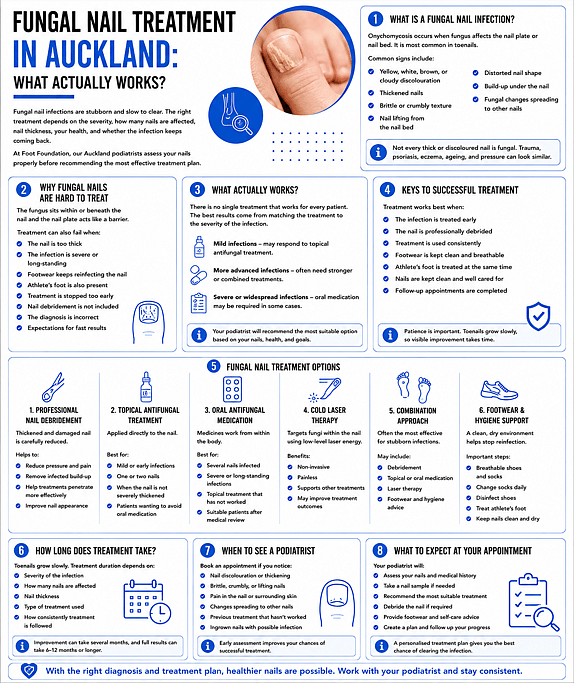
What Is a Fungal Nail Infection?
A fungal nail infection, also known as onychomycosis, occurs when fungus affects the nail plate or nail bed. It commonly affects toenails because feet are often enclosed in shoes, exposed to moisture, and placed under repeated pressure.
Common signs of a fungal nail infection include:
Yellow, white, brown, or cloudy nail discolouration
Thickened toenails
Brittle or crumbly nail texture
Nail lifting from the nail bed
Distorted nail shape
Build-up under the nail
Fungal changes spreading to other toenails
Not every thick or discoloured nail is fungal. Trauma, psoriasis, eczema, ageing, pressure from footwear, and other nail conditions can look similar. That is why diagnosis matters before treatment begins.
Why Fungal Nails Are Hard to Treat
Fungal nail infections are difficult because the fungus sits within or beneath the nail. The nail plate acts like a barrier, making it harder for treatment to reach the infected area.
Toenails also grow slowly. Even when treatment is working, visible improvement can take time because the damaged nail needs to grow out and be replaced by healthier nail.
Treatment can also fail when:
The nail is too thick for treatment to penetrate properly
The infection is severe or long-standing
Footwear keeps reinfecting the nail
Athlete’s foot is also present
Treatment is stopped too early
Nail debridement is not included
The diagnosis is incorrect
The patient expects fast cosmetic results
This is why professional podiatry care is useful. The goal is not only to treat the infection but also to improve the nail environment so treatment has a better chance of working.
What Actually Works for Fungal Nail Treatment?
The honest answer is that the best results often come from matching the treatment to the severity of the infection.
Mild infections may respond to topical antifungal treatment, especially when only a small portion of one or two nails is affected. More advanced toenail infections often need stronger or combined treatment approaches, and oral medication may be required in some cases. DermNet notes that mild infections affecting less than half of one or two nails may respond to topical medication, while cure often requires oral antifungal treatment for several months.
That means “what works” depends on the case. A small early fungal nail infection is not the same as a thick, yellow, long-term infection affecting several toenails.
Treatment Option 1: Professional Nail Debridement
Professional nail debridement is often one of the most important parts of fungal nail care.
Debridement involves carefully reducing thickened, damaged, or infected nail material. This can make the nail more comfortable, reduce pressure in shoes, and help other treatments reach the affected area more effectively.
Debridement may help when:
The nail is thick
The nail is painful in shoes
There is build-up under the nail
Topical treatment is not penetrating well
The nail looks distorted
The infection is long-standing
This does not always clear the infection by itself, but it can be a key part of a stronger treatment plan.
Treatment Option 2: Topical Antifungal Treatment
Topical antifungal treatments are applied directly to the nail. They may be useful for early or mild fungal nail infections, especially when the infection has not spread deeply or affected multiple nails.
In New Zealand, topical antifungal options such as amorolfine and ciclopirox are used for fungal nail infections and are applied directly to the nail surface. Healthify explains that amorolfine is available as a 5% liquid and ciclopirox as an 8% liquid for fungal nail infections in Aotearoa New Zealand.
Topical treatment may be suitable when:
The infection is mild
The nail is not severely thickened
Only part of the nail is affected
The patient wants to avoid oral medication
The treatment can be applied consistently
The downside is that topical treatment can take months and requires consistency. If the nail is very thick, topical treatment may struggle to penetrate without professional nail reduction.
Treatment Option 3: Oral Antifungal Medication
Oral antifungal medication may be considered for more persistent or widespread fungal nail infections. These medicines work from within the body and may be more suitable when topical care alone is unlikely to be enough.
However, oral medication is not right for everyone. It may require medical review, consideration of other medications, and monitoring. The NHS notes that a nail sample may be taken before antifungal tablets are prescribed, and blood tests may be needed before and during treatment to check liver function.
Oral medication may be considered when:
Several nails are infected
The infection is severe
The nail is deeply affected
Previous topical treatment has failed
The patient is suitable for prescription antifungal medication
At Foot Foundation, podiatry care may support oral medication treatment through nail debridement and monitoring of nail progress. This can help reduce infected nail bulk and improve overall treatment management.
Treatment Option 4: Cold Laser Treatment
Cold laser treatment, including Lunula Laser therapy, may be used as a non-invasive treatment option for fungal nail infections.
This treatment uses low-level laser light to target fungal nail infection without removing the nail or relying on oral medication. It may be suitable for patients who want a non-invasive option or who may not be suitable for oral antifungal medication.
Cold laser treatment may be considered when:
The patient wants a non-invasive treatment
The infection is persistent
Oral medication is not preferred
Several nails are affected
The nail needs a combined treatment approach
Cold laser is not an instant cosmetic fix. The damaged nail still needs time to grow out, so visible improvement usually depends on nail growth and treatment consistency.
Treatment Option 5: Combination Treatment
For many patients, the strongest approach is not one treatment by itself. It is a combination plan.
A fungal nail treatment plan may include:
Nail debridement
Topical antifungal treatment
Cold laser treatment
Foot hygiene advice
Footwear and sock advice
Management of athlete’s foot
Follow-up nail monitoring
GP support for oral medication where appropriate
Combination care is often useful because fungal nail infections can involve both the nail and the surrounding foot environment. If the nail is treated but the shoes, socks, skin, and moisture problem are ignored, recurrence becomes more likely.
Why Fungal Nail Infections Keep Coming Back
Fungal nail infections often return because the original source of reinfection has not been addressed.
Common reasons include:
Untreated athlete’s foot
Moist footwear
Reusing infected shoes
Sweaty feet
Walking barefoot in shared wet areas
Stopping treatment too early
Not treating all affected nails
Nail trauma from tight footwear
Poor nail cutting habits
Prevention matters. Healthify recommends keeping feet clean and dry as an important way to protect against fungal nail infections.
A podiatrist can help identify what may be causing recurrence and build a prevention plan alongside treatment.
When Should You See a Podiatrist for Fungal Nails?
You should consider seeing a podiatrist if:
The nail is thick, yellow, or crumbly
The nail is lifting from the nail bed
The infection is spreading to other nails
The nail is painful in shoes
Home treatment has not worked
The infection keeps coming back
You are unsure whether the nail is fungal
You have diabetes, circulation concerns, or reduced sensation
You want treatment before the nail becomes worse
Early treatment is usually easier than waiting until the nail becomes severely thickened or distorted.
Fungal Nail Treatment at Foot Foundation Auckland
Foot Foundation provides fungal nail treatment in Auckland for patients with thickened, discoloured, damaged, or persistent fungal toenails.
Our Auckland clinic locations include:
Remuera
Botany
Pinehill
Smales Farm / Takapuna
Patients can access podiatry assessment, nail debridement, fungal nail care, cold laser treatment options, topical treatment advice, footwear guidance, and prevention support.
The goal is to identify the cause, recommend the right treatment pathway, and help improve nail health over time.
What Actually Works Best?
The best fungal nail treatment is the one matched to the patient.
For mild fungal nail infections, topical treatment and nail care may be enough.
For thick or persistent infections, debridement and combination treatment may be needed.
For patients who want a non-invasive option, cold laser treatment may be considered.
For more severe infections, oral medication may be discussed with a GP or medical provider, with podiatry support for nail care and monitoring.
The real answer is this: fungal nail treatment works best when diagnosis, nail reduction, treatment consistency, and prevention are all managed together.
Book Fungal Nail Treatment in Auckland
If your toenails are thick, yellow, brittle, lifting, or not improving with home treatment, a podiatry assessment can help you understand what is happening and what treatment options may suit you.
Foot Foundation provides fungal nail treatment in Auckland to help patients manage fungal nail infections with professional care, practical advice, and treatment options based on their needs.
FAQS
Can fungal nails go away on their own?
Fungal nail infections do not usually clear quickly without treatment. Some mild cases may remain stable, but many become thicker, more discoloured, or spread to other nails over time.
Is cold laser treatment painful?
Cold laser treatment is non-invasive and does not involve cutting or removing the nail. Your podiatrist can explain whether it is suitable for your nail condition.
How long does fungal nail treatment take?
Toenails grow slowly, so visible improvement takes time. The infected nail needs to grow out and be replaced by healthier nail.
Do I need oral medication?
Not always. Some patients may be suitable for topical treatment, debridement, cold laser, or combination care. Oral medication may be considered for more severe cases and should be discussed with a GP or medical provider.
Why did my fungal nail infection come back?
Recurrence may happen because of untreated athlete’s foot, infected footwear, moisture, nail trauma, or stopping treatment too early.