Shockwave Therapy for Lower Limb Pain: How It Works and Who It Helps
If you’ve been dealing with persistent foot, heel, or leg pain that isn’t settling with rest alone, shockwave therapy may be a treatment option worth considering.
Also known as extracorporeal shockwave therapy (ESWT), this non-surgical treatment is widely used in musculoskeletal care to help manage chronic tendon and soft tissue conditions.
At Foot Foundation, shockwave therapy is used as part of a comprehensive rehabilitation approach to help patients move more comfortably and return to activity.
What Is Shockwave Therapy?
Shockwave therapy is a non-invasive treatment that delivers controlled acoustic pressure waves into injured or irritated tissues.
Despite the name, it is not an electric shock.
Instead, the device generates mechanical sound waves that travel into the affected area to stimulate a biological response within the tissue.
Key features:
Non-surgical
No injections required
Delivered in clinic
Typically quick treatment sessions
Minimal downtime
How Does Shockwave Therapy Work?
While research is ongoing, shockwave therapy is thought to help through several mechanisms:
✅ Stimulates local blood flow
✅ Promotes tissue remodelling
✅ May help break down chronic degenerative tissue
✅ Encourages cellular healing responses
✅ Modulates pain signalling
In chronic tendon problems — where healing can “stall” — shockwave therapy aims to restart or stimulate the body’s natural repair processes.
What Lower Limb Conditions May Benefit?
Shockwave therapy is most commonly used for chronic tendon and soft tissue conditions, particularly when symptoms have persisted for several months.
Foot and Heel Conditions
Plantar fasciitis
Chronic heel pain
Achilles tendinopathy
Insertional Achilles pain
Heel spur–related pain
Tibialis posterior irritation
Lower Leg Conditions
Medial tibial stress syndrome (shin splints)
Peroneal tendinopathy
Chronic calf tightness
Muscle trigger points
Around the Knee and Hip
Patellar tendinopathy
Proximal hamstring tendinopathy
Gluteal tendinopathy
At Foot Foundation, shockwave therapy is typically used alongside strengthening, load management, footwear advice, and orthotic therapy where appropriate.
What Are the Potential Benefits?
Many patients choose shockwave therapy because it is:
Non-invasive
Quick to administer
Suitable for chronic conditions
No anaesthetic required in most cases
Minimal recovery time
Patients commonly report:
Reduced pain levels
Improved load tolerance
Better function during activity
Gradual improvement over several weeks
It is important to note that improvements often occur progressively, not instantly.
What Does Treatment Feel Like?
During shockwave therapy:
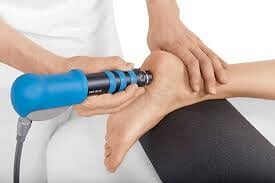
A handheld device is placed over the painful area
Pulses are delivered for several minutes
You may feel a firm tapping or pulsing sensation
Some areas can be temporarily uncomfortable but are usually well tolerated
Treatment intensity is adjusted to your comfort level.
Most sessions take 5–10 minutes per area.
How Many Sessions Are Usually Needed?
Typical treatment courses involve:
3–6 sessions
Usually spaced about one week apart
However, the exact plan depends on:
Your diagnosis
How long symptoms have been present
Tissue irritability
Your response to treatment
Your clinician will tailor this to your situation.
Is There Good Evidence for Shockwave Therapy?
Extracorporeal shockwave therapy has been extensively studied, particularly for chronic tendon conditions.
Research shows moderate to strong evidence supporting its use in conditions such as:
Plantar fasciitis
Achilles tendinopathy
Some patellar tendon conditions
Certain cases of gluteal tendinopathy
Outcomes tend to be best when shockwave is combined with an active rehabilitation programme, rather than used in isolation.
Is Shockwave Therapy Safe?
When delivered by trained clinicians, shockwave therapy has a strong safety profile.
You may experience:
Temporary redness
Mild soreness after treatment
Short-term tissue sensitivity
It is generally not recommended in certain situations, such as:
Over areas of known malignancy
Over open growth plates in children
Over acute fractures
In some bleeding disorders
A proper clinical assessment is always required first.
Is Shockwave Therapy Right for You?
If you’ve had persistent lower limb pain that hasn’t improved with rest, stretching, or basic treatment, shockwave therapy may be worth considering — particularly for chronic tendon conditions.
At Foot Foundation, our clinicians assess:
The true source of your pain
Load and activity factors
Biomechanics and contributing drivers
Whether shockwave therapy is appropriate for your case
Book a Consultation
If you’d like to explore whether shockwave therapy could help your condition, our team at Foot Foundation is here to help.
👉 Book an appointment today
🌐 www.footfoundation.co.nz
📞 (09) 922 6830 | (07) 949 7607
📧 reception@footfoundation.co.nz